

Why Is Operations Management Important for Business Productivity?
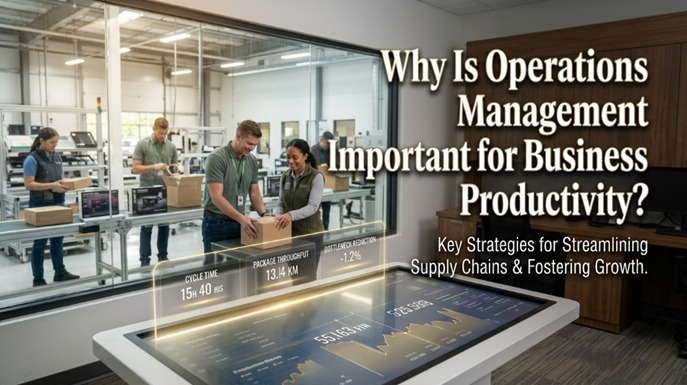
Every business aims to achieve strong performance, maintain product quality, and satisfy its customers. However, reaching these goals requires more than just selling products or providing services. Companies need well-organized processes, effective resource management, and proper coordination between employees and departments. This is why Operations Management plays an important role in improving business productivity.
Operations management focuses on planning, organizing, and controlling business activities to ensure that resources are used effectively. Through proper operational strategies, companies can reduce unnecessary costs, minimize errors, improve employee performance, and deliver products or services on time.
Understanding the importance of operations management helps business owners and managers create more efficient workflows and achieve organizational goals. Here are several reasons why operations management is essential for business productivity.
1. IMPROVING THE EFFICIENCY OF BUSINESS PROCESSES
One of the main reasons operations management is important is its ability to improve the efficiency of business processes. Every company has daily activities that must be completed, from purchasing raw materials and managing employees to producing goods and serving customers. Without proper coordination, these activities may become disorganized and waste valuable time.
Through effective operational planning, managers can identify unnecessary steps, organize workflows, and ensure that each activity has a clear purpose. For example, a manufacturing company can arrange its production stages to reduce waiting times between processes. As a result, business activities become more organized, efficient, and productive.
2. OPTIMIZING THE USE OF BUSINESS RESOURCES
Every business depends on resources such as employees, equipment, materials, technology, and finances. Operations management helps companies determine how these resources should be allocated to achieve the best possible results. Proper resource allocation prevents companies from spending more than necessary.
For example, managers can organize employee schedules according to workload and use production equipment based on actual business needs. They can also monitor material consumption to prevent excessive waste. By optimizing available resources, companies can increase productivity while maintaining operational efficiency and controlling expenses.
3. REDUCING OPERATIONAL COSTS
Operational costs have a direct influence on a company's financial performance. Expenses related to raw materials, employee wages, equipment maintenance, transportation, and production can increase when business processes are poorly managed.
Operations management helps identify activities that create unnecessary expenses. Managers can evaluate production methods, negotiate better purchasing arrangements, reduce material waste, and improve inventory control. These efforts allow businesses to manage their budgets more effectively. Cost reduction through efficient operations helps companies maintain financial stability without sacrificing essential product or service quality.
4. IMPROVING PRODUCT AND SERVICE QUALITY
Product and service quality are important factors that influence customer satisfaction and business reputation. Operations management helps companies establish standards and procedures to ensure that their products or services meet customer expectations.
Quality control activities may include inspecting raw materials, monitoring production processes, testing finished products, and evaluating customer feedback. In service businesses, quality management can involve monitoring employee performance and improving customer service procedures. Through consistent evaluation, companies can reduce errors and prevent recurring problems. This helps businesses maintain consistent quality and stronger customer trust.
5. INCREASING EMPLOYEE PRODUCTIVITY AND PERFORMANCE
Employees are important resources in every organization. Their performance influences how quickly and effectively business activities can be completed. Operations management supports employee productivity by establishing clear responsibilities, organizing workloads, and providing suitable working procedures.
Managers can also identify training needs and improve communication between departments. When employees understand their tasks and have the necessary resources, they can work more confidently and avoid unnecessary confusion. A well-organized working environment encourages better employee performance, teamwork, and productivity.
6. SUPPORTING BETTER BUSINESS DECISION-MAKING
Business decisions should be based on accurate information and a clear understanding of operational conditions. Operations management provides useful data about production levels, inventory, employee performance, costs, and customer demand.
Managers can analyze this information to identify problems and determine which areas require improvement. For example, if product demand increases, a company can use operational data to decide whether additional materials, employees, or production capacity are needed. Data-driven decision-making helps businesses reduce uncertainty and respond more effectively to changing conditions.
7. IMPROVING INVENTORY AND SUPPLY CHAIN MANAGEMENT
Inventory and supply chain management are essential for maintaining smooth business operations. Companies need sufficient materials and products to meet customer demand without storing excessive stock. Poor inventory management can lead to shortages, overstocking, higher storage costs, and delayed deliveries.
Operations management helps businesses coordinate purchasing, storage, production, and distribution activities. Managers can monitor stock levels, evaluate supplier performance, and organize delivery schedules. Effective coordination ensures that the right materials and products are available when needed. This improves inventory efficiency and supply chain performance.
8. HELPING BUSINESSES MEET CUSTOMER EXPECTATIONS
Customer satisfaction is closely connected to the quality, availability, and delivery of products or services. Operations management helps businesses organize their processes so they can respond to customer needs more effectively.
For example, a retail company needs to ensure that popular products remain available, while a restaurant must manage food preparation and service times. Managers can use customer feedback to identify service problems and improve operational procedures. When businesses deliver products or services consistently and on time, they can build customer loyalty and long-term business relationships.
9. INCREASING BUSINESS FLEXIBILITY AND COMPETITIVENESS
Business environments constantly change due to technological developments, customer preferences, market competition, and economic conditions. Companies need flexible operations to respond to these changes without disrupting their overall performance.
Operations management helps businesses evaluate their processes and adjust production capacity, resource allocation, or service methods when necessary. For example, a company may introduce digital inventory systems to improve stock monitoring or modify production schedules when customer demand changes. This flexibility allows businesses to respond more quickly to market developments and maintain a competitive advantage.
10. ENCOURAGING CONTINUOUS BUSINESS IMPROVEMENT
Business productivity should not depend on a single improvement or short-term strategy. Companies need to evaluate their performance regularly and identify opportunities to make their operations better.
Operations management supports continuous improvement by encouraging managers and employees to monitor results, identify weaknesses, and implement appropriate solutions. One common approach is the Plan-Do-Check-Act (PDCA) cycle, which involves planning an improvement, testing it, checking the results, and taking action based on the findings. By applying this approach consistently, businesses can improve efficiency, maintain quality, and achieve sustainable productivity.
CONCLUSION
Operations Management is essential for business productivity because it helps companies organize activities, optimize resources, control costs, and maintain product or service quality. It also improves employee performance, supports better decision-making, strengthens supply chain management, and helps businesses respond to customer expectations.
However, effective operations management requires consistent evaluation and cooperation between different departments. Companies must be willing to identify problems, adopt suitable technologies, and improve their working processes over time. By implementing proper operational strategies, businesses can achieve higher productivity, better efficiency, and stronger long-term competitiveness
Recent Posts

Bagaimana Sistem SKS pada Program Kuliah... 22.11.2026/21 View

How Does Technology Make Daily Evaluation... 21.11.2026/63 View

Apa Strategi Menghadapi Kesenjangan antara Kompetensi... 21.11.2026/65 View

Mengapa Inventaris Aset Penting bagi Kelancaran... 21.11.2026/62 View

When Should Musicians Join a Record... 21.11.2026/60 View
