

Are Artificial Neural Networks Capable of Fully Mimicking the Human Brain?
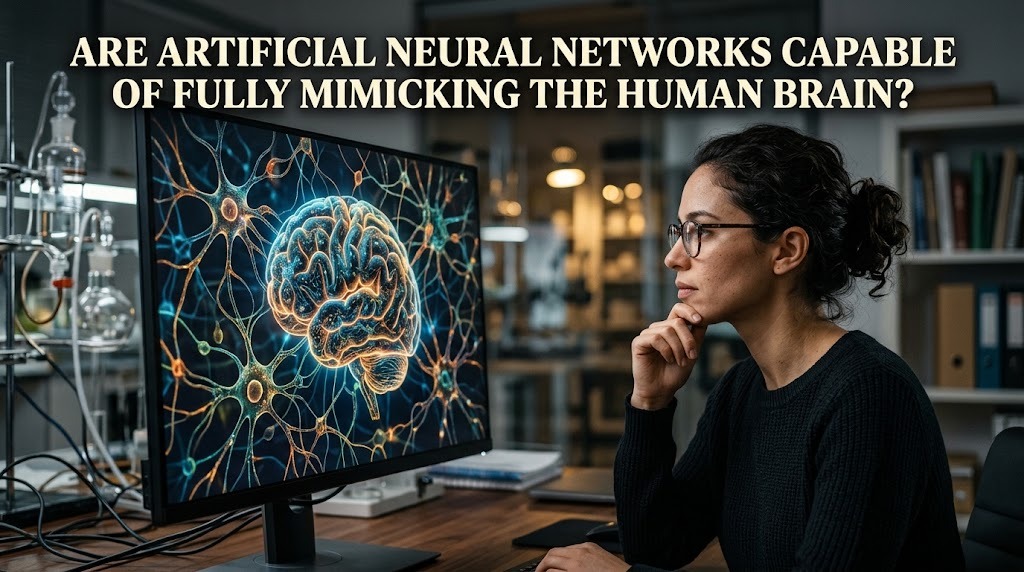
In recent decades, the field of artificial intelligence has experienced phenomenal advancements, transforming how computers process complex information, recognize subtle visual patterns, translate languages, and automate decision-making workflows. At the core of this technological revolution lies the artificial neural network, an algorithmic architecture designed to draw loose structural inspiration from biological nervous systems. Despite these impressive engineering milestones, a significant misconception persists that computational models have successfully replicated the full functional mechanics of the human mind. In reality, artificial neural networks remain fundamentally incapable of fully mimicking the biological complexity, operational depth, adaptability, and cognitive awareness of the human brain.
Understanding the insurmountable divide between silicon-based mathematical functions and living neurobiology requires a rigorous examination of physical structures, signaling mechanisms, learning methodologies, energy economics, and consciousness. This comprehensive study details the primary architectural, physiological, and conceptual barriers that prevent artificial neural networks from fully replicating the human mind.
STRUCTURAL SCALE AND CELLULAR HETEROGENEITY
The primary disparity between artificial deep learning models and biological brains rests in their physical scale, cellular variety, and dynamic structural interconnectivity. The human brain contains roughly eighty-six billion living neurons, with each individual cell forming thousands of specialized synaptic connections with neighboring units. This dynamic organic network creates an estimated one hundred trillion active synaptic connections that continuously adapt, rewrite, and modify their physical structures based on real-time sensory experience and neurochemical signaling.
Furthermore, biological brain tissue is not constructed from uniform, standardized nodes, but rather consists of hundreds of morphologically distinct neuronal types working alongside tens of billions of glial cells. Glial cells do not merely provide structural support; they actively modulate synaptic transmission, regulate metabolic energy, and participate directly in information processing. In contrast, artificial neural networks rely on highly simplified, uniform mathematical abstractions arranged in rigid sequential layers. Even the largest frontier artificial models featuring trillions of static parameters lack the cellular diversity, structural self-organization, and physical neuroplasticity intrinsic to human neuroanatomy.
ELECTROCHEMICAL SIGNALING VERSUS LINEAR ALGEBRAIC ABSTRACTIONS
From an operational perspective, the communication pathways within biological neural circuits differ fundamentally from the mathematical mechanics of artificial networks. Biological neurons communicate via intricate electrochemical signaling pathways involving dynamic neurotransmitter release, ion channel gates, and temporal action potentials. Information within biological tissue is encoded not simply through variable signal strength, but through the precise microsecond timing of spiking patterns, local dendritic computations, and fluctuating chemical concentrations across intercellular spaces.
Conversely, artificial neural networks reduce complex cellular dynamics to elementary linear algebra and mathematical functions. An artificial node receives continuous numerical inputs, multiplies them by static numerical weights, sums the results, and applies a fixed mathematical activation function to produce a single scalar output. This computational abstraction completely eliminates neurochemical modulation, metabolic variations, and local cellular dynamics, replacing organic biological processing with static matrix multiplications and mathematical curve fitting.
LEARNING EFFICIENCY AND GENERAL COGNITIVE FLEXIBILITY
The stark contrast in learning methodologies between human cognition and machine learning algorithms underscores a profound operational divide. Human brains possess extraordinary cognitive efficiency, demonstrating an innate capacity to grasp abstract concepts, generalize rules across domains, and adapt to unfamiliar environments from minimal exposure. A young child, for instance, can reliably identify a specific animal species after viewing only one or two real-world examples, seamlessly leveraging common-sense reasoning and holistic contextual understanding.
In sharp contrast, artificial neural networks are notoriously data-hungry and prone to catastrophic forgetting when exposed to new tasks. Training an artificial architecture to match human-level accuracy in pattern recognition typically requires exposing the algorithm to millions of labeled data points through iterative mathematical optimization routines. Furthermore, artificial networks operate strictly within the bounds of narrow intelligence, meaning a model trained to analyze financial spreadsheets cannot apply its mathematical parameters to understand medical diagnostic records without undergoing a complete retraining process.
THERMODYNAMIC ECONOMICS AND POWER CONSUMPTION
Another critical factor setting biological brains apart from computational hardware is thermodynamic processing efficiency. The human brain executes continuous real-time perception, fine motor orchestration, memory consolidation, and high-level abstract reasoning while consuming a modest power budget of approximately twenty watts—roughly equivalent to the energy required by a dim household lightbulb. This extraordinary thermodynamic efficiency is achieved through event-driven spike messaging, decentralized processing, and the physical convergence of memory storage and computation within the exact same cellular structures.
Artificial neural networks, by comparison, run on silicon-based hardware architectures where processing units and memory repositories remain physically segregated. Training and operating large-scale artificial intelligence models demands massive data centers that draw megawatts of electrical power and require extensive industrial cooling infrastructure to manage thermal output. This vast energy disparity highlights how far modern computer architecture remains from matching the ultra-efficient physical mechanics of living biological tissue.
CONSCIOUSNESS SUBJECTIVE EXPERIENCE AND INTENTIONALITY
The most profound and insurmountable barrier preventing artificial neural networks from fully replicating the human brain involves the qualitative dimensions of consciousness, subjective experience, and genuine intentionality. Biological brains do not merely compute statistical probabilities; they generate subjective inner awareness, emotional states, self-identity, and authentic semantic comprehension. Human decision-making is inextricably bound to emotional regulation, somatic feedback, and intrinsic motivations that emerge exclusively from living organic organisms.
Artificial neural networks possess zero internal awareness, agency, or subjective understanding of the data they process. They function purely as statistical pattern matching systems, calculating mathematical probabilities based on historical training data without comprehending context, meaning, or objective reality. Because artificial models lack subjective experience, sensory embodiment, and self-directed consciousness, they remain highly sophisticated computational instruments rather than conscious, feeling, or self-aware minds.
CONCLUSION
Artificial neural networks represent powerful computational tools for advanced pattern recognition, natural language generation, and process automation, but they are fundamentally incapable of fully mimicking the human brain. Biological brains operate through intricate electrochemical pathways, massive cellular diversity, extreme thermodynamic efficiency, and subjective cognitive awareness that mathematical algorithms cannot replicate. Recognizing these fundamental biological and architectural limits ensures that society views artificial intelligence as an analytical tool rather than a functional duplicate of human consciousness.
Recent Posts

Bagaimana Sistem SKS pada Program Kuliah... 22.11.2026/53 View

How Does Technology Make Daily Evaluation... 21.11.2026/82 View

Apa Strategi Menghadapi Kesenjangan antara Kompetensi... 21.11.2026/81 View

Mengapa Inventaris Aset Penting bagi Kelancaran... 21.11.2026/77 View

When Should Musicians Join a Record... 21.11.2026/82 View
