

Can a Double Rainbow Appear Without Rain?
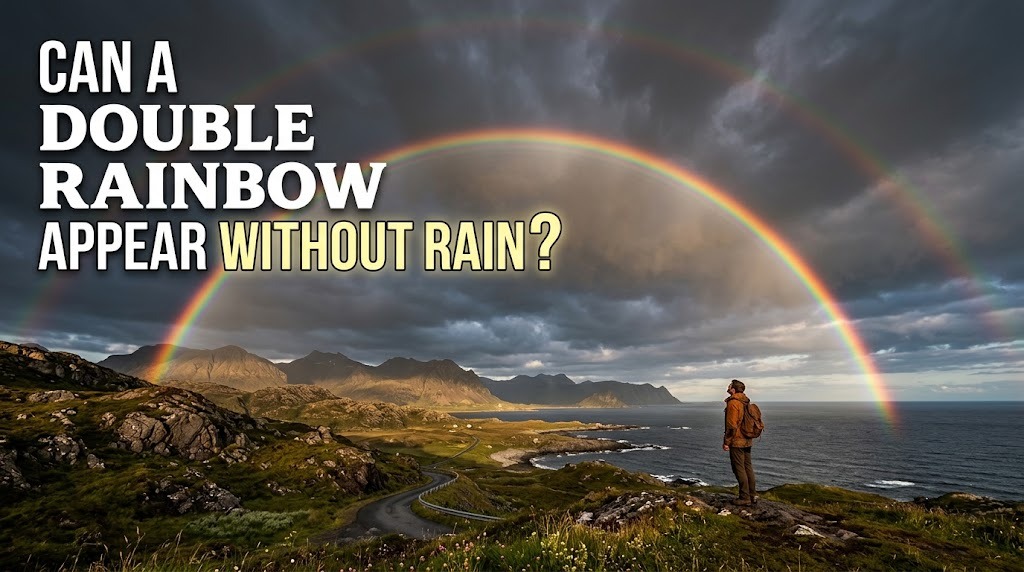
A double rainbow is commonly associated with rainfall because water droplets in the atmosphere help sunlight separate into different colors. However, visible rain is not always necessary for a rainbow to appear. Water droplets from mist, fog, waterfalls, fountains, or ocean spray can also interact with sunlight and create rainbow-like effects under suitable conditions.
The possibility of seeing a double rainbow without rain depends on the presence of water droplets, the direction of sunlight, and the observer's position. When these conditions are right, the droplets can produce both a primary and a secondary rainbow. Understanding this phenomenon helps explain why rainbows sometimes appear in places where no rainfall is occurring.
HOW WATER DROPLETS CREATE A RAINBOW WITHOUT RAINFALL?
A rainbow forms when sunlight enters water droplets, bends through refraction, reflects inside the droplets, and bends again as it exits. This process separates white sunlight into different colors, creating the familiar curved appearance of a rainbow. For a double rainbow, some of the light follows an additional internal reflection before leaving the droplets.
Rainfall is one common source of these droplets, but it is not the only source. Mist, spray, and fine droplets suspended in the air can also provide the conditions needed for rainbow formation. As long as sunlight interacts with droplets at suitable angles, a rainbow may become visible even when the surrounding area is dry.
MIST AND FOG AS ALTERNATIVE SOURCES
Mist and fog contain tiny water droplets suspended in the air. When sunlight shines through these droplets from an appropriate direction, they can produce optical effects related to rainbows. In some circumstances, a rainbow may be visible in mist, although the appearance can differ from the bright, sharply defined arcs commonly seen after rain.
Very small droplets often produce broader, less distinct color patterns. In dense fog, the result may be a whitish fogbow rather than a clearly colored rainbow. A secondary arc may be difficult to distinguish because the colors can be faint and the droplets may scatter light in ways that reduce contrast.
WATERFALLS, FOUNTAINS, AND OCEAN SPRAY
Waterfalls and fountains can create fine droplets that remain suspended in the air. When sunlight reaches these droplets from the correct direction, a rainbow can appear near the falling or spraying water. This explains why visitors sometimes see rainbows near waterfalls even when there is no rain in the surrounding area.
Ocean spray can produce a similar effect as waves break and release droplets into the air. The visibility of a rainbow depends on sunlight, the concentration of droplets, and the viewing angle. In some suitable conditions, the light paths inside the droplets can also produce a secondary arc, although it may be too faint to notice clearly.
WHAT CONDITIONS ARE NEEDED FOR A DOUBLE RAINBOW?
A double rainbow without rainfall still requires the right combination of sunlight and water droplets. The Sun is generally positioned behind the observer, while the droplets are in front. The primary rainbow usually appears at an angle of about 42 degrees from the direction opposite the Sun, while the secondary rainbow appears farther out, at approximately 51 to 53 degrees.
The second arc forms when sunlight undergoes two internal reflections inside water droplets instead of one. This extra reflection usually makes the secondary rainbow fainter and reverses its color order. Even when the droplets and sunlight are present, both arcs may not be visible if the background is too bright, the droplets are poorly distributed, or the viewing angle is unsuitable.
WHY A DOUBLE RAINBOW MAY BE HARD TO SEE WITHOUT RAIN?
A secondary rainbow is generally less bright than the primary rainbow because the additional internal reflection reduces the light emerging in the relevant direction. When droplets come from mist, fountains, or ocean spray, their distribution may also be less uniform than the rain curtain associated with a typical rainbow. These factors can make the second arc difficult to identify.
The surrounding environment also affects visibility. Buildings, trees, clouds, and bright backgrounds can reduce the contrast between the rainbow and the sky. To improve the chance of seeing one, observe water spray when the Sun is behind you and look toward the area where sunlight passes through the droplets. A double rainbow may still be absent if the necessary optical conditions are not met.
CONCLUSION
A double rainbow can appear without rain when sunlight interacts with water droplets from other sources, such as mist, waterfalls, fountains, or ocean spray. The same optical principles apply: refraction and dispersion separate sunlight into colors, while internal reflection produces the primary and secondary arcs.
However, seeing both arcs depends on more than the presence of water droplets. Sunlight direction, droplet distribution, viewing angles, and background contrast all influence visibility. Although rainfall is a common setting for double rainbows, it is not the only environment in which this fascinating optical phenomenon can occur.
Recent Posts

Bagaimana Sistem SKS pada Program Kuliah... 22.11.2026/54 View

How Does Technology Make Daily Evaluation... 21.11.2026/83 View

Apa Strategi Menghadapi Kesenjangan antara Kompetensi... 21.11.2026/82 View

Mengapa Inventaris Aset Penting bagi Kelancaran... 21.11.2026/78 View

When Should Musicians Join a Record... 21.11.2026/84 View
