

Can An Aptitude Test Determine A Person’s Future?
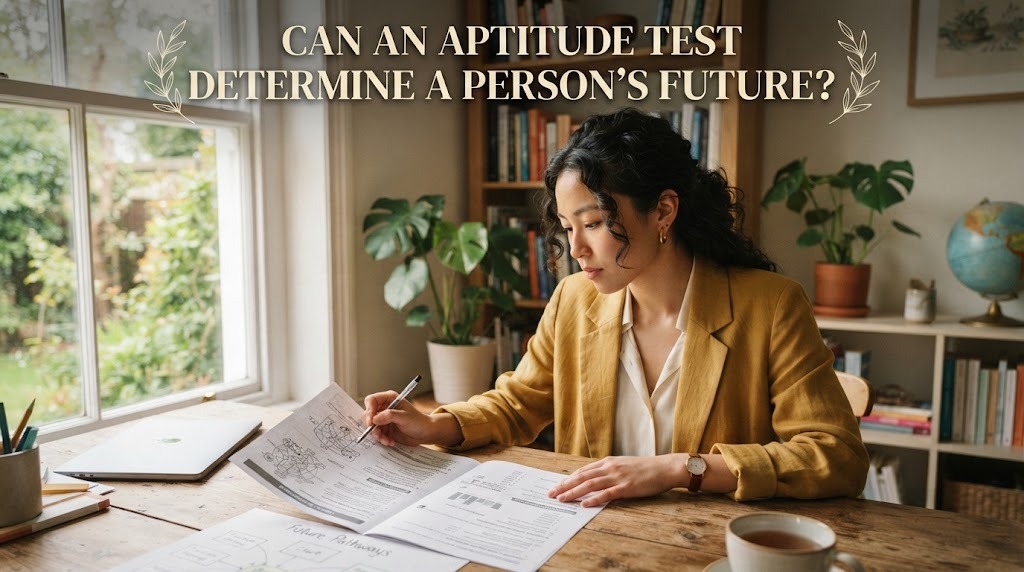
Many people take an aptitude test to understand their abilities and explore possible education or career paths. The results can provide useful information about specific skills and areas that may need development. However, an aptitude test cannot determine exactly what will happen in a person's future. A person's future is influenced by many factors, including education, experience, interests, effort, and opportunities.
WHAT DOES AN APTITUDE TEST MEASURE?
An aptitude test is designed to measure specific abilities through structured questions or tasks. Depending on the assessment, it may measure verbal reasoning, numerical ability, logical thinking, spatial skills, or other cognitive abilities. The test focuses on how a person performs certain types of tasks. It does not measure every quality that can influence a person's education or career.
The results can provide a general picture of relative strengths and areas for development. They can be useful for self-understanding and planning, but they should be interpreted within the purpose and limitations of the specific test.
CAN AN APTITUDE TEST PREDICT THE FUTURE?
An aptitude test cannot predict a person's future with certainty. It can provide information about abilities that may be relevant to certain learning or work activities. However, having a particular ability does not guarantee future success in a specific field. Many other factors influence what a person eventually achieves.
For example, someone may have strong numerical ability but choose a career that does not heavily involve mathematics. Another person may have an average result in one area but improve significantly through education and practice. This shows why test results should be viewed as guidance rather than a prediction.
HOW DO INTERESTS AFFECT A PERSON’S FUTURE?
Interests can strongly influence the direction a person chooses. Someone may have an ability that matches a particular field but prefer to spend time learning something completely different. Interest and motivation can affect how much effort a person is willing to put into developing a skill. Therefore, aptitude results should be considered together with personal interests.
For example, a student with strong communication abilities may have many possible career options. However, their final direction may depend on whether they enjoy writing, teaching, business, media, or another field. Ability and interest can work together when exploring future possibilities.
CAN EDUCATION AND EXPERIENCE CHANGE A PERSON’S ABILITIES?
Yes, education and experience can contribute to the development of many skills. People can improve through practice, training, feedback, and repeated experience. An aptitude test result represents performance under particular assessment conditions and should not automatically be treated as a permanent limit.
For example, someone who initially struggles with numerical reasoning can learn through structured practice and education. Over time, their performance may improve. This means that a test result should not prevent someone from trying to develop an ability they want to strengthen.
WHAT ROLE DOES EFFORT PLAY IN THE FUTURE?
Effort is another important factor that can influence personal development. A person's abilities may provide a starting point, but consistent effort and learning can affect how those abilities are used. People who actively practice their skills can gain knowledge and experience that are not captured by a single aptitude test.
Effort does not guarantee a particular outcome either. However, it can help people make better use of their existing abilities and respond to challenges. This is why an aptitude test should be used as one source of information, not as a fixed description of what someone can achieve.
HOW CAN APTITUDE TEST RESULTS HELP WITH CAREER PLANNING?
Aptitude results can be useful for career exploration. They may help people identify fields that involve abilities they demonstrate relatively strongly. For example, strong verbal reasoning may encourage someone to explore communication-related careers, while numerical ability may lead to research into fields involving numbers or data.
However, career planning requires more information. People should also research job requirements, education pathways, work environments, interests, and career goals. Combining these factors can create a more realistic picture of possible career directions.
WHAT ARE THE LIMITATIONS OF AN APTITUDE TEST?
Aptitude tests have several limitations. They may not fully measure creativity, motivation, personality, practical experience, communication style, or personal values. Performance can also be affected by concentration, test conditions, familiarity with the question format, and other temporary factors.
Another limitation is that different aptitude tests measure different abilities. A result from one assessment should therefore not be generalized to every part of a person's life. The meaning of the result depends on the quality, purpose, and context of the test.
HOW SHOULD A PERSON USE APTITUDE TEST RESULTS?
The best approach is to use aptitude results as a starting point for self-understanding and development. First, understand what the test measured and what the results mean. Then compare the results with personal interests, academic experiences, skills, and future goals. This can help identify areas that deserve further exploration.
People can also turn the results into practical actions. They may take a course, practice a skill, join a project, explore a career, or gain work experience. Real-world experience can provide information that a test alone cannot provide.
CONCLUSION
An aptitude test cannot determine a person's future. It can provide useful information about specific abilities and help people explore education, personal development, and career options. However, future outcomes are influenced by many factors, including interests, education, experience, effort, motivation, and opportunities.
The most useful way to view an aptitude test is as a guide rather than a prediction. By combining test results with continuous learning and real-world experience, people can make more informed decisions while remaining open to new possibilities.
Recent Posts

Bagaimana Sistem SKS pada Program Kuliah... 22.11.2026/12 View

How Does Technology Make Daily Evaluation... 21.11.2026/63 View

Apa Strategi Menghadapi Kesenjangan antara Kompetensi... 21.11.2026/64 View

Mengapa Inventaris Aset Penting bagi Kelancaran... 21.11.2026/61 View

When Should Musicians Join a Record... 21.11.2026/59 View
