

Can Artificial Neural Networks Enhance Large Scale Data Analysis?
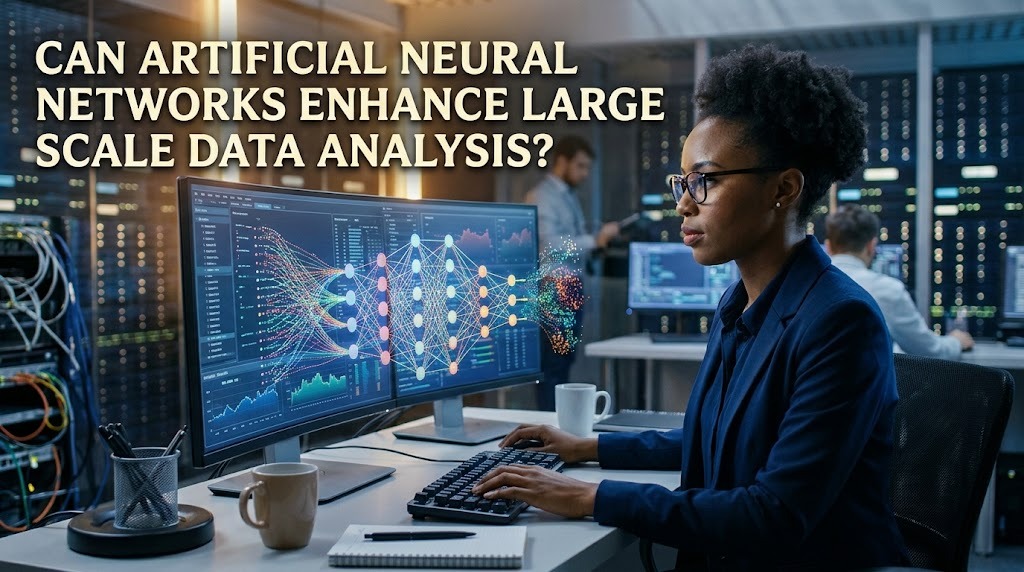
In the contemporary digital landscape, organizations across every industrial sector are overwhelmed by a relentless deluge of complex information generated by global operations, continuous sensor networks, and digital customer interactions. Traditional database management tools and classical statistical models often struggle to parse petabyte-scale datasets characterized by extreme velocity, volume, variety, and structural complexity. As corporate and scientific entities seek deeper operational insights, artificial neural networks have emerged as the definitive computational paradigm for transforming chaotic big data into structured, actionable intelligence. By mimicking biological cognitive processing through multi-layered adaptive algorithms, neural networks redefine how modern enterprises extract value, discover hidden competitive advantages, and automate decision-making across massive data repositories.
Enhancing large-scale data analysis goes far beyond simply processing vast amounts of information faster than traditional software systems. It involves uncovering subtle non-linear relationships, automating complex feature extraction, maintaining statistical stability across massive data feeds, and scaling computational workflows seamlessly across distributed cloud infrastructure. Examining the core mechanics, architectural scaling capabilities, real-time inference strategies, and practical enterprise impacts reveals why artificial neural networks have become completely indispensable for modern big data analytics pipelines.
AUTOMATED FEATURE LEARNING AND ELIMINATION OF MANUAL BOTTLENECKS
Traditional data analysis requires teams of data scientists and domain engineers to manually construct features, select variables, and write explicit logical rules to help statistical algorithms interpret incoming information. This manual feature-engineering approach breaks down completely when applied to large-scale, unstructured datasets like high-frequency industrial IoT sensor telemetry, global financial transactions, satellite imagery, or massive corpuses of natural language text. Artificial neural networks eliminate this operational bottleneck entirely through automatic representation learning.
As unstructured data flows through sequential hidden layers, the network autonomously discovers relevant patterns, spatial features, temporal dependencies, and hierarchical structures without requiring human intervention. Initial layers capture fundamental low-level attributes such as signal frequencies, pixel contrast, or character frequencies, while deeper layers synthesize these elementary components into complex semantic representations. This automated feature discovery allows neural networks to handle high-dimensional big data with unprecedented accuracy, eliminating human bias and reducing manual engineering overhead.
CAPTURING COMPLEX NON-LINEAR RELATIONSHIPS AT SCALE
Classical analytical models, such as linear regression, decision trees, and traditional econometric techniques, rely on simplified assumptions that relationships between variables are fundamentally linear and predictable. However, real-world big data—spanning global macroeconomic trends, consumer behavior matrices, climate systems, and genomic sequencing—is inherently non-linear, dynamic, multi-dimensional, and chaotic.
Artificial neural networks utilize non-linear activation functions within their interconnected mathematical nodes, enabling them to construct flexible continuous representations capable of modeling highly intricate, multi-variable interactions that linear models completely miss. By mapping high-dimensional inputs into complex mathematical spaces, deep neural networks discover subtle operational anomalies, predict rare system failures, optimize multi-layered supply chain routes, and identify microscopic consumer trends buried deep within petabytes of historical corporate records.
SCALABILITY THROUGH DISTRIBUTED COMPUTING AND HARDWARE ACCELERATION
Analyzing petabyte-scale datasets creates immense computational demands that traditional central processing units cannot process sequentially in a reasonable timeframe. Artificial neural networks achieve massive scalability by leveraging distributed computing frameworks and specialized hardware accelerators like graphics processing units and tensor processing units designed specifically for tensor linear algebra and matrix multiplication.
Modern deep learning frameworks distribute the mathematical workload of training large-scale models across extensive clusters of high-performance computing nodes operating in parallel. Techniques such as data parallelism, model parallelism, and gradient accumulation allow neural algorithms to process millions of complex data points simultaneously across distributed networks. This scalable infrastructure ensures that as organizational data volumes expand exponentially over time, neural network analytics can scale horizontally and vertically without suffering from severe processing lag or catastrophic system bottlenecks.
REAL-TIME STREAMING ANALYTICS AND PREDICTIVE INTELLIGENCE
Beyond analyzing static historical archives, modern enterprises require real-time streaming analytics to make instantaneous operational decisions in fast-moving commercial environments. Artificial neural networks excel at continuous streaming data analysis, processing live telemetry, user clickstreams, digital payment feeds, and market ticker data as events unfold.
Trained neural models deployed on edge computing nodes or cloud microservices perform rapid inference on incoming data streams within milliseconds. This continuous evaluation capability enables automated fraud detection systems to block suspicious financial transactions instantly, dynamic pricing algorithms to adjust rates based on live demand spikes, and predictive maintenance engines to alert factory engineers before critical industrial equipment suffers catastrophic mechanical failure. Shifting from retrospective batch reporting to proactive real-time predictive intelligence gives organizations a decisive strategic advantage.
ADVANCED ANOMALY DETECTION AND PATTERN RECOGNITION
Identifying rare outliers, malicious activities, or system malfunctions within petabytes of normal operational noise is one of the most difficult challenges in big data management. Traditional rule-based monitoring tools either generate overwhelming numbers of false positive alerts or miss sophisticated, multi-stage anomalous patterns entirely.
Neural network architectures such as deep autoencoders, isolation forests, and generative adversarial networks excel at unsupervised anomaly detection across vast datasets. By learning the normal structural baseline of complex multi-dimensional data, these networks instantly identify minor deviations, unauthorized network intrusions, healthcare billing irregularities, or subtle manufacturing defects that fall outside standard statistical parameters. Automating high-precision anomaly detection protects enterprise assets, maintains quality assurance, and ensures regulatory compliance across global operations.
CONCLUSION
Artificial neural networks fundamentally enhance large-scale data analysis by replacing manual feature engineering with automated representation learning, capturing complex non-linear relationships, scaling effortlessly across distributed computing hardware, delivering real-time predictive insights, and automating high-precision anomaly detection. As enterprise data volumes continue to expand exponentially in both scale and structural complexity, the integration of deep neural architectures into big data analytics pipelines is no longer an optional technological upgrade, but an essential prerequisite for sustainable operational success. Mastering these advanced computational techniques empowers organizations to unlock the full strategic potential of their digital information assets.
Recent Posts

Bagaimana Sistem SKS pada Program Kuliah... 22.11.2026/53 View

How Does Technology Make Daily Evaluation... 21.11.2026/82 View

Apa Strategi Menghadapi Kesenjangan antara Kompetensi... 21.11.2026/81 View

Mengapa Inventaris Aset Penting bagi Kelancaran... 21.11.2026/77 View

When Should Musicians Join a Record... 21.11.2026/82 View
