

Can Artificial Neural Networks Solve Complex Machine Learning Problems?
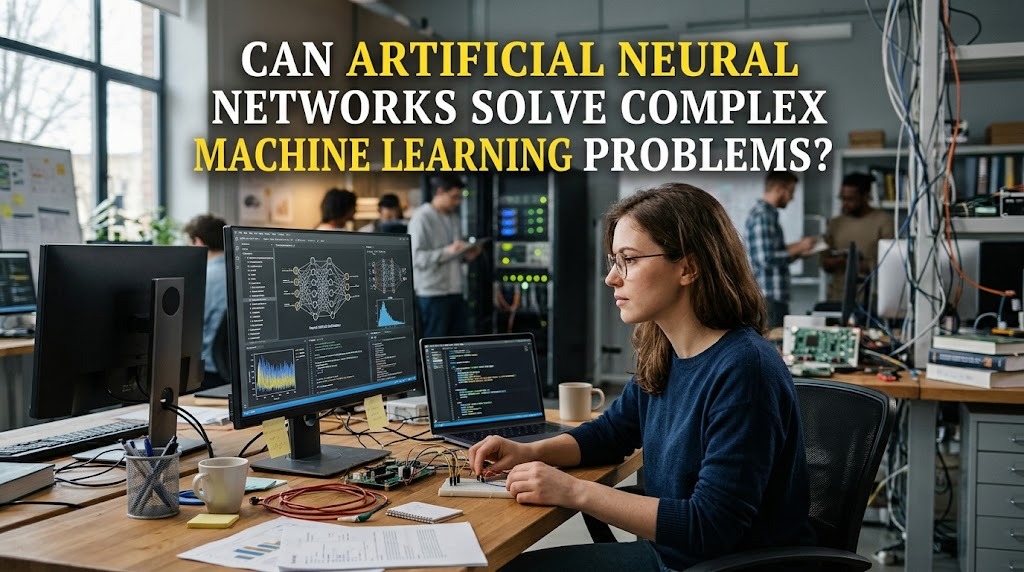
Artificial neural networks have established themselves as the most powerful and versatile computational engines for solving complex machine learning problems across science, industry, and modern computing. As datasets grow exponentially larger and real-world operational challenges become increasingly multi-dimensional, traditional linear models and classical statistical algorithms routinely fail to capture underlying patterns. Artificial neural networks bypass these limitations through multi-layered adaptive architectures, non-linear activation functions, and automated representation learning. Exploring how neural networks tackle intricate machine learning challenges reveals the mathematical foundations, architectural breakthroughs, and operational boundaries that define modern artificial intelligence.
HANDLING HIGH DIMENSIONALITY AND NON-LINEARITY
Many of the most challenging problems in machine learning involve high-dimensional data where relationships between variables are profoundly non-linear. Classical analytical tools struggle with the curse of dimensionality, where the number of input features overwhelms the computational model and creates excessive statistical noise. Artificial neural networks solve this problem by mapping high-dimensional inputs through interconnected layers of non-linear mathematical transformations. This architectural design allows deep learning models to construct complex continuous functions capable of capturing subtle interactions, rare anomalies, and intricate correlations that linear models completely miss.
AUTOMATIC FEATURE EXTRACTION AND REPRESENTATION LEARNING
Solving complex machine learning tasks traditionally required teams of human domain experts to manually engineer features, design variables, and construct rigid rules for algorithms to follow. This manual bottleneck breaks down entirely when dealing with unstructured inputs such as raw video feeds, natural language corpora, and genomic sequences. Artificial neural networks eliminate this requirement through automated representation learning, where the network autonomously discovers relevant features as information flows through its hidden layers. Initial layers capture elementary patterns while deeper layers synthesize these components into abstract semantic concepts, enabling high-precision problem-solving without human feature-engineering bias.
UNIVERSAL APPROXIMATION AND MULTI MODAL INTEGRATION
At a theoretical level, the universal approximation theorem demonstrates that a feedforward neural network with a sufficient number of hidden neurons can approximate any continuous function to arbitrary precision. This mathematical capability makes neural networks uniquely suited to handle multi-modal machine learning problems where systems must process text, images, audio, and numerical telemetry simultaneously. Advanced multimodal architectures integrate diverse data streams within a unified latent space, allowing models to reason across sensory modalities, perform complex cross-domain translations, and generate sophisticated synthetic outputs.
SCALABILITY THROUGH DISTRIBUTED COMPUTING AND HARDWARE ACCELERATION
While theoretical capability is essential, solving complex machine learning problems requires massive computational scalability. Training deep neural networks on petabyte-scale datasets demands immense processing power that traditional central processing units cannot deliver sequentially. Neural networks achieve exceptional scalability by leveraging distributed computing frameworks and specialized hardware accelerators such as graphics processing units and tensor processing units. By parallelizing matrix multiplications and tensor algebra across thousands of computing nodes, modern deep learning pipelines train massive models efficiently, turning previously intractable computational problems into solvable tasks.
INHERENT LIMITATIONS AND ONGOING RESEARCH CHALLENGES
Despite their remarkable problem-solving capacity, artificial neural networks are not a universal panacea for every machine learning challenge. Complex deep learning models require vast quantities of clean training data, consume significant electrical energy, and remain vulnerable to adversarial manipulation. Furthermore, their black box nature makes it difficult to interpret how specific conclusions are reached, posing regulatory and ethical hurdles in high-stakes fields. Ongoing research in explainable artificial intelligence, efficient edge computing, and sample-efficient learning continues to address these structural boundaries.
CONCLUSION
Artificial neural networks can successfully solve some of the most complex machine learning problems in existence, provided they are paired with appropriate architectures, sufficient computational resources, and high-quality training data. By automating feature extraction, modeling intricate non-linear relationships, scaling across distributed hardware, and integrating multi-modal data streams, deep learning has redefined the boundaries of computational intelligence. While technical challenges such as data dependency and interpretability remain, neural networks continue to serve as the definitive technology for tackling complex data challenges in the modern digital era.
Recent Posts

Bagaimana Sistem SKS pada Program Kuliah... 22.11.2026/53 View

How Does Technology Make Daily Evaluation... 21.11.2026/82 View

Apa Strategi Menghadapi Kesenjangan antara Kompetensi... 21.11.2026/81 View

Mengapa Inventaris Aset Penting bagi Kelancaran... 21.11.2026/77 View

When Should Musicians Join a Record... 21.11.2026/82 View
