

Can Bodily Kinesthetic Intelligence Be Trained And Developed?
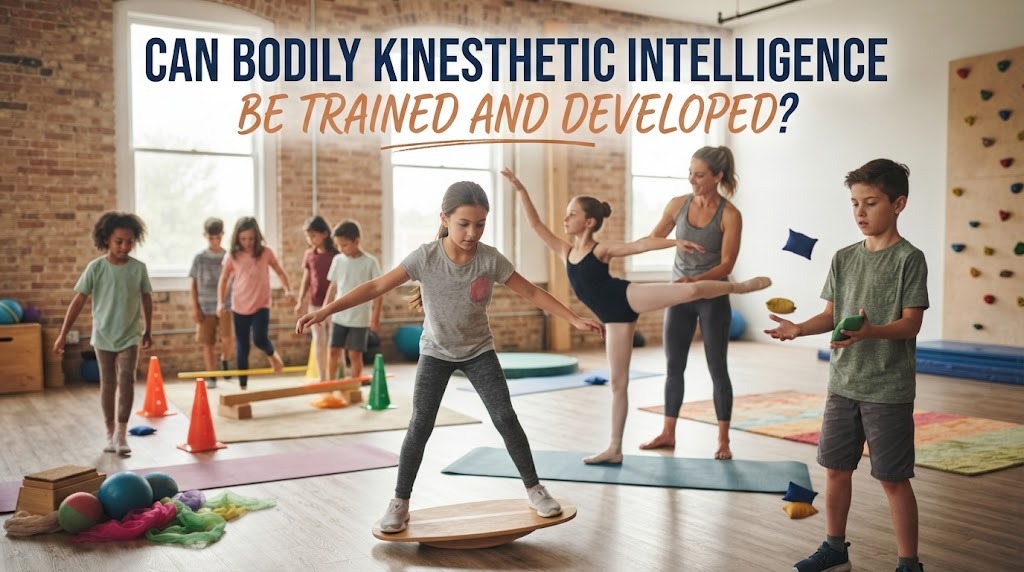
Bodily kinesthetic intelligence refers to the ability to use the body effectively to perform activities, express ideas, and solve problems. People with this strength may be comfortable with movement, physical practice, hands on activities, sports, dance, acting, or making things. Like many other abilities, physical and coordination skills can improve through regular practice and meaningful experiences. However, development does not mean that everyone will reach the same level of physical ability. With consistent training and suitable activities, a person can strengthen skills related to bodily kinesthetic intelligence.
UNDERSTANDING BODILY KINESTHETIC INTELLIGENCE
Bodily kinesthetic intelligence is commonly discussed as part of Howard Gardner’s theory of multiple intelligences. It describes the ability to use physical movement and body coordination effectively. People who show this strength may learn well through doing, practicing, moving, and interacting with physical objects. They may also be interested in activities such as sports, crafts, dance, acting, or practical work. However, intelligence should not be treated as a fixed label that determines what a person can or cannot learn.
A person can also have several different strengths at the same time. Someone who enjoys physical activities may also have strong language, social, logical, or visual abilities. Therefore, developing bodily kinesthetic skills should be viewed as building useful abilities rather than trying to fit into a single category. This approach allows people to explore different ways of learning and performing tasks.
PRACTICE COORDINATION AND BODY CONTROL
Regular practice can help improve coordination between the brain and body. Simple activities such as catching a ball, balancing, drawing, assembling objects, or following movement patterns can require hand eye coordination and body control. Repeating these activities allows a person to become more familiar with the movements. Over time, movements that once felt difficult may become easier and more controlled.
Practice should be gradual rather than unnecessarily difficult. Starting with basic movements allows learners to develop confidence before moving to more complex tasks. They can also receive feedback and correct their movements during practice. This combination of repetition, feedback, and gradual difficulty can support skill development.
TAKE PART IN PHYSICAL ACTIVITIES
Physical activities provide natural opportunities to develop body awareness and coordination. Sports such as swimming, basketball, badminton, or gymnastics can involve timing, balance, movement, and quick responses. Activities such as dancing and martial arts can also require control, rhythm, flexibility, and coordination. The best activity depends on the person's interests, physical condition, and goals.
Regular participation is more useful than occasional practice. Learners can choose activities that they enjoy so they are more likely to continue practicing. They should also learn correct techniques and follow appropriate safety guidelines. Consistent physical activity can support the development of movement skills and body awareness.
TRY HANDS ON LEARNING
Bodily kinesthetic skills can also be developed through activities that involve the hands. Building models, drawing, cooking, gardening, crafting, and simple experiments require people to interact directly with materials. These activities can improve fine motor skills, coordination, precision, and practical problem solving. They can also help learners understand how ideas work in real situations.
Hands on activities do not always need special equipment. Everyday materials can provide opportunities to practice careful movements and follow procedures. For example, assembling a simple object requires attention to sequence and accuracy. Repeated practice can make these physical tasks more familiar and controlled.
USE ROLE PLAY AND PERFORMANCE
Role play and performance activities combine physical movement with communication and expression. Acting allows people to use gestures, facial expressions, posture, and movement to communicate ideas or emotions. Dance and other performances can also require timing and coordination with music or other performers. These activities encourage learners to become more aware of how their bodies communicate.
Role play can also help people become more comfortable using movement in social situations. Learners can practice different scenarios and receive feedback about their performance. They can gradually improve their body language, timing, and confidence. This makes performance activities useful for developing both physical expression and communication skills.
DEVELOP BALANCE AND FLEXIBILITY
Balance and flexibility are important parts of physical control. Activities such as stretching, yoga, balance exercises, and controlled movement can help people become more aware of their bodies. These activities should be performed at an appropriate level to reduce the risk of injury. Beginners should focus on proper technique and controlled movement rather than trying to perform difficult positions immediately.
Progress can be tracked by observing improvements in stability, range of movement, and control. Small improvements can indicate that practice is having an effect. Rest and recovery are also important because the body needs time to adapt. A balanced approach can make physical training more sustainable over time.
COMBINE MOVEMENT WITH MENTAL PRACTICE
Bodily kinesthetic development is not only about physical repetition. People can also improve their performance by thinking about movement patterns, timing, strategies, and techniques. Athletes often study techniques before practicing them, while performers may mentally rehearse movements before performing. This combination of physical and mental practice can make learning more purposeful.
Reflection can also help learners identify what worked and what needs improvement. After an activity, they can ask themselves which movement felt difficult and how it could be performed differently. This process encourages awareness and problem solving. Learning to analyze physical performance can support continuous improvement.
PRACTICE CONSISTENTLY AND SET REALISTIC GOALS
Developing physical skills requires patience because improvement usually happens gradually. Setting small and realistic goals can make progress easier to observe. For example, a learner can focus on improving balance, accuracy, speed, or coordination one step at a time. Consistent practice is generally more useful than trying to improve everything at once.
Goals should also match the person's current abilities and physical condition. If an activity becomes painful or unsafe, the person should stop and seek appropriate guidance. Progress should not be measured only by comparison with other people. Instead, learners can focus on personal improvement and steady development.
CONCLUSION
Bodily kinesthetic intelligence can be supported through regular practice and activities that develop movement, coordination, body awareness, and practical skills. Sports, hands on activities, role play, balance exercises, and performance practice can provide useful opportunities for development. Mental practice and reflection can also help learners understand and improve their physical performance. However, development takes time and should be approached gradually and safely. With consistent practice and realistic goals, people can strengthen many skills related to bodily kinesthetic abilities while also developing other areas of learning.
Recent Posts

Bagaimana Sistem SKS pada Program Kuliah... 22.11.2026/31 View

How Does Technology Make Daily Evaluation... 21.11.2026/67 View

Apa Strategi Menghadapi Kesenjangan antara Kompetensi... 21.11.2026/66 View

Mengapa Inventaris Aset Penting bagi Kelancaran... 21.11.2026/64 View

When Should Musicians Join a Record... 21.11.2026/65 View
