

Can Students Bring a Folding Bike Onto Trans Pelajar Buses?
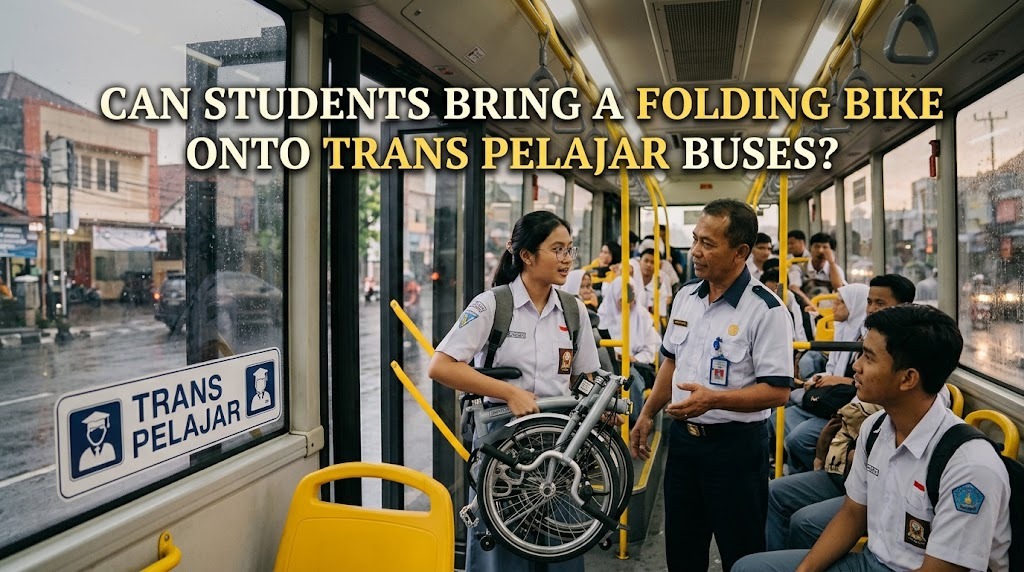
The answer depends on the city and the bus operator, and I could not find a confirmed official rule for Trans Semarang about folding bikes. Some bus services allow folded bikes if they are small enough and do not disturb other passengers. Others leave the decision to the driver or officer on duty.
Because rules vary, students should ask the operator before bringing a bike on board. This guide explains what is known from other services, how size limits usually work, and how to travel safely. Treat the examples as a guide, not as a guarantee for your route.
WHAT SOME OTHER SERVICES ALLOW
Transjakarta is one example with a clear public statement. Its official account said in 2019 that passengers may bring items up to 50 x 50 x 50 cm, and that a folding bike can be brought on board. If the item is larger, an officer decides whether it can enter the bus.
This rule applies to Transjakarta, not to every Trans Pelajar service. Other bus operators may use different sizes or no bike policy at all. Always check the notice at the bus stop or the official website of your own service.
HOW TRAINS HANDLE FOLDING BIKES
Trains give another useful comparison. For long-distance trains, KAI allows only folding bikes with a maximum weight of 20 kg and a maximum wheel size of 22 inches. Other bike types are not allowed in the passenger car.
Buses do not follow train rules, but these limits show why size and weight matter. A heavy or large bike can block aisles and doors. A small, lightweight, fully folded bike has a better chance of being accepted.
WHY BUSES MAY LIMIT BIKES
City buses are often crowded, especially during morning and afternoon peak hours. A bike can take up space, hit other passengers, or block the exit during sudden braking. For this reason, many operators restrict large items.
Safety is also important. A loose bike can fall or slide when the bus turns or stops. Officers may refuse a bike if the bus is full, even if the rules allow it at other times.
TIPS IF YOU WANT TO BRING A FOLDING BIKE
First, ask the operator through the official website, app, or social media. Second, choose a small and light bike that folds fully and has no loose parts. Third, use a cover or bag to protect other passengers from dirty tires and sharp edges.
Fourth, avoid the busiest hours, such as early morning and school dismissal time. Fifth, board last, stand near the door area, and hold the bike firmly. Follow the driver's instructions at all times.
OTHER OPTIONS FOR BIKE USERS
If bikes are not allowed, you can still combine cycling and public transport. Cycle to the nearest bus stop and lock your bike in a safe place, if the stop or school has parking. Use a strong lock and remove accessories that can be stolen.
You can also leave your bike at school or at home and use the bus for the longer part of the trip. For short distances, walking or cycling the whole way may be better. Think about safety, weather, and the time you need before you choose.
CONCLUSION
Students may be able to bring a folding bike on some bus services, but there is no confirmed rule for every Trans Pelajar route. Examples such as Transjakarta's 50 x 50 x 50 cm guideline show that size, weight, and crowd levels matter. Always confirm the rule with your local operator before you travel.
Choose a small, folded, and covered bike, avoid peak hours, and follow the officer's instructions. If bikes are not allowed, use a safe parking spot at the bus stop or leave the bike at home. A little planning keeps the ride safe and comfortable for everyone.
Recent Posts

Bagaimana Sistem SKS pada Program Kuliah... 22.11.2026/54 View

How Does Technology Make Daily Evaluation... 21.11.2026/83 View

Apa Strategi Menghadapi Kesenjangan antara Kompetensi... 21.11.2026/82 View

Mengapa Inventaris Aset Penting bagi Kelancaran... 21.11.2026/78 View

When Should Musicians Join a Record... 21.11.2026/84 View
