

How Can Applied Research Help Improve The Quality Of Education?
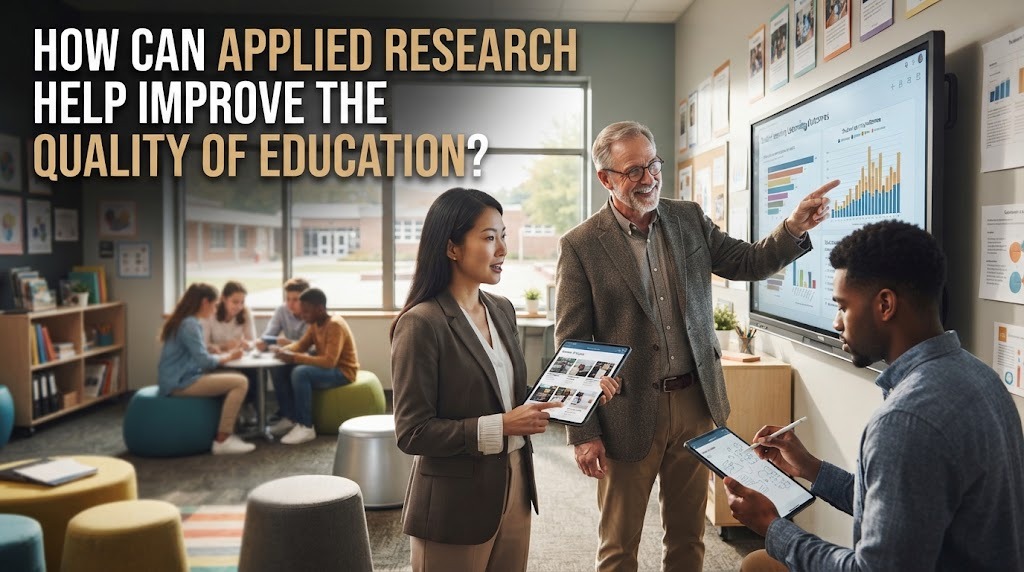
Education plays an important role in developing knowledge, skills, and opportunities for individuals and communities. However, schools and educational institutions often face challenges such as different learning abilities, limited teaching resources, low student engagement, and unequal access to technology. Applied research can help address these challenges by investigating real educational problems and testing practical solutions. Through classroom observations, surveys, experiments, and data analysis, researchers can identify which teaching methods and learning strategies are most effective. By using reliable evidence to guide decisions, applied research can improve educational quality and create better learning experiences for students.
IMPROVING TEACHING METHODS
Applied research helps teachers identify teaching methods that support student understanding and participation. Researchers can compare different approaches, such as group discussions, project-based learning, practical demonstrations, and digital learning activities. By examining student performance and classroom engagement, teachers can determine which methods work best for particular subjects and age groups. For example, a teacher may investigate whether hands-on activities help students understand scientific concepts more effectively than lectures alone. The findings can guide teachers in adjusting their lessons to meet students' learning needs. Evidence-based teaching methods make classroom instruction more purposeful and help educators improve learning outcomes.
UNDERSTANDING STUDENT LEARNING NEEDS
Every student has different strengths, challenges, interests, and learning experiences. Applied research allows educators to investigate these differences and understand why some students struggle with particular subjects or activities. Researchers may use interviews, questionnaires, classroom observations, and assessment results to identify learning difficulties. For example, a school may discover that students have difficulty understanding mathematics because they lack a strong foundation in basic calculations. Teachers can then provide additional practice, clearer explanations, or targeted support. Understanding individual learning needs helps schools develop more appropriate teaching strategies and create a learning environment where students have better opportunities to succeed.
DEVELOPING EFFECTIVE LEARNING MATERIALS
Learning materials influence how students understand information and practice new skills. Applied research helps educators evaluate textbooks, worksheets, educational videos, interactive applications, and other learning resources. Researchers can examine whether the materials are accurate, easy to understand, accessible, and suitable for the students' age and abilities. For example, a school may test whether visual learning materials help students understand complex topics more clearly. Feedback from teachers and students can then be used to improve the content and presentation. Well-designed learning materials can make lessons more engaging, support independent learning, and help students understand difficult concepts.
USING TECHNOLOGY TO SUPPORT EDUCATION
Technology provides new opportunities for teaching, learning, and communication. However, not every digital tool automatically improves educational outcomes. Applied research helps schools evaluate whether learning platforms, educational applications, online assessments, and digital classrooms meet their objectives. Researchers can compare student engagement, learning progress, accessibility, and technical difficulties before recommending a particular tool. For instance, a school may study whether an online learning platform helps students complete assignments more effectively and receive timely feedback. Research-based technology adoption allows educational institutions to choose tools that suit their needs while considering internet access, device availability, teacher readiness, and student privacy.
IMPROVING TEACHER SKILLS AND PROFESSIONAL DEVELOPMENT
Teachers play a central role in determining the quality of education. Applied research can identify areas where teachers need additional training, such as classroom management, digital teaching, assessment design, or support for students with different learning needs. Researchers may collect feedback from teachers, observe classroom practices, and evaluate professional development programs. These findings help schools design training that addresses actual teaching challenges rather than relying on general assumptions. For example, teachers may receive practical training on how to encourage classroom discussions and provide useful feedback. Continuous professional development supported by research helps teachers strengthen their skills and respond to changing educational needs.
EVALUATING STUDENT PERFORMANCE AND LEARNING OUTCOMES
Assessing student performance helps schools understand whether teaching and learning activities are achieving their goals. Applied research can examine test scores, assignments, attendance, participation, and other relevant indicators of progress. Researchers can use this information to identify learning gaps and determine which interventions are associated with better outcomes. For example, a school may evaluate whether additional reading sessions help students improve their reading comprehension over a semester. The results can guide decisions about continuing, changing, or expanding the program. Regular evaluation and evidence-based assessment help schools monitor progress and make improvements when students need additional support.
REDUCING EDUCATIONAL INEQUALITY
Students do not always have equal access to quality education. Differences in family income, school facilities, internet access, disability support, and geographical location can affect learning opportunities. Applied research helps identify these barriers and evaluate practical ways to reduce them. For example, researchers may study whether providing learning materials and additional tutoring improves educational access for students in underserved communities. Schools and policymakers can use the findings to direct resources toward the areas where they are most needed. Inclusive and equitable education requires solutions that consider students' different circumstances and remove unnecessary barriers to participation and achievement.
SUPPORTING EDUCATIONAL POLICIES AND SCHOOL MANAGEMENT
Educational policies influence curriculum design, teacher development, school funding, assessment systems, and student support services. Applied research provides evidence that helps school leaders and policymakers understand the effects of different decisions. Researchers can evaluate educational programs, examine school needs, and compare outcomes across different settings. For example, a local education authority may investigate whether a school attendance program reduces absenteeism and improves student participation. The findings can help decision-makers adjust the program and use available resources more effectively. Evidence-based educational policies are more likely to address identified problems and support meaningful improvements in schools.
CONCLUSION
Applied research can improve the quality of education by helping teachers develop effective teaching methods, understand student needs, improve learning materials, and use technology appropriately. It also supports teacher development, student assessment, educational equality, and better school policies. By collecting reliable data and evaluating practical solutions, educational institutions can make informed decisions instead of relying only on assumptions. However, research findings must be applied carefully and adapted to the needs and circumstances of each school. Ultimately, applied research helps create more effective, inclusive, and student-centered education that supports better learning outcomes and long-term development.
Recent Posts

Bagaimana Sistem SKS pada Program Kuliah... 22.11.2026/44 View

How Does Technology Make Daily Evaluation... 21.11.2026/73 View

Apa Strategi Menghadapi Kesenjangan antara Kompetensi... 21.11.2026/75 View

Mengapa Inventaris Aset Penting bagi Kelancaran... 21.11.2026/70 View

When Should Musicians Join a Record... 21.11.2026/74 View
