

How Can Applied Research Produce Innovative Solutions For Society?
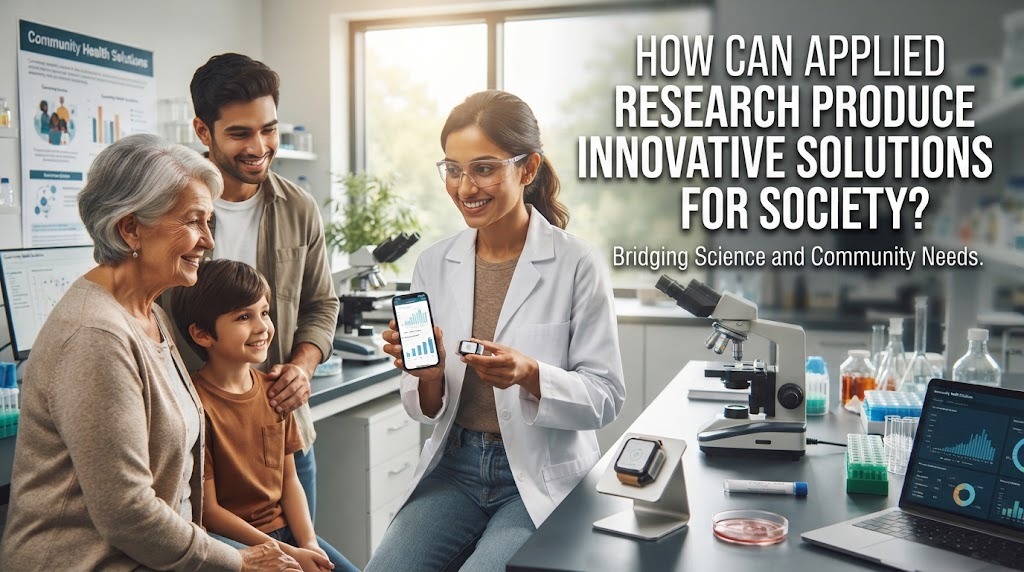
Applied research plays an important role in solving problems that affect people's daily lives. It uses scientific knowledge, practical experiments, and reliable data to develop solutions for real-world challenges. These challenges may include environmental pollution, limited access to healthcare, educational difficulties, and economic inequality. Unlike research that mainly expands theoretical knowledge, applied research focuses on practical results that can improve people's lives. By identifying problems, testing new ideas, and evaluating outcomes, researchers can create innovative solutions for society that are useful, measurable, and sustainable.
IDENTIFYING REAL PROBLEMS IN SOCIETY
The first step in producing innovative solutions is understanding the problems that communities actually face. Researchers can gather information through surveys, interviews, field observations, and discussions with local residents. These methods help them identify the causes of problems instead of focusing only on their visible effects. For example, researchers investigating poor waste management may discover that the main issue is not simply the amount of rubbish but also limited recycling facilities and public awareness. Understanding the root causes of social problems helps researchers develop solutions that address real needs.
Community participation is also important during this process. Residents often understand local conditions and challenges that may not be obvious to outside researchers. By involving them in discussions, researchers can identify practical priorities and avoid developing solutions that are difficult to use. The information collected can then guide the research objectives and the choice of methods. Solutions based on real community needs are more likely to be relevant, accepted, and effective.
COMBINING SCIENTIFIC KNOWLEDGE WITH CREATIVE THINKING
Innovative solutions often emerge when researchers combine existing scientific knowledge with new ideas. Applied research allows experts from different fields to work together and approach problems from several perspectives. For example, environmental scientists, engineers, and business specialists may collaborate to develop affordable systems for turning organic waste into useful products. Each field contributes different knowledge that can improve the final solution. Combining scientific evidence with creative thinking helps researchers discover possibilities that may not be obvious when a problem is studied from only one perspective.
Creative thinking also encourages researchers to question traditional methods and explore alternatives. However, a new idea must be tested to determine whether it is safe, practical, and effective. Researchers can compare different approaches and select the ones that best meet the project's objectives. This process supports innovation while reducing the risk of relying on assumptions. The strongest innovations balance originality with evidence and practical value.
USING TECHNOLOGY TO DEVELOP PRACTICAL SOLUTIONS
Technology provides researchers with new ways to understand problems and create useful solutions. Digital tools, artificial intelligence, sensors, and data analysis software can help researchers collect information, identify patterns, and improve decision-making. For example, researchers can use environmental sensors to monitor air quality and identify areas with high pollution levels. The results can support better planning for public health programs and environmental protection. Technology can make applied research faster, more precise, and more responsive to changing conditions.
Technology also supports the development of solutions in healthcare, education, agriculture, and public services. Researchers may test online learning platforms, develop tools for monitoring health conditions, or investigate digital systems that help farmers manage water more efficiently. However, technology should be selected according to the problem rather than used simply because it is new. Researchers must consider affordability, accessibility, data privacy, and the skills required to operate the tools. Responsible technology use helps ensure that innovations benefit society instead of creating additional barriers.
TESTING IDEAS THROUGH EXPERIMENTS AND PROTOTYPES
Before a new solution is introduced widely, researchers need to test whether it works as expected. They may create a prototype, which is an early version of a product, system, or process, to evaluate its performance. For example, researchers developing an affordable water filter can test its ability to remove contaminants and determine whether the filtered water meets relevant safety standards. Testing can reveal weaknesses that need to be corrected before the solution reaches the public. Experiments and prototypes reduce uncertainty by allowing researchers to examine ideas using real evidence.
Researchers can also compare a new method with an existing approach to understand its advantages and limitations. They should establish suitable measurements, follow ethical guidelines, and record unexpected results. If the first version does not perform well, researchers can modify the design and test it again. This repeated process is known as iterative improvement, where each round of testing helps strengthen the solution. Through careful evaluation, researchers can develop innovations that are more reliable and suitable for real-world use.
SOLVING ENVIRONMENTAL AND PUBLIC HEALTH CHALLENGES
Applied research can produce innovations that address environmental problems and improve public health. Researchers may investigate renewable energy, water treatment, waste reduction, and methods for protecting natural resources. For instance, research into affordable solar energy systems can help communities explore alternatives to conventional electricity sources, depending on local conditions and infrastructure. Environmental research can also identify more effective ways to reduce pollution and manage limited resources. Practical environmental innovations can support cleaner surroundings and more responsible resource use.
In public health, applied research can help improve disease prevention, healthcare access, and the delivery of medical services. Researchers may evaluate health education programs, test methods for improving patient communication, or study ways to deliver essential services to remote communities. Any health-related innovation must be assessed for safety, effectiveness, and suitability before it is adopted. Researchers should also consider whether people can afford and access the proposed solution. Evidence-based public health solutions can help communities make better decisions and improve overall well-being.
IMPROVING EDUCATION AND ECONOMIC OPPORTUNITIES
Education is another area where applied research can produce meaningful social improvements. Researchers can examine teaching methods, learning materials, digital tools, and student support programs to determine which approaches work best. For example, a school may test an interactive learning platform to see whether it improves student understanding and participation. Researchers can compare learning outcomes and gather feedback from teachers and students. Research-based educational innovation helps schools improve learning experiences instead of adopting new methods without evaluating their effectiveness.
Applied research can also support economic development by helping businesses and communities identify better ways to produce goods, deliver services, and create employment. Small businesses may use market research to understand customer needs and develop products that meet local demand. Farmers can investigate improved cultivation methods, while craft producers can test new materials or production techniques. These innovations may improve productivity, reduce costs, and create new sources of income. Practical research can strengthen local economies when its findings are accessible and relevant to the people who need them.
COLLABORATING WITH COMMUNITIES AND INDUSTRIES
Collaboration helps researchers turn promising ideas into solutions that can be used in everyday life. Universities, businesses, government agencies, nonprofit organizations, and community groups can contribute knowledge, equipment, funding, or practical experience. For example, a university may develop a low-cost waste treatment method, while a local government helps test it in a community. Industry partners may then help improve production and distribution. Collaboration connects research with the resources and experience needed for implementation.
Community involvement is equally important because a solution may fail if it does not match local needs or conditions. Researchers should listen to users, explain the purpose of their work, and invite feedback during development. Partnerships can also help identify possible barriers, such as maintenance costs, limited training, or unequal access. Clear communication and shared responsibilities make it easier to address these challenges. Inclusive collaboration increases the chance that an innovation will be accepted, used correctly, and maintained over time.
MEASURING IMPACT AND ENSURING LONG-TERM BENEFITS
An innovative solution is valuable when it produces meaningful improvements rather than simply introducing something new. Researchers need to establish measurable indicators before evaluating the results. These indicators may include reduced costs, improved service quality, lower pollution levels, better learning outcomes, or increased access to essential resources. They can compare conditions before and after implementation and investigate other factors that may influence the results. Measuring real-world impact helps determine whether a solution has achieved its intended goals.
Researchers should also consider whether the benefits can continue over time. A solution that works during a short trial may become too expensive or difficult to maintain when used on a larger scale. Long-term evaluation should therefore examine affordability, environmental effects, maintenance requirements, and accessibility for different groups. Researchers can use the findings to improve the solution and identify opportunities for wider implementation. Sustainable innovation creates lasting value when it remains effective, practical, and beneficial to society.
CONCLUSION
Applied research can produce innovative solutions for society by identifying real problems, combining scientific knowledge with creative thinking, and testing ideas through reliable methods. It supports progress in environmental protection, healthcare, education, technology, and economic development. Collaboration with communities and industries helps transform research findings into practical applications, while impact evaluation shows whether these solutions truly make a difference. Researchers must also consider safety, affordability, accessibility, and long-term sustainability. Ultimately, applied research turns knowledge into practical action, helping communities solve problems and build a better future.
Recent Posts

Bagaimana Sistem SKS pada Program Kuliah... 22.11.2026/44 View

How Does Technology Make Daily Evaluation... 21.11.2026/73 View

Apa Strategi Menghadapi Kesenjangan antara Kompetensi... 21.11.2026/75 View

Mengapa Inventaris Aset Penting bagi Kelancaran... 21.11.2026/70 View

When Should Musicians Join a Record... 21.11.2026/74 View
