

How Can Artificial Intelligence Help Teachers Improve Learning Effectiveness?
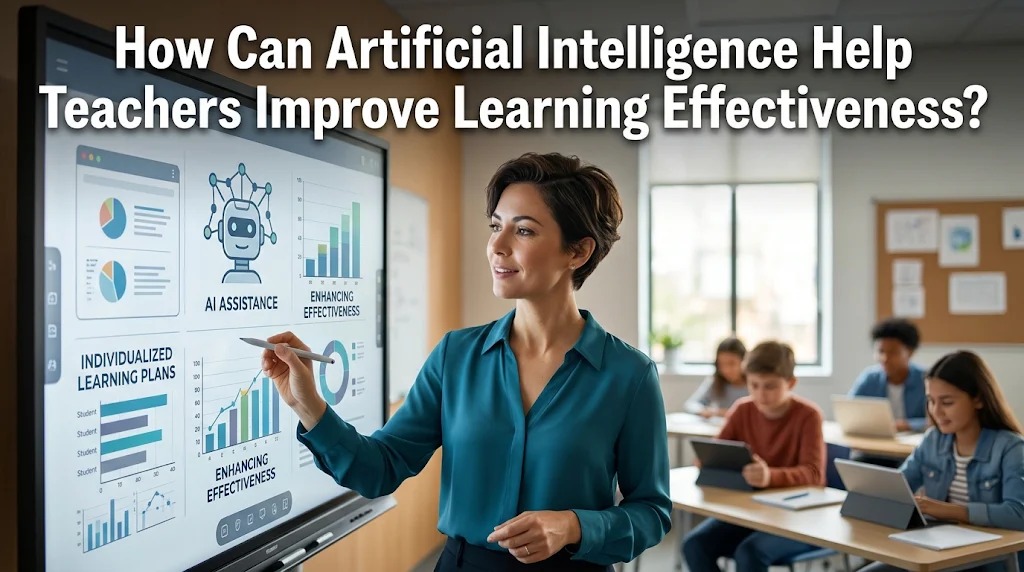
Artificial Intelligence (AI) is becoming an important part of modern education. Its development provides teachers with new opportunities to improve classroom activities, prepare learning materials, and understand students' academic needs. Through AI-powered applications, teachers can simplify certain teaching tasks and create learning experiences that are more personalized and efficient. These technologies can also help students understand difficult subjects through interactive explanations and immediate feedback.
The use of AI in education does not mean replacing teachers with machines. Instead, artificial intelligence serves as a supporting tool that helps teachers improve the quality of instruction and classroom management. When used appropriately, AI can make learning more effective by supporting different student abilities, reducing administrative workloads, and encouraging active participation. However, teachers still play an essential role in guiding students, developing critical thinking, and building meaningful relationships in the classroom.
PERSONALIZING LEARNING BASED ON STUDENTS' NEEDS
One of the main benefits of artificial intelligence in education is its ability to support personalized learning. Every student has different abilities, interests, and learning speeds. Some students can understand mathematical concepts quickly, while others need additional explanations and practice. AI-powered learning platforms can analyze students' answers, learning progress, and performance to identify areas that require improvement. Based on this information, the platforms can recommend learning materials and exercises that match individual needs.
Personalized learning allows teachers to provide more appropriate support for each student. For example, students who struggle with a particular subject can receive additional practice questions, while students who understand the material can explore more challenging activities. This approach helps teachers recognize differences in learning abilities without treating every student in exactly the same way. As a result, personalized learning can improve student engagement, build confidence, and support better academic development.
HELPING TEACHERS PREPARE LEARNING MATERIALS
Artificial intelligence can make lesson preparation more practical and efficient. Teachers can use AI tools to develop lesson outlines, create presentation materials, generate practice questions, and prepare classroom activities. These tools can also help simplify complicated explanations so that students can understand difficult concepts more easily. For example, a teacher can use AI to create different examples of English grammar exercises or prepare mathematics questions based on specific learning objectives. This support allows teachers to develop varied learning materials without spending excessive time preparing everything manually.
In addition, AI can help teachers adjust educational content to different classroom requirements. They can request alternative explanations, reading materials, discussion topics, and learning activities based on students' educational levels. However, teachers must review all AI-generated materials before using them in the classroom. Artificial intelligence can sometimes provide inaccurate information, outdated explanations, or unsuitable examples. Therefore, teacher supervision and content verification remain necessary to ensure that learning materials are accurate, relevant, and appropriate.
PROVIDING FASTER FEEDBACK AND STUDENT ASSESSMENT
AI-powered educational platforms can help teachers evaluate student assignments and provide feedback more efficiently. Some systems can automatically assess multiple-choice questions, identify common mistakes, and display students' learning progress. This allows teachers to understand which topics students have mastered and which subjects require further explanation. Faster feedback also helps students recognize their mistakes while the learning material is still fresh in their minds. Consequently, assessment becomes a more continuous process rather than something that only happens during examinations.
Artificial intelligence can also support teachers in identifying patterns in student performance. For instance, an educational platform may show that several students consistently struggle with the same mathematical topic. Teachers can use this information to review their teaching methods and provide additional explanations. However, AI assessment should not become the only basis for evaluating student abilities. Teachers still need to consider creativity, communication, participation, and other skills that cannot always be measured automatically. Combining AI-based assessment and human evaluation can create a more balanced understanding of student development.
REDUCING ADMINISTRATIVE TASKS AND IMPROVING TEACHER PRODUCTIVITY
Teachers often spend considerable time completing administrative responsibilities outside classroom instruction. These activities include preparing attendance records, organizing assignments, managing learning schedules, and documenting student progress. AI-powered systems can help automate certain repetitive tasks and organize educational information more efficiently. For example, digital platforms can assist with sorting assignments, summarizing learning records, and organizing classroom data. This reduces the time teachers need to spend on routine activities.
With fewer repetitive tasks, teachers can focus more on activities that directly support student development. They can spend additional time explaining difficult subjects, discussing learning challenges, preparing interactive lessons, and providing individual guidance. AI can also help teachers organize communication and access educational resources more quickly. Nevertheless, teachers must understand how these systems work and protect sensitive student information when using digital platforms. Responsible AI integration can improve teacher productivity while maintaining the importance of professional judgment and personal interaction.
ENCOURAGING INTERACTIVE LEARNING AND STUDENT CREATIVITY
Artificial intelligence can make classroom learning more engaging through interactive educational applications. Students can use AI-powered tools to explore new concepts, practice foreign languages, receive explanations, and solve educational problems. Some applications provide conversational learning experiences that allow students to ask questions and receive responses based on their learning needs. These features can encourage students to become more active participants rather than simply listening to explanations throughout the lesson. Teachers can also use AI to create simulations, educational scenarios, and creative classroom projects.
Furthermore, AI can support the development of creativity and problem-solving skills when students use it appropriately. For example, students can explore different ideas for writing assignments, develop project concepts, or compare alternative solutions to a problem. Teachers can guide them to evaluate AI-generated information instead of accepting every answer without questioning it. This encourages critical thinking, digital literacy, and independent learning. By combining AI tools with discussions, group activities, and practical assignments, teachers can create learning experiences that are both interactive and meaningful.
ADDRESSING THE CHALLENGES OF USING ARTIFICIAL INTELLIGENCE IN EDUCATION
Despite its benefits, implementing artificial intelligence in education also creates several challenges. One major concern is the accuracy of AI-generated information. Some tools may produce incorrect answers, misleading explanations, or information that does not match the curriculum. Students may also become overly dependent on AI when completing assignments, which can reduce opportunities to develop independent thinking. To prevent these problems, teachers should establish clear guidelines and encourage students to use AI as a learning assistant rather than a replacement for their own efforts.
Another important challenge involves unequal access to technology and the protection of personal information. Not every school has reliable internet access, sufficient digital devices, or teachers with strong technological skills. In addition, educational platforms may collect student information that must be protected against unauthorized access and misuse. Schools should provide appropriate digital facilities, teacher training, and clear data protection policies. Ethical AI use, equal technology access, and human supervision are essential to ensure that artificial intelligence benefits all students. With proper preparation, AI can become a valuable educational tool without reducing the important role of teachers.
CONCLUSION
Artificial intelligence can help teachers improve learning effectiveness in many ways. It supports personalized learning, simplifies lesson preparation, provides faster assessment, and reduces repetitive administrative tasks. AI-powered educational tools can also create more interactive classroom activities while encouraging students to develop creativity, critical thinking, and digital literacy.
However, successful AI implementation requires responsible use, accurate information, sufficient infrastructure, and appropriate teacher training. Teachers must remain actively involved in guiding students, evaluating learning outcomes, and building positive classroom relationships. By combining artificial intelligence with professional teaching skills, schools can create more effective learning environments and prepare students to face the challenges of an increasingly digital future.
Recent Posts

Bagaimana Sistem SKS pada Program Kuliah... 22.11.2026/33 View

How Does Technology Make Daily Evaluation... 21.11.2026/67 View

Apa Strategi Menghadapi Kesenjangan antara Kompetensi... 21.11.2026/67 View

Mengapa Inventaris Aset Penting bagi Kelancaran... 21.11.2026/65 View

When Should Musicians Join a Record... 21.11.2026/66 View
