

How Can Bodily Kinesthetic Intelligence Be Developed From An Early Age?
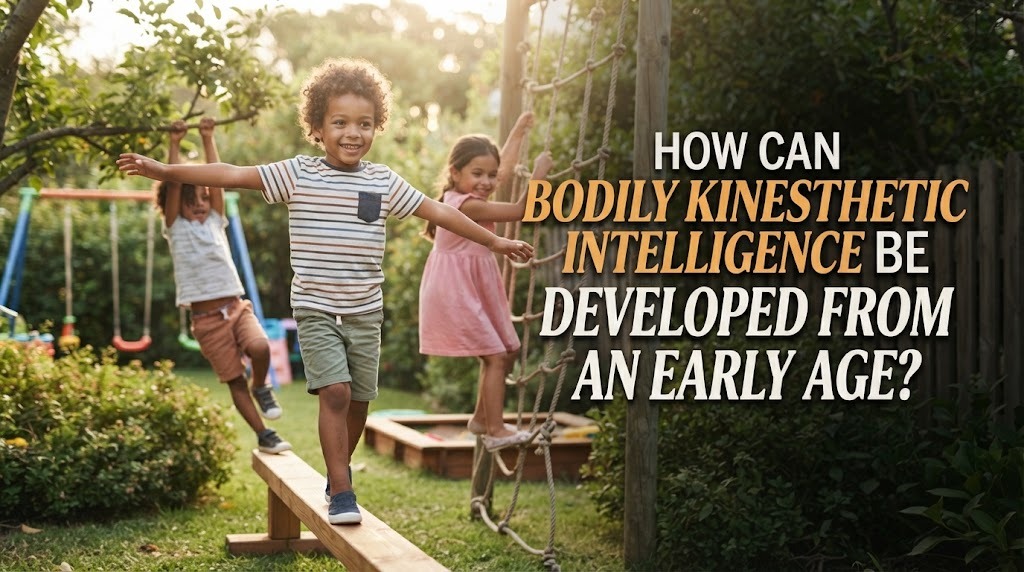
Bodily kinesthetic intelligence is the ability to use the body effectively to express ideas, perform tasks, and solve practical problems. Children begin developing physical abilities from an early age through movement, play, exploration, and daily activities. Providing suitable experiences can help children improve their coordination, body awareness, creativity, and motor skills. This intelligence is not limited to sports because it can also appear through dancing, crafting, building, cooking, and other hands-on activities. Early support can give children more opportunities to discover and strengthen their natural abilities.
PROVIDE OPPORTUNITIES FOR ACTIVE PLAY
Active play is one of the simplest ways to develop bodily kinesthetic intelligence from an early age. Children can run, jump, crawl, climb safely, throw balls, or play movement-based games according to their age and abilities. These activities allow them to practice balance, coordination, strength, and body control naturally. Active play can also make physical development enjoyable rather than feeling like formal training. Parents should provide a safe environment where children can move and explore freely.
Children do not need expensive equipment to develop these abilities. Simple activities such as following movement instructions, playing catch, walking along a safe line, or imitating animal movements can be useful. What matters is giving children regular opportunities to move, explore, and control their bodies. Adults can also join the activities to make them more enjoyable and encourage children to participate.
ENCOURAGE HANDS ON ACTIVITIES
Hands-on activities can help children understand concepts while using their hands and bodies. Parents and teachers can introduce activities such as building blocks, puzzles, drawing, crafts, simple cooking tasks, gardening, or assembling age-appropriate objects. These activities require children to touch, move, arrange, and manipulate different materials. They can also strengthen fine motor skills and hand-eye coordination. Children may become more interested in learning when they can directly interact with what they are studying.
For example, a child learning about shapes can use blocks to create different structures. A child learning about plants can participate in planting seeds and observing their growth. These experiences connect learning with physical action, making abstract ideas easier to understand for some children. Adults should focus on the learning process instead of expecting perfect results.
INTRODUCE SPORTS AND MOVEMENT ACTIVITIES
Sports and movement activities can provide structured opportunities for children to develop their physical abilities. Depending on their age and interests, children may try activities such as swimming, dancing, cycling, gymnastics, martial arts, or simple ball games. These activities can help improve balance, coordination, timing, flexibility, and body control. Regular participation can also teach children about practice, patience, and following instructions.
Children should be allowed to explore different activities instead of being forced into one particular sport. Some may enjoy dancing, while others may prefer swimming, cycling, or noncompetitive movement games. The goal is to help children discover activities that make them feel comfortable and motivated. A supportive environment can encourage them to practice consistently without unnecessary pressure.
USE LEARNING THROUGH MOVEMENT
Learning does not always have to happen while children are sitting at a desk. Teachers and parents can include movement in educational activities to make learning more active. For example, children can act out a story, move to represent numbers, use their bodies to demonstrate scientific concepts, or participate in educational games. These methods can provide physical experiences while children learn new information. Movement can also make lessons more engaging for children who enjoy active participation.
This approach does not mean every lesson needs to involve physical activity. Children still need opportunities to read, listen, observe, and think quietly. A balanced approach can combine physical practice with traditional learning methods. This allows children to develop different abilities instead of relying on only one learning approach.
DEVELOP FINE MOTOR SKILLS
Fine motor skills are important for activities that require precise hand and finger movements. Children can practice these skills through drawing, coloring, cutting with child-safe scissors, molding clay, threading beads, building small structures, or using age-appropriate tools under supervision. These activities can strengthen hand control and coordination. They can also prepare children for everyday tasks such as writing, dressing, eating, and handling objects.
Adults should choose activities that match the child's developmental stage. Materials should be safe and appropriate for the child's age and abilities. Children may need repeated practice before they can perform precise movements confidently. Encouraging them to keep trying can support patience, concentration, and motor development.
ENCOURAGE CREATIVE EXPRESSION
Creative activities can combine physical movement with imagination. Dancing, acting, role-playing, making crafts, and building projects allow children to express ideas through their bodies and hands. These activities can strengthen coordination while also encouraging creativity and communication. Children can experiment with different movements, materials, and ways of presenting their ideas. They can also learn to make decisions and solve simple problems during the creative process.
Adults should give children enough freedom to explore instead of controlling every step. For example, when making a craft, children can choose their own shapes, materials, or designs when possible. This encourages independence and creative thinking while allowing them to practice physical skills. The activity becomes an opportunity for exploration rather than simply completing a predetermined product.
SUPPORT PRACTICE WITHOUT PRESSURE
Developing bodily kinesthetic intelligence requires regular practice and positive support. Children may not immediately perform a movement correctly, especially when learning a new skill. Parents and teachers can provide simple guidance, demonstrate the movement, and allow children to try again. Constructive feedback can help children understand what they can improve without making them afraid of mistakes. A positive environment can make practice more enjoyable.
Adults should also avoid comparing children's physical abilities with those of their friends or siblings. Each child develops at a different pace, and interests can change over time. The focus should be on progress, participation, and enjoyment rather than competition. When children feel supported, they may become more willing to explore new activities and develop their abilities.
CREATE A SAFE ENVIRONMENT FOR EXPLORATION
A safe environment is essential because children learn about their bodies by exploring movement. Parents can provide enough open space for age-appropriate activities and remove unnecessary hazards from the play area. Equipment should be suitable for the child's age and used with appropriate supervision. Children should also learn simple safety rules while participating in physical activities. This allows them to explore without creating avoidable risks.
Safety does not mean preventing children from trying new things. Instead, adults can provide reasonable boundaries and guidance while allowing children to experience movement independently. For example, children can practice climbing on suitable equipment while being supervised. This balance can help them develop confidence, body awareness, and responsible behavior.
CONCLUSION
Bodily kinesthetic intelligence can be developed from an early age through active play, hands-on learning, creative activities, sports, and everyday physical experiences. Children can strengthen coordination, motor skills, body awareness, and practical problem-solving through regular practice. Parents and teachers can support this development by providing safe opportunities and encouraging children without excessive pressure. Different activities should be introduced because every child has different interests and developmental needs. With consistent support and meaningful experiences, children can gradually develop their physical abilities while enjoying the learning process.
Recent Posts

Bagaimana Sistem SKS pada Program Kuliah... 22.11.2026/27 View

How Does Technology Make Daily Evaluation... 21.11.2026/65 View

Apa Strategi Menghadapi Kesenjangan antara Kompetensi... 21.11.2026/65 View

Mengapa Inventaris Aset Penting bagi Kelancaran... 21.11.2026/62 View

When Should Musicians Join a Record... 21.11.2026/63 View
