

How Can Color Blindness Be Detected in Children and Adults?
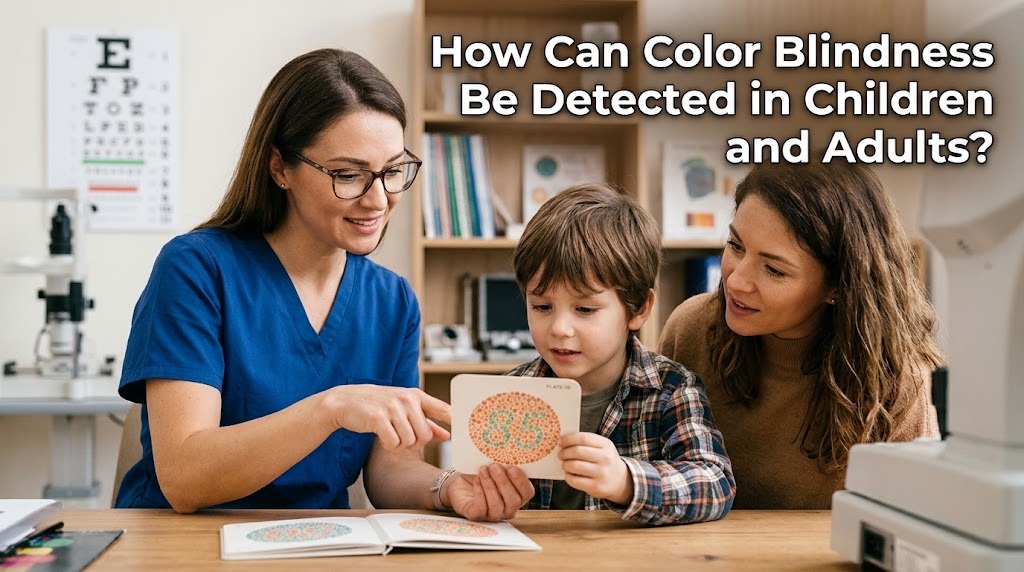
Color blindness is a vision condition that affects a person's ability to distinguish certain colors. This condition can occur in children and adults, although some individuals may not realize they have it until they experience difficulties recognizing colors in everyday activities. Common examples include confusing red and green, having trouble identifying blue and yellow, or seeing certain shades as almost identical.
Detecting color blindness early is important because it helps individuals understand their visual abilities and find appropriate ways to manage the condition. Although the examination methods are generally similar for children and adults, the approach may differ depending on age, communication skills, and the ability to follow testing instructions. Understanding the available detection methods can help parents and individuals recognize possible symptoms and seek appropriate eye examinations.
RECOGNIZING EARLY SIGNS OF COLOR BLINDNESS
One of the first ways to detect color blindness is by observing difficulties in recognizing and distinguishing colors. Children with color vision deficiencies may frequently confuse crayons, colored pencils, toys, or objects that have similar shades. For example, a child may identify a green object as brown or have difficulty selecting the correct color when completing drawing activities.
In adults, color blindness may become noticeable through difficulties with activities that require accurate color recognition. Some individuals may struggle to distinguish traffic signals, interpret color-coded charts, select matching clothes, or identify specific colors in their workplace. These difficulties can be more noticeable in environments with poor lighting or when two colors have similar brightness.
However, not everyone with color blindness experiences obvious symptoms. Some individuals adapt to their condition by remembering object positions, labels, or familiar color arrangements. Therefore, observing daily behavior alone is not enough to confirm color blindness, and proper vision testing is necessary for an accurate assessment.
DETECTING COLOR BLINDNESS IN CHILDREN
Detecting color blindness in children can be challenging because younger children may not fully understand color differences or testing instructions. Parents and teachers can begin by observing how children recognize colors during everyday activities. Repeatedly confusing certain colors, struggling with color-based learning tasks, or giving unexpected color names may indicate a possible color vision problem.
Parents can also introduce simple color recognition activities using toys, books, and educational materials. These activities should be treated as observations rather than medical tests because children's answers can be influenced by their age, vocabulary, attention, and familiarity with colors. A child who makes mistakes does not automatically have color blindness.
If concerns continue, parents should arrange an examination with an eye specialist. Depending on the child's age and ability to understand instructions, the specialist may use picture-based tests, colored patterns, or other suitable examination methods. Early identification can help parents and teachers adjust learning materials so children can participate comfortably in educational activities.
USING THE ISHIHARA TEST TO IDENTIFY COLOR BLINDNESS
The Ishihara test is one of the most common methods used to detect red-green color vision deficiency in children and adults. This examination uses circular plates containing small colored dots that form numbers or patterns. Individuals are asked to identify the numbers or shapes displayed on each plate.
People with normal color vision can generally recognize the expected patterns, while individuals with certain types of red-green color blindness may see different numbers or have difficulty identifying them. The examiner evaluates the answers according to the official scoring guide to determine whether a color vision deficiency may be present.
This test is relatively quick and can be used in many eye clinics, hospitals, and vision screening programs. However, it mainly focuses on red-green color vision deficiencies and cannot identify every type of color blindness. Additional examinations may be recommended when the results indicate a possible problem or when other color vision difficulties are suspected.
OTHER EYE EXAMINATIONS FOR CHILDREN AND ADULTS
Besides the Ishihara test, several other examinations can help identify color vision deficiencies more accurately. One example is the Farnsworth D 15 test, which requires individuals to arrange colored caps according to their shades. The examiner evaluates the arrangement to identify patterns that may indicate difficulties distinguishing particular color groups.
Another method is the Farnsworth-Munsell 100 Hue Test, which provides a more detailed assessment of color discrimination. Participants arrange a larger number of colored caps in a gradual sequence. This examination can help identify subtle difficulties in distinguishing different color shades and is generally used for more detailed evaluations.
For certain cases, an anomaloscope may also be used to examine red-green color perception. This specialized instrument requires individuals to match different colored lights until they appear similar. The results can help eye specialists identify and classify specific types of color vision deficiency.
DIFFERENCES BETWEEN DETECTING COLOR BLINDNESS IN CHILDREN AND ADULTS
The main difference between detecting color blindness in children and adults is the way the examination is conducted. Children may need simpler instructions and picture-based tests because they may not yet understand numbers or complicated testing procedures. Eye specialists usually select examination methods based on the child's age, attention span, and ability to recognize patterns.
Adults can generally complete more detailed examinations because they are better able to follow instructions and explain their visual experiences. They may also undergo specialized tests to determine the type and severity of their color vision deficiency. These examinations are particularly useful when color vision accuracy is important for certain occupational requirements.
Another important difference involves the possible causes of color blindness. Inherited color vision deficiencies are often present from birth, even if they are only recognized later in life. However, adults can also develop acquired color vision problems due to certain eye diseases, medication effects, or damage to the visual system. Sudden changes in color perception should therefore be evaluated by an eye specialist.
WHY EARLY DETECTION AND PROFESSIONAL EXAMINATION ARE IMPORTANT
Early detection of color blindness helps children receive appropriate support during their learning and development. Teachers can provide educational materials that use labels, symbols, patterns, and clear contrasts instead of relying entirely on color differences. These adjustments can help children understand lessons and complete classroom activities more comfortably.
For adults, knowing their color vision condition can help them manage everyday responsibilities and understand whether certain work activities require additional visual support. People who work with electrical wiring, transportation signals, graphic design, or other color-dependent tasks may need to understand the specific requirements of their occupations.
Professional examinations are also important because color vision difficulties can sometimes be associated with other health conditions. An eye specialist can determine whether the problem is inherited or potentially acquired and recommend further evaluation when necessary. Accurate detection allows individuals to understand their condition and make appropriate decisions about their vision needs.
CONCLUSION
Color blindness can be detected in children and adults by recognizing early symptoms and undergoing appropriate eye examinations. Common detection methods include the Ishihara test, Farnsworth D 15 test, Farnsworth-Munsell 100 Hue Test, and anomaloscope examination. Each method has a different purpose and can provide information about an individual's ability to distinguish colors.
Although children and adults may require different testing approaches, early identification is beneficial for both age groups. Parents should pay attention to children's color recognition difficulties, while adults should seek an examination if they notice unusual changes in color perception. Consulting an eye specialist remains the best way to obtain an accurate diagnosis and appropriate guidance.
Recent Posts

Bagaimana Sistem SKS pada Program Kuliah... 22.11.2026/40 View

How Does Technology Make Daily Evaluation... 21.11.2026/71 View

Apa Strategi Menghadapi Kesenjangan antara Kompetensi... 21.11.2026/73 View

Mengapa Inventaris Aset Penting bagi Kelancaran... 21.11.2026/69 View

When Should Musicians Join a Record... 21.11.2026/73 View
