

How Can Education Improve Scientific Literacy Skills?
THE ROLE OF EDUCATION IN SCIENTIFIC LITERACY
Education plays an important role in developing scientific literacy because schools give students opportunities to learn scientific concepts and practice using evidence. Scientific literacy is not only about remembering facts but also about understanding scientific processes, asking questions, analyzing information, and applying knowledge. Through effective science education, students can learn how to connect classroom lessons with real situations. This makes scientific knowledge more meaningful and useful. A strong educational foundation can also encourage students to become curious about the world around them.
Teachers have an important role in creating learning experiences that develop scientific thinking. Instead of relying only on lectures and memorization, teachers can encourage students to investigate questions and explain their reasoning. Students can be given opportunities to observe, discuss, experiment, and interpret information. These activities can help them understand how scientific knowledge is developed. Over time, regular practice can strengthen students' scientific literacy skills.
USING PRACTICAL AND INQUIRY BASED LEARNING
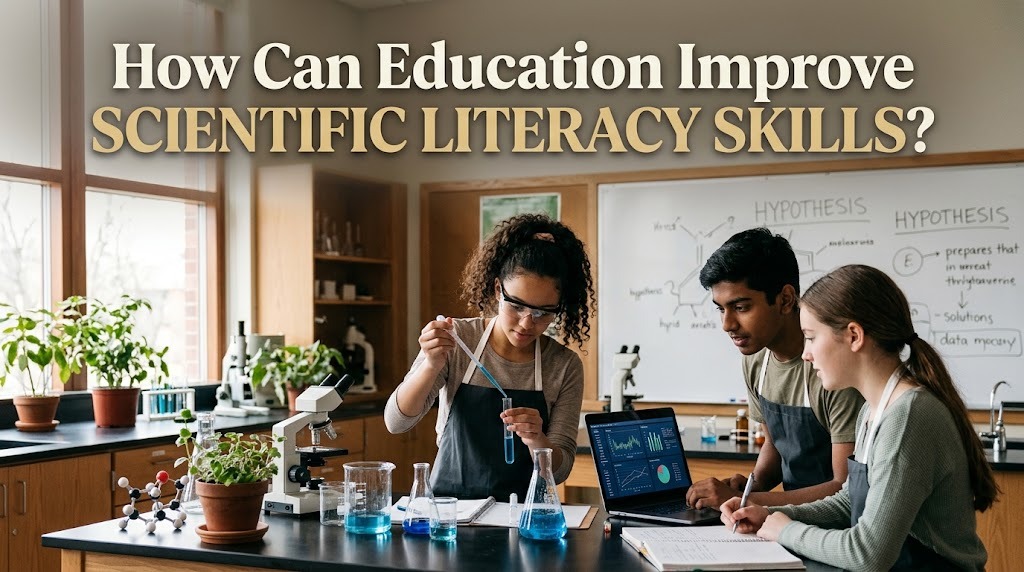
Practical activities can help students understand scientific concepts through direct experience. Students can conduct simple experiments, make observations, collect data, and discuss their findings. These activities allow them to see how evidence can be used to answer scientific questions. Practical learning can also make lessons more engaging because students actively participate in the learning process. It gives them opportunities to connect theoretical concepts with observable events.
Inquiry based learning is another useful approach for developing scientific literacy. Students can begin with a question, investigate possible explanations, and use evidence to develop conclusions. Teachers can guide the process without providing every answer immediately. This encourages students to develop curiosity, problem solving, and analytical skills. It also helps them understand that scientific knowledge is developed through systematic investigation.
DEVELOPING CRITICAL THINKING SKILLS
Scientific literacy requires students to think critically about information and evidence. Education can develop this ability by giving students opportunities to compare sources, identify evidence, analyze arguments, and evaluate conclusions. Teachers can present different claims about a scientific topic and ask students to determine which claims are better supported. This encourages students to examine information rather than accepting it automatically. Critical thinking can therefore become an important part of science learning.
Students should also learn how to recognize uncertainty in scientific information. Not every scientific question has a simple or permanent answer, especially when research is still developing. Teachers can explain that scientific conclusions may be updated when new and reliable evidence becomes available. Understanding this process helps students develop a more realistic view of science. It also encourages them to remain open to evidence while avoiding unsupported conclusions.
IMPROVING DIGITAL AND INFORMATION LITERACY
Students today encounter scientific information through websites, social media, videos, online articles, and other digital platforms. Education can help them develop digital literacy so they can evaluate the quality of information they find online. Students can learn to check the source, author, publication date, references, and evidence supporting a scientific claim. They can also compare information from several credible sources. These skills can help them avoid misinformation and make more informed judgments.
Teachers can include activities that require students to evaluate online scientific content. For example, students can examine whether a scientific claim is supported by reliable evidence or whether an online article uses information without proper context. Such activities can strengthen source evaluation and evidence based reasoning. Students can also learn to use academic databases, digital libraries, and reputable educational websites for research. This makes technology a useful part of scientific literacy education.
CONNECTING SCIENCE WITH REAL LIFE
Education can improve scientific literacy by connecting lessons with everyday situations. Topics such as health, nutrition, climate, energy, transportation, and technology can help students see how science affects their daily lives. When students understand the practical value of scientific knowledge, they may become more interested in learning science. Real life examples also give students opportunities to apply concepts rather than simply memorize them. This can make scientific learning more relevant and meaningful.
Schools can also use projects that encourage students to investigate problems in their communities. Students might study environmental conditions, examine energy use, or explore a local scientific issue. They can collect information, analyze findings, and present their conclusions to others. These projects combine research, observation, analysis, communication, and problem solving. As a result, students can practice scientific literacy in situations that resemble real world challenges.
CONCLUSION
Education can improve scientific literacy by providing students with opportunities to investigate questions, evaluate evidence, think critically, and apply scientific knowledge. Practical activities and inquiry based learning can make students active participants in the learning process. Education can also strengthen digital literacy, helping students evaluate online scientific information and recognize unreliable claims. Connecting science lessons with real life situations makes scientific knowledge more relevant and easier to apply. With consistent support from teachers and schools, students can develop scientific literacy skills that are valuable for learning, decision making, and everyday life.
Recent Posts

Bagaimana Sistem SKS pada Program Kuliah... 22.11.2026/33 View

How Does Technology Make Daily Evaluation... 21.11.2026/67 View

Apa Strategi Menghadapi Kesenjangan antara Kompetensi... 21.11.2026/67 View

Mengapa Inventaris Aset Penting bagi Kelancaran... 21.11.2026/65 View

When Should Musicians Join a Record... 21.11.2026/66 View
