

How Can Educational Games Develop Logical Intelligence in Children?
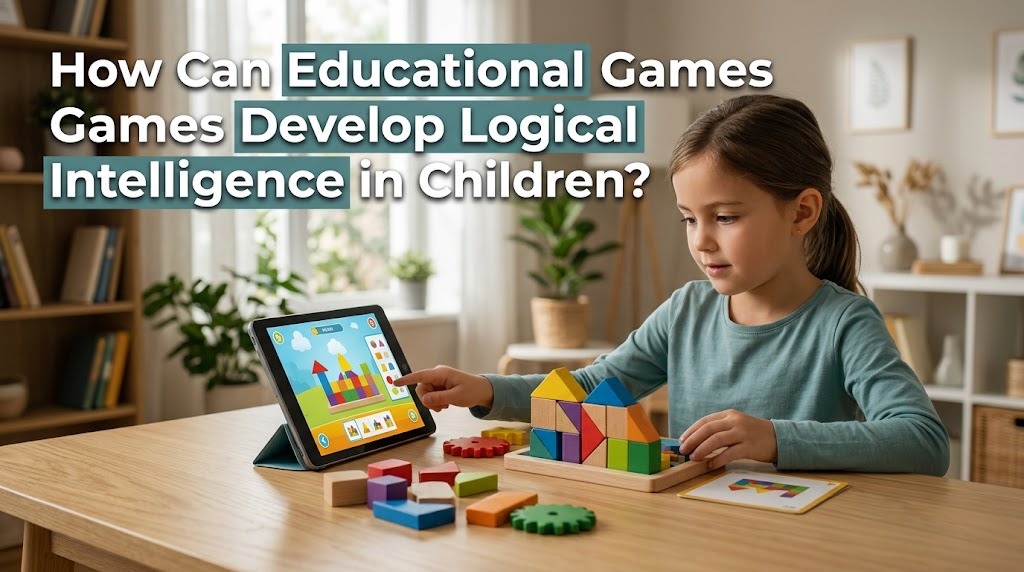
Children learn through many different activities, including playing, exploring, asking questions, and solving problems. Educational games can combine learning with enjoyable activities that encourage children to think and make decisions. When games require children to identify patterns, follow rules, or find solutions, they can provide opportunities to practice logical thinking. This makes educational games a useful complement to other learning activities. However, games work best when they are selected according to a child's age and learning needs.
UNDERSTANDING LOGICAL INTELLIGENCE IN CHILDREN
Logical intelligence is the ability to recognize patterns, understand relationships, analyze information, and use reasoning to solve problems. Children can demonstrate this ability when they sort objects, complete patterns, count items, or figure out how something works. Logical thinking develops gradually as children gain experience and interact with their environment. Educational activities can provide opportunities for children to practice these skills in an enjoyable way.
Logical intelligence is not limited to mathematical ability. Children can use logical reasoning when they organize objects by size, understand sequences, follow instructions, or predict what might happen next. Simple problem-solving activities can encourage children to think carefully before choosing an answer. Educational games can provide these experiences while allowing children to learn through exploration. This can make logical thinking feel like a natural part of play.
HOW EDUCATIONAL GAMES ENCOURAGE PROBLEM SOLVING
Many educational games require children to identify a problem and determine how to solve it. Puzzle games, matching activities, mazes, and strategy games can ask children to examine different possibilities before making a choice. Problem solving encourages children to use reasoning instead of relying only on guessing. When a solution does not work, children can try another approach and learn from the result.
Games can also teach children to break a problem into smaller steps. For example, a child completing a puzzle may first identify the edges, then group similar pieces, and finally connect the pieces together. This process encourages systematic thinking and planning. Children can gradually learn that difficult problems can often be managed by approaching them one step at a time.
DEVELOPING PATTERN RECOGNITION AND REASONING
Pattern recognition is an important part of logical thinking. Educational games can ask children to identify what comes next in a sequence, match similar objects, or recognize relationships between different shapes and numbers. Recognizing patterns helps children understand how different elements are connected. This ability can later support learning in areas such as mathematics, science, language, and technology.
Reasoning is also developed when children need to explain why a particular answer makes sense. For example, a sorting game may require children to group objects according to color, shape, or size. Children can learn to identify the rule being used and apply it consistently. This process encourages children to observe details and make connections between information.
BUILDING DECISION MAKING AND STRATEGY
Some educational games require children to make choices and consider possible consequences. Strategy games can encourage children to think about what might happen after they make a particular move. Considering possible outcomes helps children practice decision making and planning. They may learn that one choice can produce a different result from another choice.
Children can also learn to adjust their strategy when their first attempt does not succeed. This teaches them that making a mistake does not necessarily mean they should stop trying. Instead, they can examine what happened and consider another approach. Flexible thinking is an important part of problem solving because real-life situations do not always have one simple solution.
HOW PARENTS AND TEACHERS CAN SUPPORT LEARNING
Parents and teachers can make educational games more meaningful by encouraging children to explain their thinking. Instead of focusing only on whether an answer is correct, adults can ask questions such as why the child chose a particular solution. Open-ended questions can encourage children to explain their reasoning and consider alternative approaches. This can turn a simple game into a valuable learning activity.
It is also important to choose games that are appropriate for the child's age and abilities. Games that are too easy may provide limited challenges, while games that are too difficult can cause frustration. Adults can provide guidance when necessary while still allowing children to explore solutions independently. A balance between support and independence can help children develop confidence as they practice logical thinking.
CONCLUSION
Educational games can help children develop logical intelligence by providing opportunities to solve problems, recognize patterns, make decisions, and use reasoning. Games can make these activities engaging because children learn while actively participating. Different types of games can support different logical skills, from simple classification to more complex strategic thinking. The learning benefits depend on how the games are designed and how children interact with them.
Educational games should not replace other forms of learning and real-world interaction. Instead, they can become a useful complement to reading, discussion, hands-on activities, and guided learning. With age-appropriate games and supportive guidance from adults, children can gradually strengthen logical thinking skills that are useful for school and everyday life.
Recent Posts

Bagaimana Sistem SKS pada Program Kuliah... 22.11.2026/21 View

How Does Technology Make Daily Evaluation... 21.11.2026/63 View

Apa Strategi Menghadapi Kesenjangan antara Kompetensi... 21.11.2026/65 View

Mengapa Inventaris Aset Penting bagi Kelancaran... 21.11.2026/62 View

When Should Musicians Join a Record... 21.11.2026/59 View
