

How Can Employers Verify the Authenticity of an Academic Transcript?
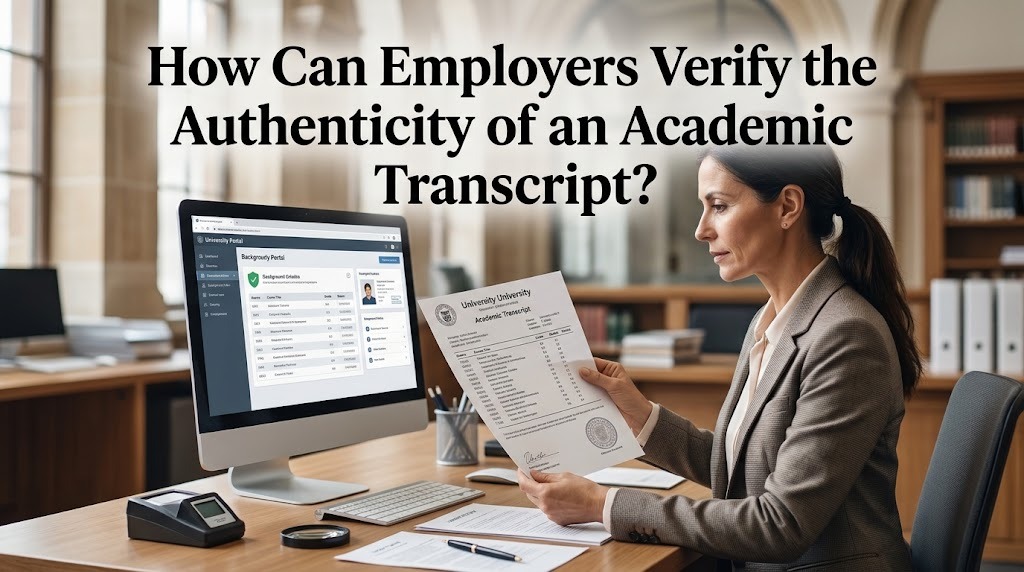
An academic transcript is an important document used by employers to evaluate a job applicant's educational background and academic achievements. During recruitment, companies may request transcripts to confirm the courses completed, grades obtained, and qualifications presented by candidates. However, employers must ensure that these documents are genuine and have been issued by legitimate educational institutions. Verifying transcript authenticity helps companies avoid inaccurate information, prevent document fraud, and make more reliable recruitment decisions.
UNDERSTANDING THE IMPORTANCE OF ACADEMIC TRANSCRIPT VERIFICATION
Academic transcript verification is the process of confirming whether an educational document is genuine and accurately represents a person's academic history. Employers use this process to ensure that applicants provide reliable information about their educational qualifications. It is particularly important when academic credentials are required for specific positions or professional responsibilities.
A genuine transcript provides information that can be checked against official university records. Without proper verification, employers may have difficulty distinguishing authentic documents from altered or fabricated ones. Therefore, document verification is an important part of background screening and helps companies maintain fair recruitment standards. It also protects organizations from making hiring decisions based on misleading academic information.
CHECKING THE OFFICIAL DETAILS ON AN ACADEMIC TRANSCRIPT
One of the simplest ways to begin verification is by examining the information printed on the academic transcript. Employers should check the student's full name, identification number, university name, study program, course list, grades, and graduation information. These details should be consistent with the applicant's other educational documents and recruitment information.
Employers should also examine official authentication features, such as institutional stamps, authorized signatures, document reference numbers, and security elements when available. For digital transcripts, they may check digital signatures or QR codes provided by the university. However, visual examination alone cannot guarantee that a document is genuine because some security features can be copied or manipulated. Additional verification through official university channels is therefore recommended.
CONTACTING THE UNIVERSITY THAT ISSUED THE TRANSCRIPT
Another reliable method is contacting the university or educational institution that issued the academic transcript. Employers can communicate with the academic administration office, registrar, or another department responsible for managing student records. Through this process, companies can request confirmation that the document was officially issued and belongs to the applicant.
Universities may verify information such as student identity, study program, graduation status, and academic records, subject to their privacy policies and applicable regulations. Employers should follow the institution's official verification procedure and obtain the applicant's consent when required. Using official university communication channels helps reduce the risk of receiving inaccurate information from unauthorized sources.
USING DIGITAL VERIFICATION SYSTEMS AND ONLINE RECORDS
Technology has made academic transcript verification more efficient through digital document systems. Some universities provide electronic transcripts with QR codes, digital signatures, verification numbers, or secure online links. These features allow authorized users to check whether a document was issued by the institution and whether its information remains valid.
Employers can use the university's official verification platform when such services are available. They should access the platform through the institution's legitimate website rather than relying on unfamiliar links provided without confirmation. Digital verification can reduce administrative delays and make the recruitment process more convenient. However, not every university offers the same technology, so employers may need to use alternative verification methods.
IDENTIFYING SIGNS OF FAKE OR ALTERED ACADEMIC TRANSCRIPTS
Employers should pay attention to unusual details that may indicate a transcript has been modified or falsified. Examples include inconsistent fonts, irregular formatting, incorrect university information, unclear signatures, and differences between the applicant's transcript and other academic documents. Unusual grading information or inconsistent graduation dates may also require further investigation.
However, these signs should not automatically be treated as proof of document fraud. Differences can sometimes result from document scanning, printing quality, administrative updates, or changes in university systems. Employers should conduct additional verification before reaching conclusions. If inconsistencies are discovered, they should give applicants an opportunity to provide clarification or additional supporting documents.
MAINTAINING FAIR AND SECURE ACADEMIC VERIFICATION PROCEDURES
Employers should establish clear procedures for verifying academic transcripts during recruitment. These procedures should explain which documents are required, how verification is conducted, and which departments are responsible for reviewing educational qualifications. Consistent standards help ensure that all applicants are evaluated fairly and that academic verification does not become an unnecessary obstacle.
Companies must also protect applicants' personal and educational information during the verification process. Academic transcripts contain sensitive personal details, so access should be limited to authorized personnel. Employers should collect only the information necessary for recruitment and follow applicable data protection regulations. By combining secure document handling, applicant consent, and reliable verification methods, organizations can maintain professional recruitment standards while respecting candidates' privacy.
CONCLUSION
Employers can verify the authenticity of academic transcripts through document examination, direct communication with universities, and digital verification systems. Checking personal information, academic results, institutional details, and official authentication features helps identify possible inconsistencies. However, suspicious documents should always be investigated through reliable sources before any conclusions are made. By implementing fair, secure, and consistent verification procedures, companies can make better recruitment decisions and reduce the risk of academic document fraud.
Recent Posts

Bagaimana Sistem SKS pada Program Kuliah... 22.11.2026/40 View

How Does Technology Make Daily Evaluation... 21.11.2026/71 View

Apa Strategi Menghadapi Kesenjangan antara Kompetensi... 21.11.2026/73 View

Mengapa Inventaris Aset Penting bagi Kelancaran... 21.11.2026/69 View

When Should Musicians Join a Record... 21.11.2026/73 View
