

How Can Games Help Improve Visual Intelligence in Children?
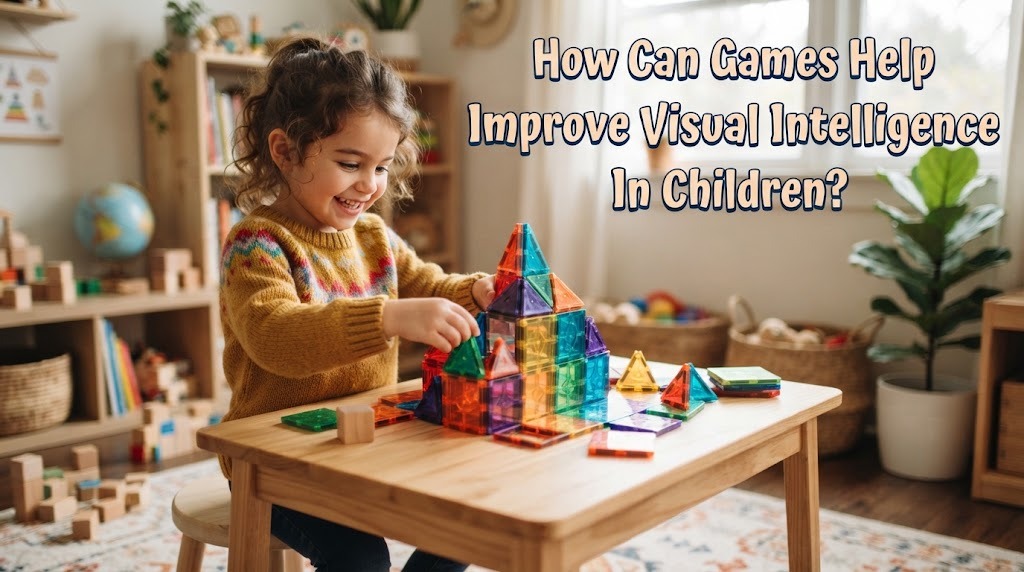
Visual intelligence is an important ability that helps children understand shapes, colors, patterns, images, and spatial relationships. Children use this ability when they recognize objects, build structures, follow directions, or understand pictures. Games can become a fun way to develop visual intelligence because children can practice these skills while playing.
Many games encourage children to observe details, remember visual information, identify patterns, and solve problems. These activities can make learning feel more enjoyable and less stressful. With suitable games and regular practice, children can gradually strengthen their visual thinking skills.
WHAT IS VISUAL INTELLIGENCE IN CHILDREN?
Visual intelligence is the ability to understand and process information through images and spatial relationships. Children with developing visual intelligence may become better at recognizing shapes, comparing objects, understanding directions, and imagining how things fit together. These abilities are useful in both learning and everyday activities.
Visual intelligence is not limited to drawing or artistic activities. It also involves observation, visual memory, spatial awareness, and mental visualization. Children can develop these abilities through many types of play, especially games that require them to look carefully and make connections between different objects.
HOW DO GAMES DEVELOP VISUAL THINKING?
Games can encourage children to think visually by presenting challenges through pictures, shapes, colors, and objects. Instead of only listening to instructions, children interact directly with visual information. This can help them understand relationships and recognize patterns more naturally.
For example, matching games require children to compare images, while sorting games encourage them to identify similarities and differences. Repeated visual activities can strengthen a child's ability to notice details and organize information. Over time, these skills can also support learning in subjects that use diagrams, charts, maps, and other visual materials.
PUZZLE GAMES FOR VISUAL INTELLIGENCE
Puzzle games are useful for developing visual intelligence because children need to examine shapes, positions, and relationships between pieces. Jigsaw puzzles are a simple example because children must identify which pieces fit together based on their images and shapes. This process encourages careful observation and spatial reasoning.
Block puzzles and shape puzzles can provide similar benefits. Children learn to recognize how different parts can form a complete object or picture. Puzzle activities can also encourage problem solving because children need to test different possibilities before finding the correct solution.
BUILDING GAMES AND SPATIAL AWARENESS
Building games can help children understand how objects relate to space. Playing with blocks, construction sets, or digital building games allows children to create structures using different shapes and sizes. They learn that changing the position of one object can affect the entire structure.
These activities can improve spatial awareness because children must think about height, width, distance, direction, and balance. Building games also encourage mental visualization, especially when children imagine what their structure will look like before they finish it. This skill can be useful later in areas such as mathematics, science, engineering, and design.
MEMORY AND MATCHING GAMES
Memory and matching games can help strengthen children's visual memory. In a typical memory game, children need to remember the location of pictures or symbols and find matching pairs. This requires them to pay attention to visual details and remember where information appears.
Matching games can also improve concentration. Children need to focus on shapes, colors, pictures, or patterns while comparing different options. Strong visual memory can help children remember information presented through images, which may support their learning in classrooms and everyday situations.
DRAWING AND CREATIVE VISUAL GAMES
Drawing games provide children with opportunities to express and organize what they see. They may draw objects, people, places, patterns, or imaginary scenes. During this process, children practice observing shapes, proportions, positions, and visual details.
Creative games can also encourage children to imagine new possibilities. For example, children can be asked to complete an unfinished picture or create a scene using several shapes. These activities combine visual intelligence with creativity, allowing children to practice both observation and imagination.
HOW PARENTS CAN USE GAMES FOR VISUAL LEARNING
Parents can introduce visual games according to a child's age and interests. Simple activities such as finding differences, matching pictures, building blocks, drawing, sorting objects, and completing puzzles can be used at home. The goal is not to make every activity feel like a lesson but to create opportunities for children to explore and think visually.
It is also important to let children play without excessive pressure to achieve a perfect result. Parents can ask questions such as, “Which shape fits here?” or “What do you think this picture will look like when it is finished?” Giving children time to observe, experiment, and solve problems independently can make visual games more meaningful.
CONCLUSION
Games can be an effective and enjoyable way to support visual intelligence in children. Puzzle games, building activities, memory games, matching games, and drawing activities can help develop visual memory, spatial awareness, observation, pattern recognition, and problem solving.
The most important part is choosing games that match the child's age and interests. With regular opportunities to play, observe, create, and solve visual challenges, children can gradually strengthen their visual thinking skills. Fun and consistent activities can make visual learning a natural part of childhood development.
Recent Posts

Bagaimana Sistem SKS pada Program Kuliah... 22.11.2026/21 View

How Does Technology Make Daily Evaluation... 21.11.2026/63 View

Apa Strategi Menghadapi Kesenjangan antara Kompetensi... 21.11.2026/65 View

Mengapa Inventaris Aset Penting bagi Kelancaran... 21.11.2026/62 View

When Should Musicians Join a Record... 21.11.2026/59 View
