

How Can Google Scholar Help You Find Relevant Research Articles?
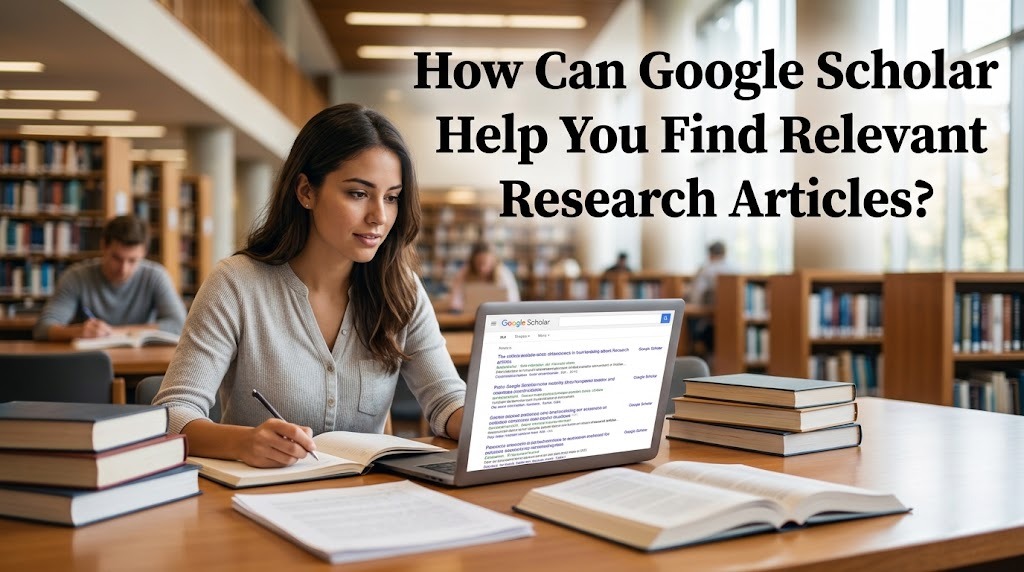
Finding relevant research articles is an important part of academic work. Students need appropriate references when writing essays, research papers, literature reviews, and theses. However, searching for academic information can be difficult when there are thousands of publications available online. Google Scholar can help simplify this process by providing a search platform focused on scholarly literature.
Using Google Scholar effectively requires more than simply entering a keyword and selecting the first result. Students need to understand how to create specific searches, evaluate results, and identify articles that truly support their research topics. With the right approach, Google Scholar can help students find relevant research articles more efficiently and improve the quality of their academic work.
USE SPECIFIC KEYWORDS FOR BETTER RESULTS
One of the easiest ways to find relevant research articles on Google Scholar is to use specific keywords. General keywords can produce a large number of results that may not directly relate to the research question. Students should identify the main concepts of their topic and combine several related terms when searching. For example, instead of searching only for "online learning," a student could search for online learning university students academic performance.
Students can also use quotation marks when they want to search for an exact phrase. This can make the results more focused because Google Scholar looks for publications containing the specific phrase. Choosing keywords carefully is especially important when the research topic is broad. A more precise search usually makes it easier to identify articles that are closely connected to the subject being studied.
USE FILTERS TO FIND RELEVANT ARTICLES
Google Scholar provides search options that can help students narrow down academic results. Users can limit results by publication date, which is useful when they need recent research. Recent sources can be particularly important for topics involving rapidly changing areas such as technology, artificial intelligence, or digital education. Students can also use custom date ranges when they need research published during a particular period.
Sorting and filtering search results can reduce the time required to examine unrelated publications. Students should first identify the requirements of their assignment or research before choosing a date range. For some topics, older studies may still be important because they contain foundational theories or influential findings. Therefore, students should balance recent research with significant earlier studies when appropriate.
EXAMINE ARTICLE TITLES AND ABSTRACTS
After conducting a search, students should carefully examine the article titles before opening every result. A title can provide an initial indication of whether a publication addresses the research topic. However, a similar title does not always mean that an article is suitable. Students should continue by reading the abstract to determine whether the research objectives, methods, and findings are relevant.
The abstract is particularly useful because it provides a short overview of the study. It can help students understand what the researchers investigated and what they discovered without immediately reading the entire article. If the abstract closely matches the research question, students can continue examining the full publication. This approach can save time while helping students prioritize potentially useful sources.
EXPLORE CITED BY AND RELATED ARTICLES
Google Scholar can help students discover additional research through its Cited by feature. This feature shows publications that have cited a particular article. Students can use these results to identify newer research that discusses, applies, or builds upon earlier findings. This is useful when students have already found one strong article and want to expand their collection of references.
The Related articles option can also help users discover research with similar subjects or themes. Exploring related publications can reveal different perspectives and approaches to the same research problem. Students should still evaluate each new source independently rather than assuming that all related articles are equally suitable. This process can gradually help students develop a stronger understanding of the existing academic literature.
CHECK SOURCE QUALITY AND RELEVANCE
Relevance is important, but it should always be considered together with source quality. Students should check the authors, publication, year, research methodology, evidence, and references before using an article in their academic work. They should also consider whether the research directly supports their argument or simply discusses a similar topic. A publication may be academically legitimate but still unsuitable for a particular research question.
Students should avoid selecting sources based only on citation counts or search-result rankings. A frequently cited article can be valuable, but its relevance and research quality still need to be examined. Students should read enough of the article to understand its arguments, evidence, limitations, and conclusions. Careful evaluation helps ensure that the references used in academic writing are both credible and appropriate.
ORGANIZE RESEARCH ARTICLES EFFECTIVELY
Finding relevant articles is more useful when students can organize the information they collect. Students can record important details such as the article title, author, publication year, research objective, methodology, and key findings. Keeping these details organized makes it easier to compare different studies later. It can also reduce the risk of forgetting where particular information came from.
Google Scholar also provides features that can support reference management, including the ability to save selected articles and obtain citation information in different formats. Students should still check automatically generated citations carefully because formatting can sometimes require corrections. Organizing references from the beginning can make the writing process more efficient. It also helps students maintain accurate attribution and avoid accidental citation errors.
CONCLUSION
Google Scholar can help students find relevant research articles by providing access to a broad range of academic publications in one searchable platform. Specific keywords, date filters, article abstracts, citation links, and related-article features can make academic searching more efficient. These tools allow students to move from a broad research topic toward sources that are more closely connected to their research questions.
However, effective academic research requires more than finding articles. Students must evaluate the relevance, credibility, methodology, publication details, and quality of evidence before using a source. By searching strategically and organizing the references they find, students can use Google Scholar as an effective tool for developing stronger academic research and writing.
Recent Posts

Bagaimana Sistem SKS pada Program Kuliah... 22.11.2026/38 View

How Does Technology Make Daily Evaluation... 21.11.2026/71 View

Apa Strategi Menghadapi Kesenjangan antara Kompetensi... 21.11.2026/73 View

Mengapa Inventaris Aset Penting bagi Kelancaran... 21.11.2026/69 View

When Should Musicians Join a Record... 21.11.2026/73 View
