

How Can Insect-Inspired Robots Monitor Fragile Ecosystems?
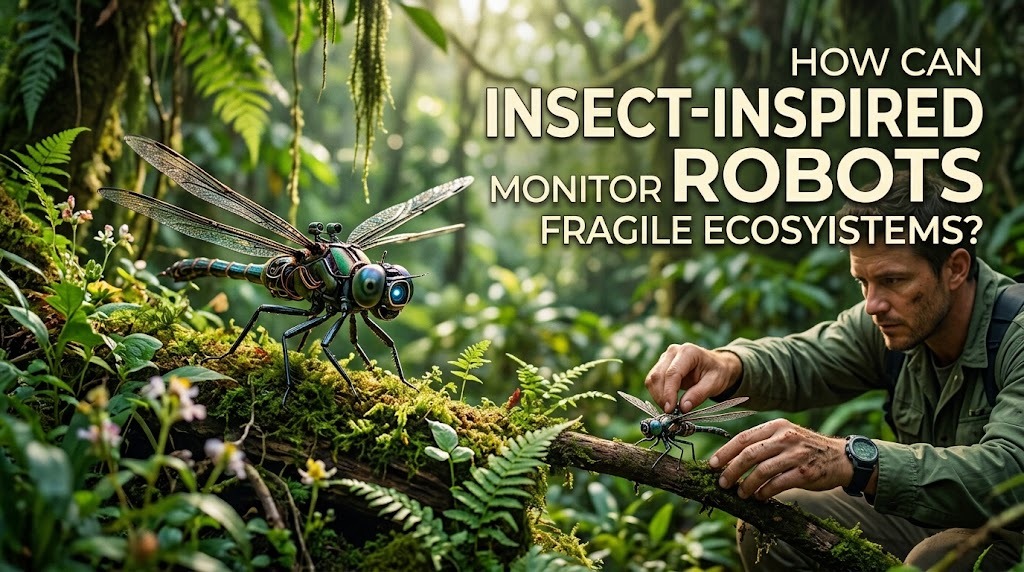
Fragile ecosystems, such as wetlands, coral reefs, forests, and grasslands, require careful monitoring to protect biodiversity and detect environmental changes. Traditional monitoring methods can disturb wildlife, damage sensitive habitats, or require considerable human effort. Insect-inspired robots offer an alternative by using small bodies, specialized movement, and lightweight sensors to collect environmental information with minimal disruption. These robots can help researchers observe ecosystems more frequently while reducing the need for direct human intervention.
WHAT ARE INSECT-INSPIRED ROBOTS?
Insect-inspired robots are robotic systems designed to imitate the movement, structure, or sensing abilities of insects. Some use six-legged walking mechanisms to travel across uneven terrain, while others use small wings to move through the air.
Their compact designs allow them to access narrow spaces that larger robots may not reach easily. Researchers can equip them with cameras, temperature sensors, humidity detectors, and other instruments to collect information about environmental conditions.
MONITORING ENVIRONMENTAL CONDITIONS
Environmental changes can indicate whether an ecosystem is becoming stressed. Insect-inspired robots can carry sensors that measure temperature, humidity, light intensity, and, where suitable instruments are installed, air quality or other environmental variables.
By collecting measurements at different locations, these robots can help researchers identify patterns that might be missed by stationary monitoring equipment. Repeated observations can reveal changes in microclimates, helping scientists understand how environmental conditions affect plants, insects, and other organisms.
OBSERVING WILDLIFE WITH MINIMAL DISTURBANCE
Small robots may approach certain observation areas with less physical disruption than larger monitoring equipment. Cameras and compact sensors can help researchers observe insect activity, nesting behavior, or the movement of small animals without requiring people to remain nearby.
However, small size does not automatically make a robot harmless. Motor noise, vibration, artificial lighting, and close approaches can disturb wildlife. Researchers should therefore test robot behavior, maintain suitable observation distances, and use quiet operating modes when monitoring sensitive species.
ACCESSING HARD-TO-REACH HABITATS
Fragile ecosystems often contain narrow gaps, dense vegetation, uneven ground, and confined spaces. Walking robots inspired by ants or beetles may navigate obstacles that are difficult for wheeled machines to cross.
Flying robots inspired by bees or dragonflies may access elevated vegetation or observe areas from above. Each design has limitations: flying robots can disturb wildlife or struggle in strong winds, while ground-based robots may become trapped in soft soil or dense vegetation. Choosing the right movement system is essential for safe and effective monitoring.
DETECTING POLLUTION AND HABITAT CHANGES
Insect-inspired robots can support pollution monitoring by carrying sensors that detect selected substances or changes in environmental conditions. Depending on the equipment, they may help identify unusual gas concentrations, changes in water-related measurements, or signs of contamination near vulnerable habitats.
Visual sensors can also document changes in vegetation, soil surfaces, and other habitat features. When combined with laboratory testing and established environmental monitoring methods, these observations can help researchers identify areas that require closer investigation.
COLLECTING DATA FOR ECOLOGICAL RESEARCH
Robots can collect observations across multiple locations and at different times. Researchers can combine these measurements with geographic information systems, remote sensing, and ecological databases to study environmental patterns.
Artificial intelligence may help classify images, recognize selected organisms, or identify unusual sensor readings. Nevertheless, automated classifications can contain errors, particularly when species look similar or lighting conditions change. Human verification and reliable calibration remain important for producing trustworthy ecological data.
REDUCING HABITAT DISTURBANCE
Conventional fieldwork may require researchers to walk through vegetation, install equipment, or repeatedly visit sensitive areas. Small robots can reduce some of these activities by collecting measurements remotely or accessing selected locations without requiring people to enter them as frequently.
To minimize environmental impact, robots should use lightweight materials, energy-efficient components, and routes that avoid vulnerable plants and animal habitats. Their batteries, lubricants, and other materials must also be managed carefully to prevent accidental contamination.
CHALLENGES AND RESPONSIBLE DEPLOYMENT
Insect-inspired robots face several technical challenges, including limited battery life, restricted payload capacity, unreliable wireless communication, and difficulty navigating natural terrain. Their small size also limits the sensors they can carry and the amount of data they can store.
Responsible deployment requires field testing, equipment maintenance, and clear procedures for recovering lost or damaged robots. Researchers should assess potential effects on wildlife before deployment and avoid introducing robots into sensitive areas without appropriate permissions. Data collection should also follow relevant conservation rules and research ethics requirements.
CONCLUSION
Insect-inspired robots can help monitor fragile ecosystems by measuring environmental conditions, observing wildlife, accessing difficult terrain, and collecting ecological data. Their small designs may reduce some forms of habitat disturbance, although careful operation is necessary to avoid harming sensitive species. When combined with established scientific methods, these robots can provide valuable information for ecosystem research, conservation planning, and environmental protection.
Recent Posts

Bagaimana Sistem SKS pada Program Kuliah... 22.11.2026/49 View

How Does Technology Make Daily Evaluation... 21.11.2026/77 View

Apa Strategi Menghadapi Kesenjangan antara Kompetensi... 21.11.2026/78 View

Mengapa Inventaris Aset Penting bagi Kelancaran... 21.11.2026/74 View

When Should Musicians Join a Record... 21.11.2026/79 View
