

How Can Logical Intelligence Be Developed from an Early Age?
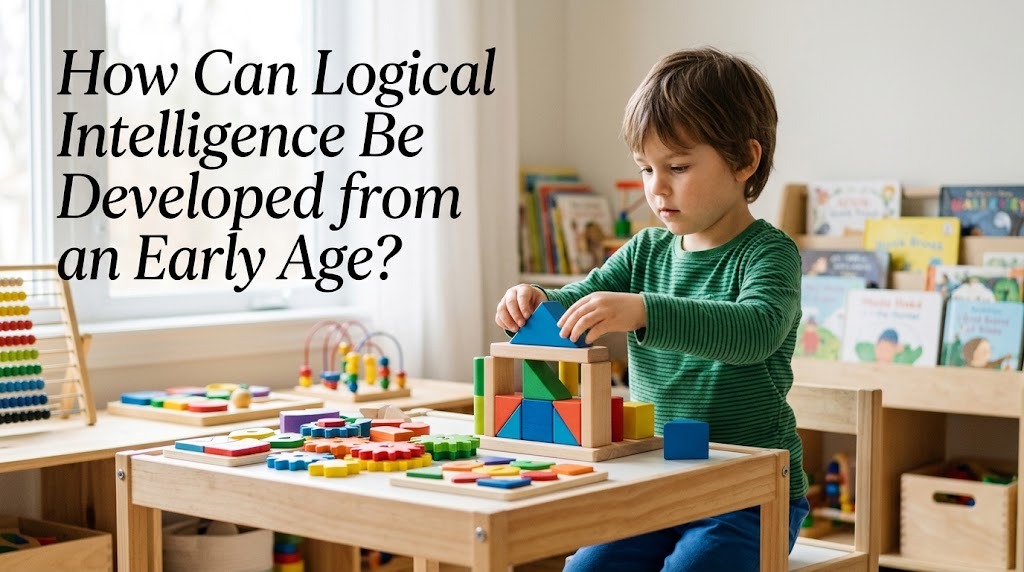
Logical intelligence is the ability to think clearly, recognize patterns, understand relationships, and solve problems using reasoning. Developing this ability from an early age can help children become more confident when facing new challenges. Logical thinking can be encouraged through simple activities at home, school, and in everyday life. With consistent practice, children can gradually build stronger reasoning and problem-solving skills.
UNDERSTANDING LOGICAL INTELLIGENCE FROM AN EARLY AGE
Logical intelligence involves the ability to understand information, identify patterns, compare objects, and determine relationships between different ideas. Children begin developing these abilities when they ask questions, explore their surroundings, and try to understand how things work. Simple activities such as sorting objects or completing patterns can introduce basic logical concepts. These experiences provide opportunities for children to practice reasoning naturally.
Developing logical intelligence does not mean forcing children to solve difficult academic problems. Instead, children need opportunities to explore, ask questions, make connections, and find solutions at a level appropriate for their age. Parents and teachers can encourage this process by allowing children to explain their thoughts. This can make learning more active and meaningful.
ENCOURAGING CHILDREN TO ASK QUESTIONS
Asking questions is an important part of developing logical thinking skills. When children ask why something happens or how something works, they are beginning to explore relationships between causes and effects. Adults can respond by providing explanations and asking simple follow-up questions. This encourages children to think about information instead of simply memorizing answers.
Children can also be encouraged to make predictions before discovering the result of an activity. For example, they can predict what might happen when objects are placed in water or when a particular action is performed. Afterward, they can compare their prediction with what actually happened. This process helps develop reasoning, observation, and cause-and-effect understanding.
USING GAMES AND PUZZLES
Games and puzzles can provide an enjoyable way to strengthen logical intelligence. Jigsaw puzzles, pattern games, matching activities, mazes, and strategy games can encourage children to observe details and search for possible solutions. These activities can also teach children that some problems require several attempts before they are solved. The experience can make problem solving feel like an interesting challenge rather than a difficult task.
Educational games can be adjusted according to a child's age and ability. Younger children may benefit from simple sorting and matching activities, while older children can try more complicated puzzles or strategy-based games. The important point is to provide an appropriate level of challenge. Activities that are too easy may provide little opportunity for reasoning, while activities that are too difficult may reduce motivation.
DEVELOPING LOGICAL THINKING THROUGH DAILY ACTIVITIES
Logical intelligence can also be developed through ordinary daily activities. Children can help organize objects according to size, color, shape, or function. They can also participate in activities such as following recipes, arranging schedules, counting items, or planning what needs to be done first. These experiences help children understand order, categories, sequences, and relationships.
Parents and teachers can turn daily situations into opportunities for reasoning without making them feel like formal lessons. For example, adults can ask children to explain why certain steps should happen before others. Children can also be encouraged to find different ways to complete the same task. This supports flexible thinking and independent problem solving.
PROVIDING HANDS ON LEARNING EXPERIENCES
Hands-on learning allows children to understand concepts by directly interacting with objects and situations. Building blocks, simple experiments, drawing patterns, measuring objects, and creating structures can encourage children to observe results and make adjustments. When something does not work as expected, children have an opportunity to think about what went wrong. This process can strengthen their ability to analyze problems.
Adults should give children enough freedom to experiment while still providing appropriate guidance. Instead of immediately giving the correct answer, they can ask questions that encourage children to think about possible solutions. This approach helps children become more comfortable with trial and error, observation, and logical reasoning. Over time, these experiences can support greater confidence when facing unfamiliar problems.
BUILDING A SUPPORTIVE LEARNING ENVIRONMENT
A supportive environment is important when developing logical intelligence from an early age. Children should feel comfortable making mistakes, asking questions, and trying different solutions without being discouraged. Mistakes can become useful learning opportunities when children are encouraged to understand what happened and how they can approach the problem differently. This helps develop a positive attitude toward challenging tasks.
Parents and teachers can also recognize the effort children put into reasoning rather than focusing only on whether the final answer is correct. Encouraging children to explain their thinking can reveal how they approach problems and where they may need additional support. With regular practice and positive guidance, children can gradually develop stronger analytical and problem-solving abilities.
CONCLUSION
Logical intelligence can be developed from an early age through activities that encourage children to ask questions, recognize patterns, solve problems, and understand relationships. Games, puzzles, hands-on activities, and everyday tasks can provide practical opportunities to strengthen logical thinking. A supportive environment also allows children to learn from mistakes and explore different solutions. Parents and teachers can help by providing suitable challenges and encouraging children to explain their reasoning. With consistent practice, these skills can become a valuable foundation for learning, decision making, and problem solving in the future.
Recent Posts

Bagaimana Sistem SKS pada Program Kuliah... 22.11.2026/12 View

How Does Technology Make Daily Evaluation... 21.11.2026/63 View

Apa Strategi Menghadapi Kesenjangan antara Kompetensi... 21.11.2026/64 View

Mengapa Inventaris Aset Penting bagi Kelancaran... 21.11.2026/61 View

When Should Musicians Join a Record... 21.11.2026/59 View
