

How Can Mind Mapping Help Improve Student Creativity?
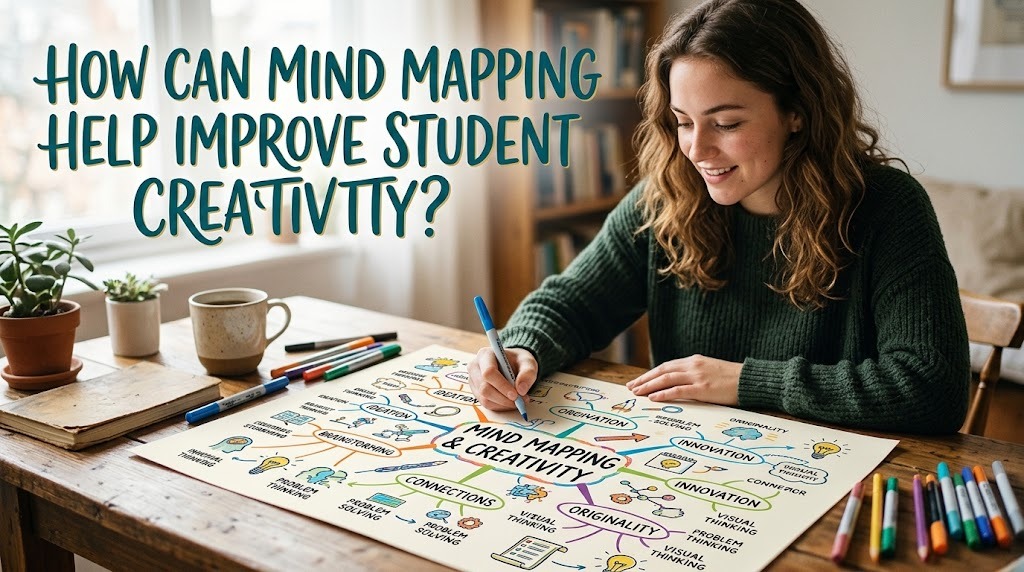
Creativity is an important skill that students can use when learning, solving problems, and completing assignments. However, students may sometimes find it difficult to develop ideas when information is presented in a rigid or linear format. Mind mapping provides a visual way to arrange thoughts and explore connections between different concepts. Students can freely add branches, keywords, symbols, and ideas as they develop their understanding. This makes mind mapping a useful learning strategy for encouraging creative thinking.
WHAT IS THE CONNECTION BETWEEN MIND MAPPING AND CREATIVITY?
Mind mapping and creativity are connected because both involve generating, organizing, and connecting ideas. Instead of writing information from top to bottom, students can place a main idea in the center and develop several branches from it. Each branch can lead to another idea, example, question, or possibility. This flexible structure gives students more freedom to explore different directions. It can also help students see relationships between ideas that may not be obvious at first.
When students create a mind map, they do not have to follow one fixed sequence. They can add new branches whenever they discover additional information or think of another possibility. This flexibility can support divergent thinking, which involves considering multiple ideas or approaches. For example, one central topic can develop into several possible solutions to a problem. Students can then examine and organize those ideas before deciding which ones are most useful.
HOW DOES MIND MAPPING HELP STUDENTS GENERATE NEW IDEAS?
Mind mapping can help students generate new ideas by giving them a visual starting point. Once the main topic is written in the center, students can ask themselves questions about related concepts. Each answer can become a new branch that leads to additional ideas. This process can continue until students have explored several possible directions.
For example, a student creating an assignment about entrepreneurship can start with the word Business Ideas. Branches could include products, customers, marketing, technology, costs, and business opportunities. Each branch can then produce more specific ideas. Seeing all these possibilities on one page can help students develop their thoughts without becoming limited to their first idea.
HOW CAN MIND MAPPING ENCOURAGE FLEXIBLE THINKING?
Flexible thinking means being able to consider different perspectives, approaches, or solutions. Mind mapping can encourage this skill because students can easily add, remove, or rearrange branches as their ideas develop. They are not required to follow a single order when organizing their thoughts. This allows them to explore a topic from different angles.
For example, when solving a problem, students can create separate branches for possible causes, solutions, advantages, disadvantages, and examples. They can then compare these branches and identify relationships between them. This process encourages students to look beyond the first solution that comes to mind. As a result, mind mapping can support more open and flexible approaches to problem solving.
HOW DO VISUAL ELEMENTS SUPPORT CREATIVE THINKING?
Visual elements such as colors, symbols, icons, and simple drawings can make a mind map more engaging. Students can use different visual elements to represent different categories or types of information. For example, a symbol can represent an important idea, while another can indicate a question or example. These elements can provide additional visual cues when students review their ideas.
However, creativity in mind mapping does not depend on artistic ability. A simple mind map can still be creative if it clearly represents the student's ideas and connections. The main purpose of visual elements is to support thinking and organization, not decoration. Students should therefore focus on creating a map that is meaningful, readable, and useful for their learning.
HOW CAN MIND MAPPING SUPPORT CREATIVE ASSIGNMENTS?
Mind mapping can be particularly useful when students need to complete assignments that require ideas, planning, and problem solving. Before writing an essay, creating a presentation, or developing a project, students can use a mind map to collect possible ideas. The central topic can represent the assignment, while branches can contain arguments, examples, supporting information, and possible conclusions. This provides a basic structure before students begin producing the final work.
Mind maps can also help students avoid depending on only one idea. By creating several branches first, they can compare different possibilities and choose information that best fits the assignment. Students can then rearrange the branches into a logical order when preparing the final work. This can make the creative process more organized without limiting the student's original ideas.
CONCLUSION
Mind mapping can help improve student creativity by providing a flexible structure for generating, connecting, and organizing ideas. Students can explore multiple possibilities instead of following only one linear path. Branches, keywords, and visual elements can help them discover relationships between different concepts. The method can also support creative assignments, brainstorming, and problem solving by giving students a clear place to develop their thoughts. When used effectively, mind mapping can become a useful tool for creative thinking and organized learning.
Recent Posts

Bagaimana Sistem SKS pada Program Kuliah... 22.11.2026/27 View

How Does Technology Make Daily Evaluation... 21.11.2026/65 View

Apa Strategi Menghadapi Kesenjangan antara Kompetensi... 21.11.2026/65 View

Mengapa Inventaris Aset Penting bagi Kelancaran... 21.11.2026/62 View

When Should Musicians Join a Record... 21.11.2026/63 View
