

How Can Numeracy Literacy Be Developed From an Early Age?
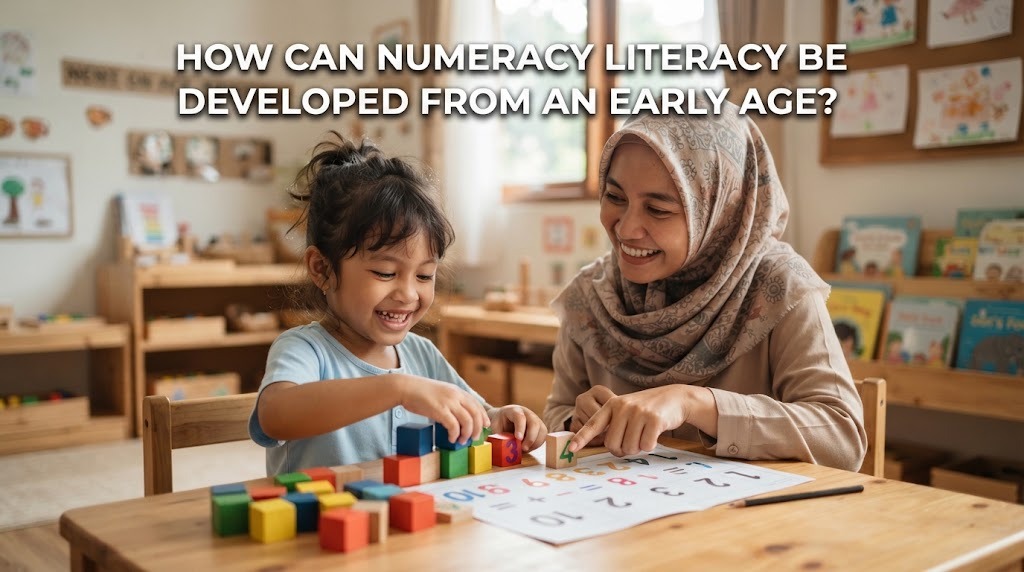
Numeracy literacy is an important skill that helps children understand numbers, recognize patterns, and use mathematical ideas in everyday situations. It is not limited to counting or solving calculations but also includes comparing quantities, measuring objects, understanding time, and making simple decisions. Developing numeracy literacy from an early age can help children build confidence and prepare for future learning.
Early childhood is a valuable period for introducing mathematical concepts through enjoyable and practical activities. Parents and teachers can support this development by using toys, games, stories, and daily routines. Children do not need complicated lessons to begin learning numeracy. Simple experiences, repeated regularly, can create a strong foundation for future mathematical understanding.
INTRODUCE NUMBERS THROUGH DAILY ACTIVITIES
Children can begin learning numeracy through simple activities at home and school. Parents can invite them to count toys, books, steps, or pieces of fruit. These activities help children connect number symbols with real quantities. Repeating counting in different situations also helps them recognize numbers more naturally.
Daily routines provide many opportunities to practice mathematical thinking. For example, children can count how many plates are needed for dinner or compare the number of objects in two groups. Adults should encourage children to explain what they notice rather than simply giving the answer. This approach makes numeracy learning practical, familiar, and enjoyable.
USE PLAY-BASED LEARNING METHODS
Play is one of the most effective ways for young children to explore mathematical ideas. Building blocks, puzzles, number cards, and sorting games can introduce counting, shapes, patterns, and comparison. Through play, children learn without feeling that they are taking a formal test. They can also repeat activities until they become more confident.
Parents and teachers should choose games that match a child's age and development. For example, younger children can sort objects by color or size, while older children can play simple board games involving counting and addition. Adults can ask questions such as which tower is taller or how many pieces are needed to complete a pattern. These interactions encourage children to think, observe, and solve problems.
CONNECT MATHEMATICS WITH REAL-LIFE EXPERIENCES
Children understand mathematical concepts more easily when they can see how numbers are used in real life. Shopping, cooking, gardening, and organizing toys can become useful learning opportunities. For example, children can help count vegetables, compare prices with adult guidance, or measure ingredients during cooking. These activities show that mathematics is part of everyday life.
Real-life experiences also help children develop practical reasoning. They can learn about time by following a daily schedule or understand measurement by comparing the length of household objects. Adults should explain mathematical ideas using simple language and familiar examples. This makes learning more meaningful and helps children remember what they have discovered.
DEVELOP NUMBER SENSE THROUGH SIMPLE GAMES
Number sense refers to the ability to understand numbers and their relationships. Children develop it by recognizing quantities, comparing numbers, and understanding that numbers can be combined or separated. Games involving dice, cards, or small objects can support these abilities. For instance, children can roll a die and collect the same number of blocks.
As children become more familiar with quantities, adults can introduce simple addition and subtraction through objects. They might ask what happens when two more toys are added to a group of three. Children can count the objects to find the answer rather than relying only on memorization. This helps them understand the meaning behind mathematical operations.
ENCOURAGE PATTERN AND SHAPE RECOGNITION
Recognizing patterns and shapes is another important part of early numeracy literacy. Children can explore patterns through colored beads, building blocks, clothing designs, or natural objects. They may create a sequence such as red, blue, red, blue, and predict what comes next. Such activities strengthen observation and logical thinking.
Shape recognition can be developed by identifying circles, squares, triangles, and rectangles in the surrounding environment. Children can compare shapes based on their sides, corners, and sizes. Parents and teachers can encourage them to build pictures using different shapes. These experiences prepare children for more advanced mathematical concepts, including geometry and spatial reasoning.
READ MATHEMATICAL STORIES AND PICTURE BOOKS
Stories and picture books can introduce numeracy in a friendly and engaging way. Books that include counting, shapes, comparisons, or simple number problems help children connect language with mathematics. Parents can read together and ask children to count objects shown in the pictures. This supports both early literacy and numeracy development.
Adults can also create simple stories involving numbers. For example, a story about three birds meeting two more birds can introduce basic addition. Children can use drawings or toys to show what happens in the story. Combining storytelling with hands-on activities makes mathematical ideas easier to understand and remember.
USE DIGITAL LEARNING TOOLS WISELY
Digital learning tools can provide additional opportunities for children to practice numeracy. Age-appropriate educational games, interactive videos, and counting applications may help introduce numbers and patterns. These resources can make learning visually engaging and provide immediate responses to simple activities. However, digital learning should be balanced with physical play and direct interaction.
Parents and teachers should select content that is suitable for the child's age and learning needs. They should also participate when possible by discussing what the child sees and does. Screens should not replace conversations, movement, or hands-on exploration. Used thoughtfully, technology can complement other numeracy activities.
CREATE A POSITIVE LEARNING ENVIRONMENT
A supportive learning environment helps children feel comfortable exploring mathematical ideas. Adults should encourage curiosity and treat mistakes as normal parts of learning. Children may need several attempts before understanding a concept, so patience is important. Praise should focus on effort, strategies, and progress rather than only correct answers.
Children should also have opportunities to ask questions and try different ways to solve problems. Comparing their progress with other children can create unnecessary pressure. Instead, parents and teachers can set small goals based on each child's development. A positive attitude toward mathematics can help children build confidence and remain interested in learning.
WORK TOGETHER WITH PARENTS AND TEACHERS
Parents and teachers play complementary roles in developing early numeracy literacy. Parents can provide everyday experiences at home, while teachers introduce structured activities and observe children's learning progress. Sharing information about a child's interests and difficulties can help both sides provide consistent support. This cooperation makes learning more connected between home and school.
Teachers can also suggest simple activities that families can practice without expensive materials. Parents can share observations about how children use numbers during daily routines. Regular communication helps adults adjust activities according to children's needs. With consistent guidance, children can develop mathematical understanding gradually and confidently.
CONCLUSION
Numeracy literacy can be developed from an early age through counting, play-based learning, real-life experiences, stories, and simple mathematical games. Children can strengthen number sense, pattern recognition, and problem-solving skills when learning activities are enjoyable and connected to their surroundings. Digital tools may also support learning when used appropriately and in balance with direct experiences.
The most important factors are consistency, patience, and a positive learning environment. Parents and teachers should encourage curiosity, allow children to explore, and recognize progress at every stage. By building these habits early, children can develop confidence in mathematics and gain useful skills for school and everyday life.
Recent Posts

Bagaimana Sistem SKS pada Program Kuliah... 22.11.2026/31 View

How Does Technology Make Daily Evaluation... 21.11.2026/67 View

Apa Strategi Menghadapi Kesenjangan antara Kompetensi... 21.11.2026/66 View

Mengapa Inventaris Aset Penting bagi Kelancaran... 21.11.2026/64 View

When Should Musicians Join a Record... 21.11.2026/65 View
