

How Can Parents Support the Development of Numeracy Literacy in Children?
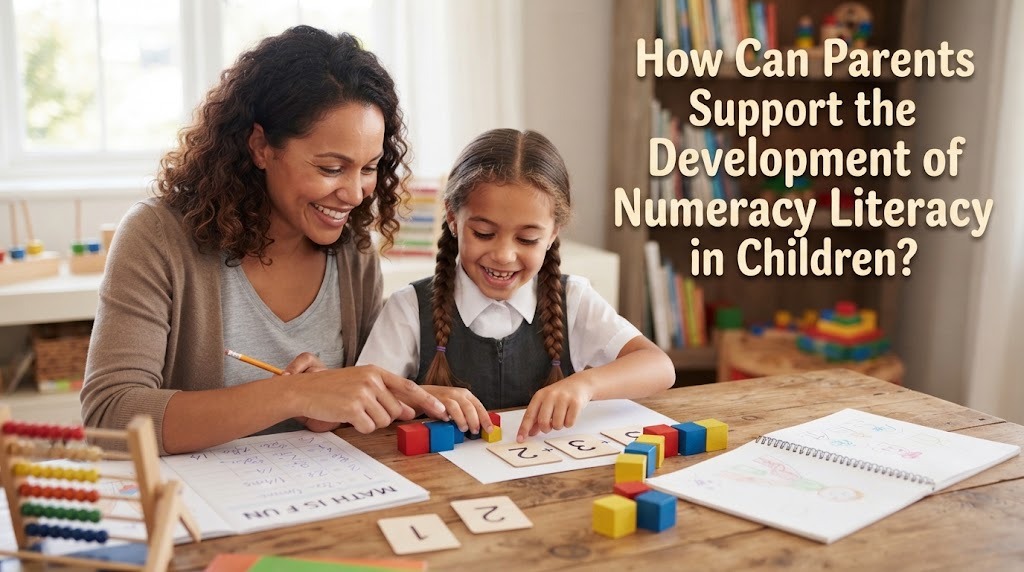
Numeracy literacy is an important ability that helps children understand and use numbers in everyday situations. It involves more than learning how to count or perform mathematical calculations because children also need to understand numerical information and apply it to real-life problems. Parents have an important role in supporting this development because children encounter numbers not only at school but also at home and in their daily activities. Simple experiences such as counting objects, comparing prices, measuring ingredients, or organizing time can become opportunities to practice numeracy literacy. With consistent support and enjoyable activities, parents can help children develop confidence and a positive attitude toward mathematics from an early age.
UNDERSTANDING THE IMPORTANCE OF NUMERACY LITERACY FOR CHILDREN
Numeracy literacy helps children understand how numbers and mathematical ideas are connected to everyday life. Children use numerical skills when they count objects, recognize quantities, compare sizes, read time, measure things, and solve simple problems. As they grow, they encounter more complex situations involving money, percentages, graphs, measurements, and data. Developing numeracy literacy early can make it easier for children to understand these situations as they become more independent. It also helps them approach problems using logical thinking rather than simply memorizing mathematical procedures.
Numeracy literacy is closely connected to other learning abilities. Children who regularly work with numbers can develop skills such as reasoning, recognizing patterns, estimating, and analyzing information. These abilities can also support learning in science, technology, economics, and other subjects that involve numerical information. Numeracy literacy may also help children become more confident when explaining how they reach an answer. For this reason, parents should view numerical learning as part of overall child development rather than something that belongs only to mathematics lessons.
Parents also need to understand that every child develops mathematical abilities at a different pace. Some children may quickly understand calculations, while others may need more time and practical examples. Comparing a child's progress with siblings, classmates, or other children may create unnecessary pressure. Instead, parents can focus on the child's individual progress and provide encouragement when difficulties appear. A supportive environment can make children more willing to ask questions, make mistakes, and continue learning.
USE EVERYDAY ACTIVITIES TO PRACTICE NUMERACY
One of the simplest ways parents can support numeracy literacy is by connecting mathematics with everyday activities. At home, children can practice counting toys, sorting objects, comparing quantities, or helping organize household items. Parents can ask questions such as how many objects there are, which group has more, or how many items are needed to reach a certain number. These simple questions encourage children to think about quantities rather than simply repeat numbers. Because the activities are connected to familiar situations, children may find numerical concepts easier to understand.
Cooking can also become an enjoyable opportunity to introduce measurement and basic calculations. Parents can involve children when measuring ingredients, dividing portions, or adjusting a recipe. For example, children can observe what happens when a recipe designed for two people needs to be prepared for four people. Older children can calculate quantities or compare measurements using different units. Through these activities, children can see that mathematics has a practical purpose outside the classroom.
Shopping provides another useful learning opportunity. Parents can allow children to help compare prices, count items, estimate the total cost, or check change after a purchase. Older children can learn about discounts, unit prices, and simple budgeting through supervised shopping activities. Parents can explain why one product may appear cheaper but actually cost more when the quantity is considered. These experiences help children understand that numbers can be used to support real decisions.
ENCOURAGE CHILDREN TO ASK QUESTIONS AND EXPLAIN THEIR THINKING
Parents can support numeracy development by encouraging children to explain how they solve a problem. Instead of immediately giving the correct answer, parents can ask children what they think and why they reached that conclusion. This approach allows children to practice reasoning and recognize the steps involved in solving a problem. Even when an answer is incorrect, the explanation can help parents understand which part of the concept the child finds difficult. The goal is not only to obtain the correct answer but also to develop the ability to think logically.
Open-ended questions can make numerical conversations more meaningful. Parents can ask children to estimate how many objects are in a container, predict which group has more items, or explain why one option costs less than another. These questions encourage children to observe information and make connections. Parents can then discuss the answer together rather than turning the activity into a test. This creates a more relaxed learning environment and allows children to build confidence gradually.
Mistakes should also be treated as a natural part of learning. Children may sometimes make incorrect calculations or misunderstand a numerical concept. Parents can help them review the process and identify where the mistake occurred without using negative or discouraging language. When children feel safe making mistakes, they may become more willing to try unfamiliar problems. Over time, this attitude can support persistence and improve their ability to solve problems independently.
MAKE NUMERACY LEARNING FUN AND ENGAGING
Children are generally more motivated to learn when activities are enjoyable and connected to their interests. Parents can introduce numeracy through board games, puzzles, building activities, card games, or simple challenges involving numbers. Games can help children practice counting, addition, subtraction, patterns, probability, and logical reasoning without feeling like they are completing a formal lesson. The type of activity should be adjusted to the child's age and ability. When children enjoy the process, they may be more willing to practice repeatedly.
Stories can also be used to introduce numerical ideas. Parents can create simple situations involving characters who need to share objects, organize items, calculate distances, or manage a certain amount of money. Children can then be asked to help solve the problem in the story. This approach combines language development with mathematical reasoning. It can be particularly useful for children who find traditional numerical exercises less engaging.
Technology can provide additional opportunities for practice when used appropriately. Educational applications and interactive games can introduce calculations, patterns, measurements, and problem-solving through visual activities. Parents should still guide children when using digital resources and choose content that matches their age and learning needs. Digital activities can complement direct interaction but should not completely replace conversations and practical experiences. Combining technology with real-world activities can provide a broader learning experience.
CREATE A POSITIVE HOME ENVIRONMENT FOR MATHEMATICAL LEARNING
A positive attitude from parents can strongly influence how children view mathematics. If parents frequently describe mathematics as difficult or frightening, children may develop similar feelings before they fully understand the subject. Instead, parents can present mathematical activities as opportunities to explore, discover patterns, and solve interesting problems. Encouraging effort and progress can be more helpful than focusing only on perfect answers. Children need to understand that mathematical ability can develop through practice and experience.
Parents can also create a simple routine for numerical activities at home. This does not mean children need long study sessions every day. Short activities incorporated into normal routines can provide regular practice without making children feel overwhelmed. For example, parents can discuss time while preparing for school, calculate quantities during cooking, or talk about prices while shopping. Consistency is more important than making every activity feel like a formal lesson.
The home environment should also provide opportunities for children to use mathematical language. Words such as more, less, equal, larger, smaller, longer, shorter, earlier, later, and approximately can help children describe numerical relationships. As children grow, parents can introduce concepts such as percentage, average, ratio, and probability through appropriate examples. Regular conversations help children become familiar with mathematical ideas and recognize them in different situations. This can gradually strengthen their ability to interpret numerical information.
WORK WITH SCHOOLS AND MONITOR CHILDREN'S PROGRESS
Parents and schools can work together to support children's numeracy development. Teachers can provide information about the mathematical concepts children are learning and areas where additional practice may be helpful. Parents can then reinforce these concepts at home through simple activities that are consistent with classroom learning. Communication between parents and teachers can also help identify difficulties before they become more challenging. When home and school provide complementary support, children can receive more consistent learning experiences.
Parents should monitor progress without turning every activity into an examination. Paying attention to how children approach problems can provide useful information about their understanding. A child may know how to perform a calculation but have difficulty explaining what the answer means in a real situation. Another child may understand the concept but need more practice to calculate accurately. Understanding these differences allows parents to provide more appropriate support.
If a child consistently struggles with certain concepts, parents can discuss the situation with teachers and consider additional learning support when appropriate. The focus should be on identifying the source of the difficulty rather than simply increasing the amount of homework. Some children may benefit from visual examples, practical activities, repeated explanations, or different ways of presenting the same concept. With patience and appropriate support, children can gradually build stronger numeracy skills. The most important part is maintaining encouragement while helping children develop independence in solving problems.
CONCLUSION
Parents can support the development of numeracy literacy in children by making mathematics a natural part of everyday life. Counting objects, cooking, shopping, managing time, playing games, and discussing numerical information can provide meaningful opportunities for children to practice. These activities help children understand that mathematics is not limited to textbooks or classroom exercises. Parents can also encourage children to explain their thinking, ask questions, learn from mistakes, and solve problems independently. A supportive approach can help children develop both numerical skills and confidence.
The development of numeracy literacy is a gradual process that requires practice, patience, and positive support. Parents do not need to become mathematics teachers to help their children because simple interactions at home can have meaningful learning value. Working together with teachers can also help parents understand children's progress and provide support that matches their needs. By creating an environment where numbers are explored rather than feared, parents can help children develop a stronger foundation for future learning and everyday decision-making. Good numeracy literacy can ultimately help children become more confident when dealing with numbers, information, and practical problems throughout their lives.
Recent Posts

Bagaimana Sistem SKS pada Program Kuliah... 22.11.2026/33 View

How Does Technology Make Daily Evaluation... 21.11.2026/67 View

Apa Strategi Menghadapi Kesenjangan antara Kompetensi... 21.11.2026/67 View

Mengapa Inventaris Aset Penting bagi Kelancaran... 21.11.2026/65 View

When Should Musicians Join a Record... 21.11.2026/66 View
