

How Can People With Bodily Kinesthetic Intelligence Learn More Effectively?
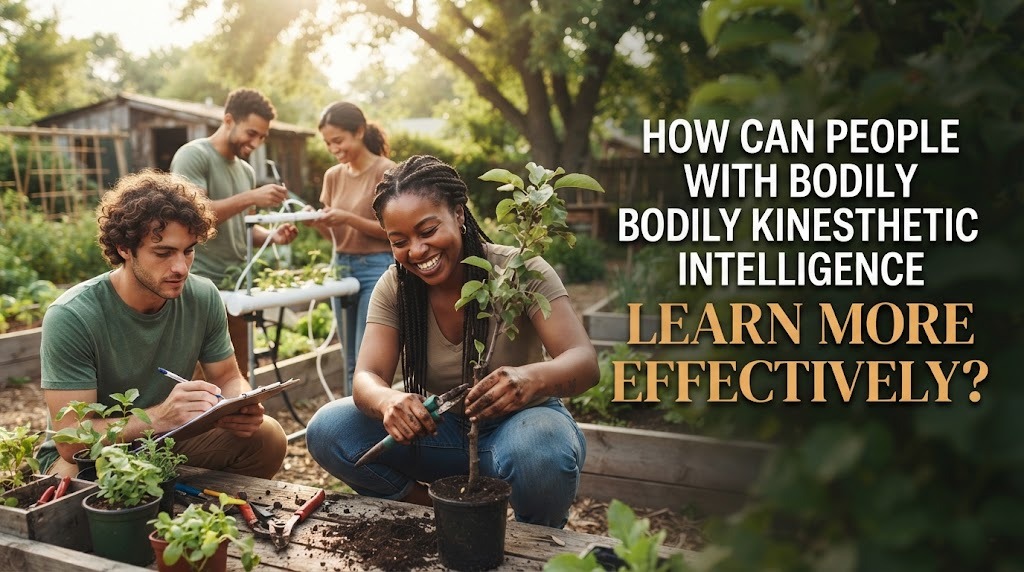
Bodily kinesthetic intelligence is the ability to use the body effectively when learning, creating, expressing ideas, and solving practical problems. People with this strength may understand certain information more easily when they can move, practice, touch, build, or directly experience something. However, this does not mean they cannot learn through reading, listening, or other methods. Learning can become more effective when physical activities are combined with suitable strategies. By understanding how they learn best, people can make study sessions more active, practical, and meaningful.
USE HANDS ON LEARNING METHODS
One effective strategy is to use hands-on learning whenever possible. Instead of only reading instructions, learners can practice the skill directly after understanding the basic explanation. For example, someone learning a technical skill can follow a demonstration and then perform the procedure themselves. Students can also use models, objects, experiments, or practical projects to explore concepts. This approach allows them to connect information with physical experience.
Hands-on activities can also make learning more memorable because learners are actively involved. When a mistake occurs, they can observe what happened and make adjustments. This process can develop practical problem-solving and deeper understanding. The activity should still have a clear learning objective so that movement supports learning rather than becoming a distraction.
COMBINE MOVEMENT WITH STUDY
Adding appropriate movement to study sessions can help make learning more active. Learners can walk while reviewing information, use gestures to remember concepts, or act out processes that they are studying. They can also use role-playing and physical demonstrations to understand subjects that involve actions or sequences. These strategies can provide additional ways to interact with information. However, the amount of movement should match the task and personal preference.
Movement can be especially useful during longer study sessions. Taking short activity breaks can provide an opportunity to stretch, walk, or perform simple exercises before returning to focused study. These breaks should be purposeful rather than excessive. A balanced routine can combine focused study, physical activity, and rest.
PRACTICE SKILLS REPEATEDLY
People with bodily kinesthetic strengths can benefit from repeated practice because physical skills often improve through repetition. When learning a new movement or procedure, they can perform it several times while paying attention to accuracy. Each repetition provides an opportunity to identify mistakes and make small improvements. This can gradually increase coordination, confidence, and control. Practice should be consistent rather than unnecessarily long.
Learners should also increase the difficulty gradually. Starting with simple steps can help them understand the basic movement before moving to more complex tasks. This creates a clear progression from basic practice to advanced performance. Recording progress can also help learners recognize improvements and identify areas that still need attention.
LEARN THROUGH DEMONSTRATIONS
Watching someone demonstrate a skill can be helpful before attempting it independently. A demonstration allows learners to observe movement, timing, sequence, and technique. After watching, they can immediately practice the same skill and compare their performance with the example. This method can be useful for activities such as laboratory procedures, sports techniques, crafts, cooking, and technical tasks. It can also reduce confusion when written instructions are difficult to visualize.
Learners should not rely only on watching demonstrations. The important step is to move from observation to active practice. They can pause during a demonstration, ask questions, repeat specific steps, and receive feedback. This combination can make the learning process clearer and more practical.
USE REAL WORLD PROJECTS
Real-world projects can make learning more meaningful for people who prefer practical experiences. Instead of only studying theoretical information, learners can create something, solve a realistic problem, or complete a useful task. For example, students can build a simple model, organize an event project, grow plants, prepare a presentation with physical materials, or conduct a safe experiment. These activities connect knowledge with real applications.
Projects also require planning and decision-making. Learners may need to choose materials, organize steps, manage time, and adjust their approach when difficulties appear. This develops problem-solving, creativity, and independence. Projects can therefore combine physical learning with important thinking skills.
USE MULTIPLE SENSES
Learning can become richer when learners use more than one sense. They can see, touch, hear, and physically interact with materials while studying. For example, a science learner can observe an object, handle suitable materials, and perform an experiment while listening to an explanation. Using several forms of input can provide more connections to the information. This approach can be particularly useful for practical subjects.
However, using multiple senses does not guarantee better learning in every situation. Learners should choose methods that genuinely help them understand the material. Combining physical experience with reading, visual information, discussion, and reflection can provide a balanced approach. The goal is to support understanding rather than simply adding more activities.
TAKE NOTES THROUGH ACTIVE METHODS
Traditional note-taking is useful, but people with bodily kinesthetic strengths can make notes more active. They can create mind maps, diagrams, flashcards, models, or physical study materials. Writing key information by hand can also involve physical action and may help some learners focus on important ideas. Another option is to organize information using cards that can be moved and rearranged. These methods turn studying into an interactive process.
Learners can also explain information while standing, walking, or using simple gestures. For example, they can physically demonstrate a process while explaining each step aloud. This combines movement with verbal processing. Such strategies can make review sessions more varied and encourage active recall.
USE FEEDBACK TO IMPROVE PERFORMANCE
Feedback is important when learning physical or practical skills. Learners can ask teachers, coaches, classmates, or experienced people to observe their performance and provide specific suggestions. Feedback can help them identify problems with technique, coordination, timing, or accuracy. They can then practice the suggested improvements. This creates a cycle of practice, feedback, adjustment, and repetition.
Self-evaluation is also useful. Learners can record their performance when appropriate or use a simple checklist to compare their current skills with their learning goals. The focus should be on progress rather than perfection. This can help learners remain motivated and recognize improvements that may not be obvious from day to day.
CREATE A BALANCED STUDY ROUTINE
An effective learning routine should include more than physical activities. People with bodily kinesthetic intelligence can combine hands-on practice with reading, listening, writing, reflection, and discussion. Different subjects may require different methods, so flexibility is important. For example, practical skills may require more physical practice, while theoretical topics may require reading and discussion before application. This balance can support a broader understanding of the material.
A good routine should also include enough rest. Learning while tired can reduce concentration and make practice less effective. Scheduling short study periods, movement breaks, and adequate rest can make learning more sustainable. The best routine is one that is realistic and can be maintained consistently.
CONCLUSION
People with bodily kinesthetic intelligence can learn more effectively by combining hands-on practice, meaningful movement, demonstrations, repetition, and real-world projects. They can also use multiple senses, active note-taking, feedback, and a balanced study routine to strengthen their understanding. Physical learning should not replace reading, listening, or reflection because different tasks require different approaches. Instead, movement can become a valuable part of a broader learning strategy. By choosing methods that match their strengths and practicing consistently, learners can make the learning process more active and effective.
Recent Posts

Bagaimana Sistem SKS pada Program Kuliah... 22.11.2026/27 View

How Does Technology Make Daily Evaluation... 21.11.2026/65 View

Apa Strategi Menghadapi Kesenjangan antara Kompetensi... 21.11.2026/65 View

Mengapa Inventaris Aset Penting bagi Kelancaran... 21.11.2026/62 View

When Should Musicians Join a Record... 21.11.2026/63 View
