

How Can Political Literacy Be Developed from an Early Age?
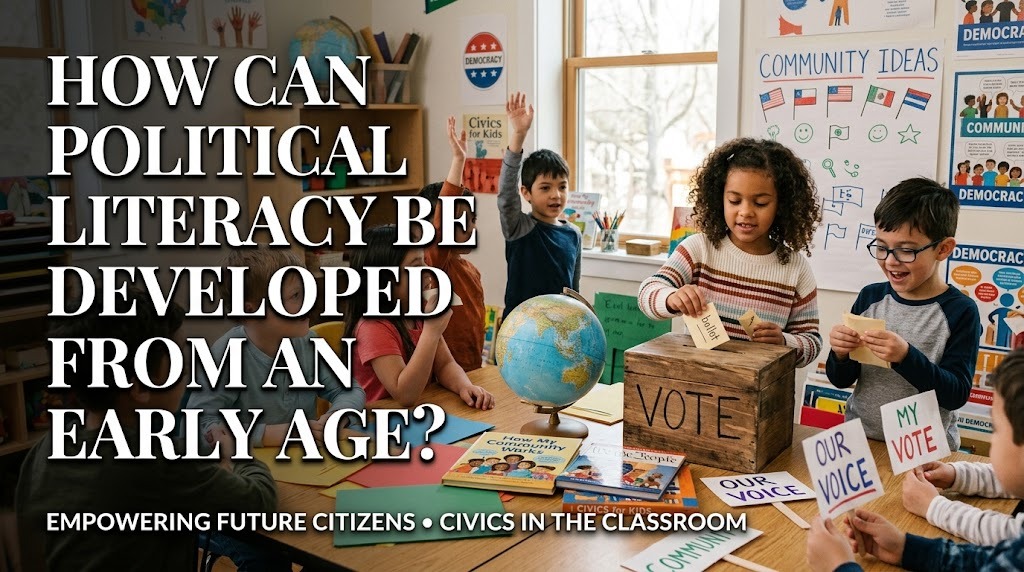
Political literacy can be introduced from an early age by helping children and young people understand basic ideas about society, rules, rights, responsibilities, and decision-making. Political literacy does not mean teaching children to support a particular political party or viewpoint. Instead, it can encourage curiosity, critical thinking, respectful discussion, and awareness of how communities function.
Developing political literacy from an early age can be done through everyday activities and age-appropriate education. Children do not need to study complicated political theories immediately. They can begin by learning simple concepts and gradually develop a broader understanding as their age and ability increase.
INTRODUCING BASIC CIVIC CONCEPTS
The first step in developing political literacy for children is introducing basic civic concepts. Children can learn about rules, fairness, cooperation, responsibilities, and the importance of respecting other people.
Simple examples from everyday life can make these concepts easier to understand. For example, parents and teachers can explain why rules are created at home, at school, or in a community and how rules can help people live together.
As children grow older, these basic ideas can be connected with civic rights and responsibilities. This gradual approach allows political knowledge to develop according to their level of understanding.
ENCOURAGING QUESTIONS AND CRITICAL THINKING
Children naturally ask questions about the world around them. Encouraging them to ask questions can support the development of critical thinking skills that are useful for understanding public issues later in life.
Parents and teachers can respond to questions with explanations that are appropriate for the child's age. Instead of simply telling children what to think, adults can encourage them to consider why something happens and whether different explanations are possible.
As children become more familiar with asking questions, they can learn to examine information rather than accepting every statement immediately. This is an important foundation for political literacy in the digital age.
TEACHING CHILDREN TO EVALUATE INFORMATION
As children gain access to the internet and social media, they may encounter information about public issues at an increasingly young age. Teaching them basic information literacy can help them understand that not everything they see online is automatically accurate.
Children can gradually learn to ask who created a piece of information, where it came from, and whether there is evidence to support it. Older students can learn to compare information from several credible sources.
UNESCO's media and information literacy framework emphasizes the importance of accessing, evaluating, and using information effectively. These skills can support children's ability to navigate information responsibly as they grow.
CREATING OPPORTUNITIES FOR RESPECTFUL DISCUSSION
Political discussion can be introduced through age-appropriate conversations about community issues. Children can discuss topics such as school rules, environmental concerns, cooperation, or community activities.
Adults can teach children to listen when others are speaking, express disagreement respectfully, and understand that people may have different opinions. These habits can help children become more comfortable with constructive discussions.
The Council of Europe includes dialogue, respect for diversity, human rights, and peaceful conflict resolution among important elements of democratic culture. Teaching these principles from an early age can help children understand that disagreement does not have to result in hostility.
USING SCHOOL AND EVERYDAY ACTIVITIES
Schools can provide opportunities to develop political literacy skills through classroom discussions, group projects, student activities, and lessons about society and civic life. These activities can help students understand cooperation, responsibilities, decision-making, and different perspectives.
Families can also support learning at home by discussing age-appropriate current events, explaining community decisions, and encouraging children to participate in suitable activities. Everyday experiences can make civic concepts easier to understand because children can connect them with situations they already know.
As children grow older, their learning can become more detailed. They can gradually study public institutions, elections, laws, political information, and other aspects of democratic life according to their educational level.
CONCLUSION
Political literacy can be developed from an early age by introducing basic civic concepts, encouraging questions, teaching information evaluation, promoting respectful discussions, and providing suitable learning experiences at home and school.
The process should be gradual and appropriate to a child's age and development. By building critical thinking, information literacy, and civic awareness from an early age, children can develop useful skills for understanding public issues and participating responsibly in society as they grow older.
Recent Posts

Bagaimana Sistem SKS pada Program Kuliah... 22.11.2026/33 View

How Does Technology Make Daily Evaluation... 21.11.2026/67 View

Apa Strategi Menghadapi Kesenjangan antara Kompetensi... 21.11.2026/67 View

Mengapa Inventaris Aset Penting bagi Kelancaran... 21.11.2026/65 View

When Should Musicians Join a Record... 21.11.2026/66 View
