

How Can Political Literacy Be Improved?
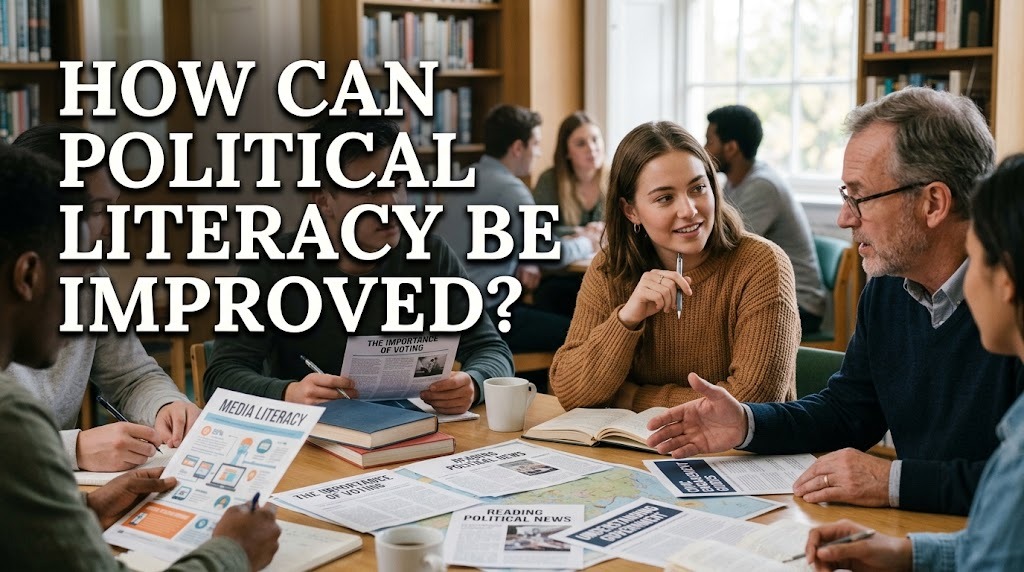
Political literacy helps people understand political issues, public institutions, civic rights, responsibilities, and democratic processes. In everyday life, people encounter political information through news, social media, conversations, and various digital platforms. Improving political literacy can help individuals understand this information more carefully.
Developing political literacy skills is a gradual process. It can involve learning basic political concepts, reading reliable sources, discussing public issues, evaluating information, and participating responsibly in civic activities. These efforts can be carried out through education as well as everyday experiences.
LEARNING BASIC POLITICAL KNOWLEDGE
One way to improve political literacy is to understand basic concepts related to government, elections, laws, public institutions, and citizens' rights and responsibilities. Basic knowledge provides a foundation for understanding more complex political issues.
People can begin by learning how public institutions function and how decisions are made. Understanding the roles of different institutions can make political information easier to interpret and reduce confusion when discussing public affairs.
Political education can also provide opportunities to learn these concepts in a structured way. Schools, universities, community organizations, and other educational institutions can contribute to developing knowledge about civic and democratic life.
READING RELIABLE POLITICAL INFORMATION
Accessing reliable political information is another important part of improving political literacy. People can use credible news organizations, official government websites, educational resources, and established institutions as sources of information.
When reading political claims, it is useful to examine who published the information, when it was published, what evidence is provided, and whether other reliable sources report similar facts. UNESCO's media and information literacy framework emphasizes the ability to access, evaluate, and use information effectively.
Comparing information from several reliable sources can also provide a broader understanding of an issue. This approach can help distinguish factual information from opinions, interpretations, or claims that require further verification.
DEVELOPING CRITICAL THINKING SKILLS
Critical thinking plays an important role in political literacy. People may encounter political claims that contain incomplete information, emotional language, or different interpretations of the same event.
To develop critical thinking, individuals can ask questions such as what evidence supports a claim, whether the source is trustworthy, and whether important context is missing. They can also consider different explanations before reaching a conclusion.
The ability to think critically does not mean rejecting every piece of political information. Instead, it involves examining information carefully and making judgments based on relevant evidence and context.
DISCUSSING POLITICAL ISSUES RESPECTFULLY
Political literacy can also be developed through respectful political discussion. Talking about public issues with people who have different perspectives can help individuals understand why opinions may differ.
A constructive discussion should focus on ideas and evidence rather than personal attacks. Listening carefully, asking questions, and explaining one's own position clearly can make conversations more useful.
Democratic culture also emphasizes dialogue, respect for diversity, human rights, and peaceful ways of handling disagreement. These principles are included in the Council of Europe's framework for democratic culture.
PRACTICING CIVIC PARTICIPATION
Another way to improve political awareness is through appropriate civic participation. Depending on age and legal rights, people can take part in community activities, learn about local issues, express opinions, volunteer, or participate in democratic processes.
Practical experiences can help people connect political knowledge with real situations. For example, learning about local government can become more meaningful when individuals observe how public services and community decisions affect daily life.
Civic participation should be based on adequate information and respect for other people's rights. By combining knowledge, information literacy, critical thinking, and responsible participation, people can gradually strengthen their political literacy.
CONCLUSION
Political literacy can be improved by learning basic political knowledge, reading reliable information, developing critical thinking, discussing political issues respectfully, and participating responsibly in civic life.
Improving political literacy skills is an ongoing process rather than a one-time activity. By building good information habits and continuing to learn about public issues, individuals can become better prepared to understand political developments and participate in democratic society.
Recent Posts

Bagaimana Sistem SKS pada Program Kuliah... 22.11.2026/33 View

How Does Technology Make Daily Evaluation... 21.11.2026/67 View

Apa Strategi Menghadapi Kesenjangan antara Kompetensi... 21.11.2026/67 View

Mengapa Inventaris Aset Penting bagi Kelancaran... 21.11.2026/65 View

When Should Musicians Join a Record... 21.11.2026/66 View
