

How Can Questions Be Organized By Difficulty Level In A Question Bank?
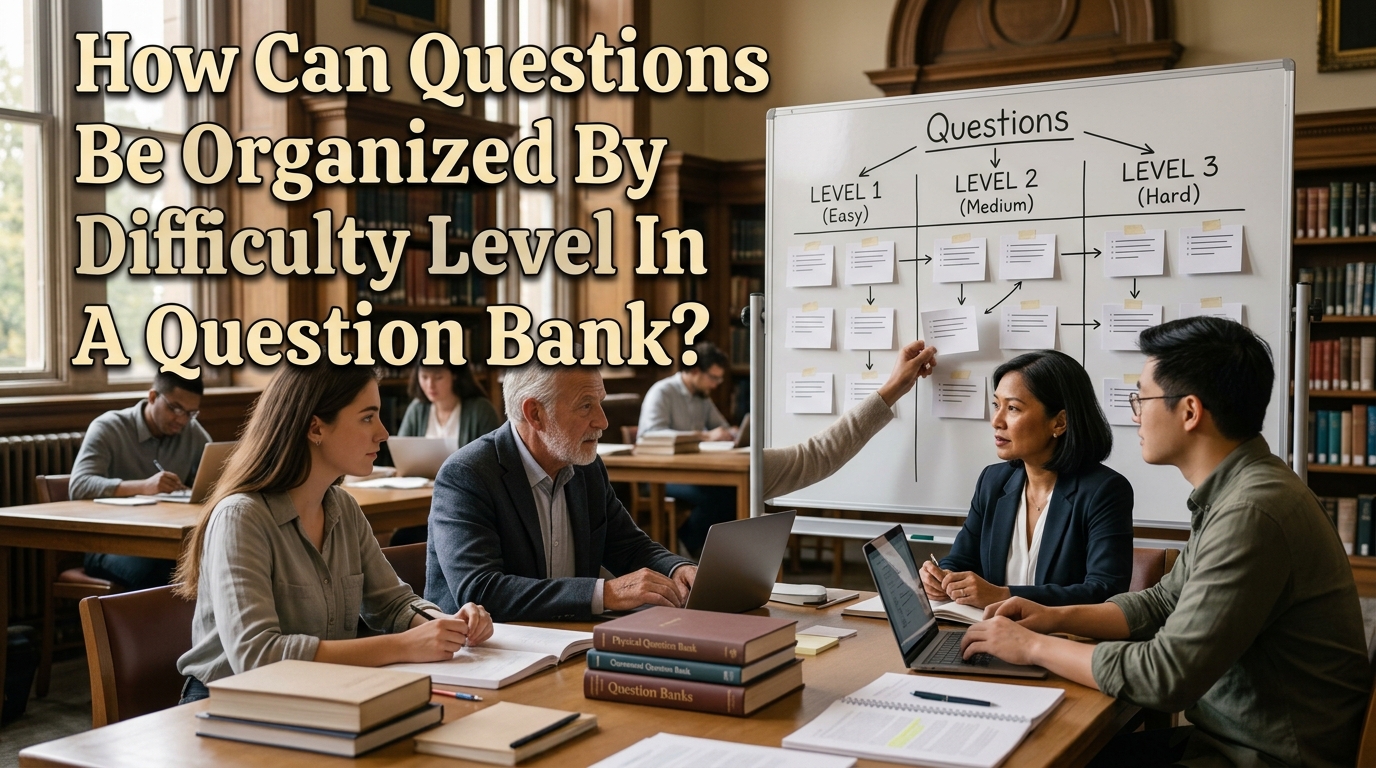
A question bank is a collection of questions used to support learning, practice, and assessment. To make it more effective, questions should be organized according to their difficulty levels, learning objectives, and subject topics. This organization helps teachers select suitable questions for different students and educational activities. It also allows students to practice basic concepts before moving on to more challenging tasks. With a clear classification system, a question bank can support structured learning, fair assessment, and better learning outcomes.
UNDERSTANDING QUESTION DIFFICULTY LEVELS
The first step in organizing a question bank is understanding what makes a question easy, moderate, or difficult. Easy questions usually test basic knowledge, such as recognizing terms, recalling facts, or identifying simple concepts. Moderate questions often require students to explain ideas, compare information, or apply knowledge to familiar situations. Difficult questions may involve several steps, complex problem-solving, analysis, or evaluation. These categories help teachers create a balanced collection of questions for different learning needs.
However, difficulty does not depend only on how long a question is or how complicated its wording appears. A short question can be difficult if it requires deep understanding, while a longer question may be easy if it asks students to recall familiar information. Students' previous knowledge and learning experiences can also affect how challenging a question feels. Therefore, teachers should classify questions based on the knowledge and thinking skills required rather than appearance alone. This approach creates a more meaningful difficulty system.
CLASSIFYING QUESTIONS BY THINKING SKILLS
Teachers can organize questions by considering the thinking skills needed to answer them. A useful approach is Bloom's Taxonomy, which describes learning processes such as remembering, understanding, applying, analyzing, evaluating, and creating. Questions that ask students to define a term or identify a fact usually focus on remembering. Questions that require students to use a formula or explain a concept involve understanding or applying knowledge. Meanwhile, questions that ask students to compare evidence or justify a conclusion require more complex thinking.
This framework helps teachers organize questions beyond simple labels such as easy and difficult. For example, a science question may ask students to name the parts of a plant, explain their functions, or analyze how environmental changes affect plant growth. Each question measures a different type of thinking, even when all questions cover the same topic. Teachers should choose the thinking level according to the learning objectives and students' abilities. Classifying questions by cognitive demand makes the question bank more useful for developing a wide range of skills.
USING CLEAR DIFFICULTY CATEGORIES
A question bank should use clear and consistent categories so teachers can find suitable questions quickly. The categories may include easy, moderate, and difficult, or another simple system that meets the institution's needs. Each category should have written guidelines explaining the expected level of knowledge and problem-solving. For instance, easy questions may focus on basic concepts, while moderate questions require applying knowledge and difficult questions involve several connected ideas. Clear definitions help different teachers classify questions more consistently.
Teachers should avoid assigning difficulty levels based only on personal opinions. They can review the question wording, required knowledge, number of reasoning steps, and likely challenges for the intended students. When possible, questions can be tested with a group of learners to see how students perform. If many students answer a supposedly easy question incorrectly, teachers should examine whether the content is unfamiliar or the wording is confusing. Consistent classification rules improve the reliability of the question bank and make question selection more efficient.
TESTING QUESTIONS BEFORE FINAL CLASSIFICATION
Testing questions with students can provide useful evidence about their actual difficulty. Teachers may use practice quizzes, classroom exercises, or sample assessments to observe how students respond. One useful measure is the proportion of students who answer a question correctly. If most students answer correctly, the question may be relatively easy for that group, while a lower success rate may indicate greater difficulty. However, results must be interpreted carefully because student preparation and teaching methods can influence performance.
Teachers can also review common mistakes and examine whether students misunderstood the question or lacked the necessary knowledge. In formal assessment, specialists may use item analysis to evaluate question difficulty and how well each question distinguishes between students with different levels of achievement. These methods provide more evidence than relying on intuition alone. Questions should be revised when problems arise from unclear wording, incorrect answers, or irrelevant information. Testing and reviewing questions helps ensure that their difficulty labels reflect actual learning demands.
ORGANIZING QUESTIONS BY TOPIC AND DIFFICULTY
Difficulty labels are most useful when combined with other information about each question. A question bank should also organize questions by subject, topic, learning objective, and question format. For example, a mathematics collection may contain easy, moderate, and difficult questions for fractions, geometry, and algebra. This structure allows teachers to select questions that match both the lesson being taught and the students' current abilities. It also helps prevent assessments from focusing too heavily on only one topic or difficulty level.
Digital question banks can make this process easier through filters, tags, and search tools. Teachers may select questions by topic and difficulty when preparing a quiz or practice activity. Each question should also include its correct answer, explanation when appropriate, and relevant learning objective. A consistent naming and tagging system makes questions easier to update and reuse. Organized question metadata helps teachers create balanced assessments with less preparation time.
UPDATING DIFFICULTY LEVELS REGULARLY
Question difficulty should not always be treated as permanent. A question that is difficult for beginners may become easier after students receive instruction and practice. Changes in curriculum, wording, or the student group can also affect how a question performs. For this reason, teachers should review question classifications periodically and update them when new evidence becomes available. Regular maintenance helps keep the question bank relevant and accurate.
Teachers can use assessment results, student feedback, and classroom observations to identify questions that need review. They should check whether questions remain aligned with current learning objectives and whether the answer keys are still correct. Questions that are outdated, repetitive, or misleading should be revised or removed. Keeping a record of changes can help teachers understand why a question's classification was updated. Continuous review ensures that difficulty levels remain useful for both teaching and assessment.
CONCLUSION
Organizing questions by difficulty level requires a clear classification system, appropriate learning objectives, and careful review. Teachers can begin by grouping questions into easy, moderate, and difficult categories, then consider the thinking skills required to answer them. Testing questions with students provides valuable evidence for checking whether the categories are appropriate. Combining difficulty labels with topics, question types, and learning objectives makes a question bank easier to manage. Through consistent classification, item analysis, and regular updates, educators can build a question bank that supports effective practice and fair assessment.
Recent Posts

Bagaimana Sistem SKS pada Program Kuliah... 22.11.2026/61 View

How Does Technology Make Daily Evaluation... 21.11.2026/87 View

Apa Strategi Menghadapi Kesenjangan antara Kompetensi... 21.11.2026/85 View

Mengapa Inventaris Aset Penting bagi Kelancaran... 21.11.2026/83 View

When Should Musicians Join a Record... 21.11.2026/87 View
