

How Can Radiation Rays Pass Through the Human Body?
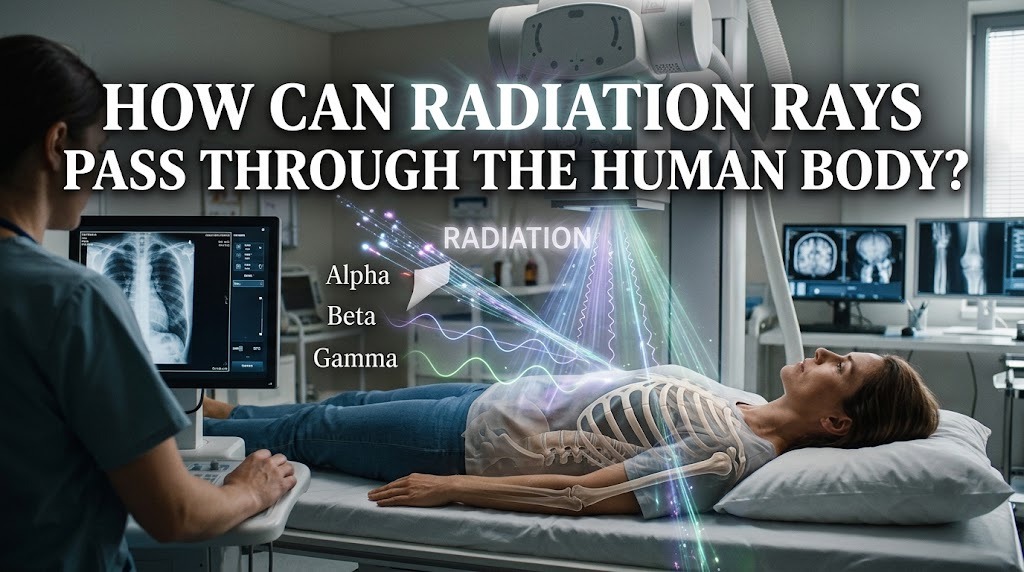
Penetrating radiation refers to high-energy waves and particles that can travel through physical matter, including biological tissue. Radiation moves through space in the form of electromagnetic waves or subatomic particles, interacting directly with the atoms that make up our bodies.
Whether radiation passes completely through human tissue, gets partially absorbed, or reflects off the skin depends on its frequency, energy level, and wavelength. Understanding these physical characteristics explains how different energy forms travel through the human body safely and effectively in medical and environmental contexts.
THE PHYSICAL MECHANISM OF PENETRATION
The primary reason radiation can pass through human tissue lies in the atomic structure of matter. At a microscopic level, solid matter—including human cells, skin, and bones—is made up of atoms surrounded by large amounts of empty atomic space.
When radiation with high frequency and extremely short wavelengths enters the body, it travels through these microscopic atomic gaps. Rays with sufficient energy move forward until they either hit an atomic nucleus or electron, or pass entirely through to the other side.
PENETRATION OF NON-IONIZING RAYS
Non-ionizing radiation includes low-energy forms of energy such as radio waves, microwaves, and visible light. Because these waves possess long wavelengths and low frequencies, they do not break down chemical or atomic bonds.
Certain non-ionizing waves, like radio frequencies and Wi-Fi signals, pass straight through human tissue because our bodies are mostly transparent to long wavelengths. Other forms, such as visible light and infrared, cannot penetrate deep into the body and are mostly absorbed or reflected by the skin.
PENETRATION OF IONIZING RAYS
Ionizing radiation consists of high-frequency waves, including X-rays and gamma rays, which carry immense kinetic energy. These short-wavelength rays have enough force to pass through soft biological tissues like muscles, fat, and organs with minimal resistance.
Because soft tissues are relatively low in density, high-energy rays travel straight through them, making medical imaging possible. In contrast, denser biological structures absorb more energy and partially block ray progression, allowing medical equipment to capture clear internal images.
DENSITY AND ABSORPTION IN TISSUE
The human body is composed of materials with varying mass and tissue density. Soft tissues, which consist mainly of water and organic compounds, allow radiation rays to pass through easily.
Denser materials, such as bone tissue, contain heavy elements like calcium that absorb or scatter rays. This difference in tissue density determines how much energy is absorbed locally versus how much exits the body, which forms the exact scientific foundation behind modern radiology.
MEDICAL APPLICATIONS AND SAFETY
Understanding how radiation passes through tissues allows medical professionals to utilize diagnostic imaging tools safely. X-rays and CT scans rely on controlled beams passing through the body to detect fractures and internal conditions.
To protect patients during diagnostic procedures, healthcare providers carefully measure the radiation dose and exposure time. Utilizing precise targeting, short exposure durations, and protective lead aprons ensures that diagnostic benefits are maximized while keeping tissue exposure well within safety boundaries.
CONCLUSION
In conclusion, radiation rays pass through the human body due to their unique wave energy and atomic physics. While low-energy non-ionizing waves travel through harmlessly, high-energy ionizing rays penetrate soft tissues based on density and energy levels.
By mastering how different energy wavelengths interact with biological matter, science has developed vital medical imaging techniques. Today, strict safety protocols continue to ensure that radiation is used safely and effectively in modern healthcare.
Recent Posts

Bagaimana Sistem SKS pada Program Kuliah... 22.11.2026/53 View

How Does Technology Make Daily Evaluation... 21.11.2026/82 View

Apa Strategi Menghadapi Kesenjangan antara Kompetensi... 21.11.2026/81 View

Mengapa Inventaris Aset Penting bagi Kelancaran... 21.11.2026/77 View

When Should Musicians Join a Record... 21.11.2026/82 View
