

How Can Research Survey Results Support Better Decision Making?
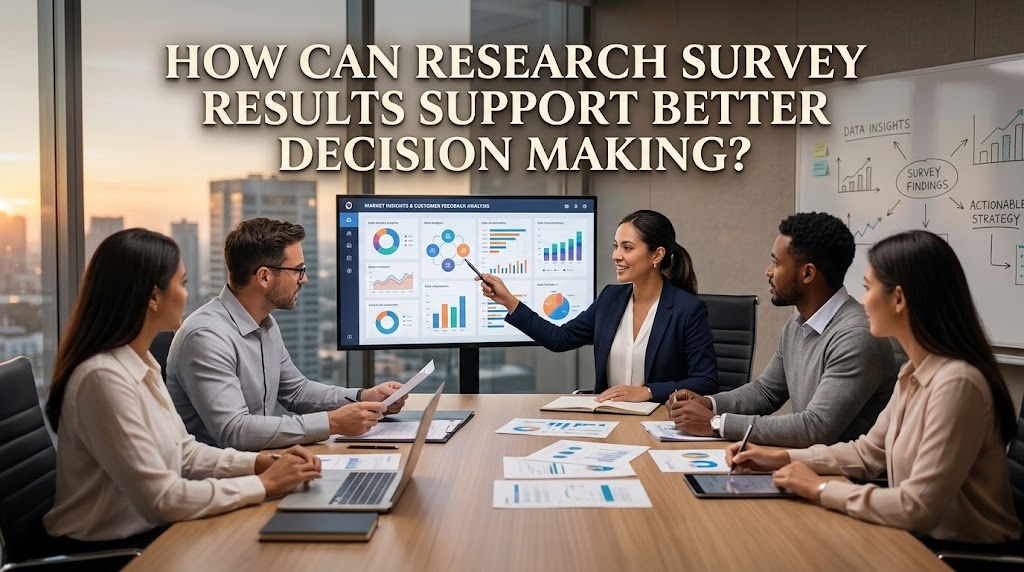
Research survey results play an important role in helping individuals, businesses, educational institutions, and government organizations make informed decisions. Surveys collect information about people's opinions, experiences, preferences, and behaviors, allowing decision-makers to understand situations more clearly. Instead of relying entirely on assumptions or personal opinions, they can use data-driven insights to identify problems and evaluate possible solutions. However, survey findings must be collected and analyzed carefully to avoid misleading conclusions. When researchers interpret the results appropriately, surveys can support better planning, improve performance, and guide decisions toward more effective outcomes.
IDENTIFY PROBLEMS AND UNDERSTAND PEOPLE'S NEEDS
Research survey results help decision-makers identify problems that may not be immediately visible. By collecting responses from relevant participants, researchers can discover common concerns, unmet needs, and areas requiring improvement. For example, a university may conduct a survey to understand why students experience difficulties accessing digital learning materials. The responses may reveal problems involving internet connectivity, platform usability, or insufficient learning resources. These findings help the institution identify the issues that deserve attention.
Surveys also provide insights into the needs and expectations of different groups. Businesses can investigate customer preferences, while public institutions can examine community concerns and service accessibility. Educational organizations may use student feedback to evaluate teaching methods and campus facilities. By understanding these perspectives, decision-makers can develop solutions that address actual needs rather than relying on assumptions. This approach makes problem identification more systematic and helps organizations establish relevant priorities.
SUPPORT PLANNING AND STRATEGIC DECISIONS
Survey findings can provide useful evidence when organizations develop plans and establish strategic priorities. Decision-makers can use information about customer behavior, employee experiences, student needs, or community preferences to determine which activities deserve the greatest attention. For instance, a company may discover through a customer survey that buyers value reliable delivery more than additional product features. Based on this information, the company may prioritize improvements to its distribution process. Such decisions connect organizational strategies with the expectations of the people they serve.
In educational settings, survey results can help universities plan academic programs, improve student support, and allocate resources more effectively. Government agencies may use public feedback to understand community priorities when designing services or evaluating existing programs. However, survey results should be considered alongside budget limitations, organizational objectives, expert knowledge, and other relevant evidence. Strategic planning becomes more effective when decisions reflect both reliable data and realistic implementation conditions. This balanced approach helps organizations establish achievable goals and use their resources more carefully.
COMPARE OPTIONS AND ALLOCATE RESOURCES EFFECTIVELY
Organizations often face several possible solutions but have limited time, funding, and personnel. Research survey results can help decision-makers compare alternatives by showing which issues matter most to respondents. For example, a campus survey may reveal that students consider library opening hours, internet access, and study space important improvements. University administrators can use these findings to evaluate which changes should be prioritized. The final decision should also consider costs, feasibility, and the expected benefits of each option.
Survey data can also support resource allocation by helping organizations identify where assistance is most needed. A business may discover that customer complaints are concentrated in a particular service area, while a public institution may identify communities experiencing difficulties accessing essential facilities. These findings can guide the distribution of staff, funding, and other resources. Nevertheless, decision-makers should avoid assuming that the most frequently mentioned problem is always the most urgent. They should also consider the severity of the issue, the needs of underrepresented groups, and the potential consequences of different decisions.
EVALUATE PERFORMANCE AND MEASURE SATISFACTION
Research surveys can help organizations evaluate their performance by collecting feedback from customers, employees, students, or service users. Performance evaluation allows decision-makers to understand whether current programs and services are meeting their intended objectives. For example, a company may survey customers to measure satisfaction with product quality, customer service, and delivery speed. If satisfaction ratings decline over time, managers can investigate the causes and develop appropriate improvements. Survey findings therefore provide a useful starting point for reviewing organizational performance.
Repeated surveys can also help organizations monitor changes over time. A university that measures student satisfaction each semester may identify whether improvements to academic advising are producing better experiences. Businesses can compare feedback before and after introducing a new service, provided the survey methods are sufficiently consistent. Researchers should consider differences in respondents, sample composition, and external circumstances when interpreting these comparisons. Continuous evaluation helps organizations understand progress and determine whether further changes are necessary.
REDUCE UNCERTAINTY AND MANAGE POTENTIAL RISKS
Making decisions often involves uncertainty because decision-makers cannot predict every outcome. Research survey results can reduce some uncertainty by providing structured information about people's expectations, experiences, and concerns. For example, a business considering a new product can survey potential customers to understand their preferences and willingness to purchase it. The findings may help the company refine the product, adjust its pricing strategy, or reconsider its launch plans. However, stated intentions do not always translate into actual purchasing behavior, so survey findings should not be treated as guarantees.
Surveys can also help organizations identify potential risks before they become more serious problems. Employee surveys may reveal concerns about workplace communication, while community surveys may highlight difficulties accessing public services. Decision-makers can investigate these findings and develop preventive measures where appropriate. However, survey results must be interpreted carefully because inaccurate questions, low participation, or biased samples can distort the information collected. Combining survey evidence with other relevant sources helps organizations make more informed and responsible decisions.
IMPROVE DECISION MAKING THROUGH ACCURATE DATA ANALYSIS
The usefulness of research survey results depends heavily on how the collected information is analyzed and interpreted. Researchers should organize the responses, check for errors, and select analysis methods that match the research objectives. Descriptive statistics, such as percentages and averages, can summarize common responses, while more advanced methods may help examine differences or relationships between variables. Open-ended answers can provide additional explanations for patterns found in numerical data. Accurate analysis allows decision-makers to understand what the results show and what they cannot establish.
Decision-makers should also recognize the limitations of survey findings. A survey involving only a small or unrepresentative group may not reflect the views of the entire target population. Similarly, a relationship between two variables does not automatically demonstrate that one causes the other. Researchers should report important limitations and avoid exaggerating conclusions. By combining reliable survey data, appropriate analysis, professional judgment, and other relevant evidence, organizations can develop decisions that are better supported and more transparent.
CONCLUSION
Research survey results support better decision-making by helping organizations identify problems, understand people's needs, plan strategies, allocate resources, and evaluate performance. They can also reduce uncertainty and reveal potential risks before important decisions are implemented. However, the benefits depend on collecting relevant responses, analyzing the data accurately, and recognizing the limitations of the findings. Survey results should complement professional judgment and other reliable sources of information rather than replace them entirely. By using research surveys systematically, organizations can make more informed, effective, and evidence-based decisions that better serve their objectives and the people affected by them.
Recent Posts

Bagaimana Sistem SKS pada Program Kuliah... 22.11.2026/45 View

How Does Technology Make Daily Evaluation... 21.11.2026/73 View

Apa Strategi Menghadapi Kesenjangan antara Kompetensi... 21.11.2026/75 View

Mengapa Inventaris Aset Penting bagi Kelancaran... 21.11.2026/71 View

When Should Musicians Join a Record... 21.11.2026/75 View
