

How Can Robotics Reduce Defects in Textile Manufacturing?
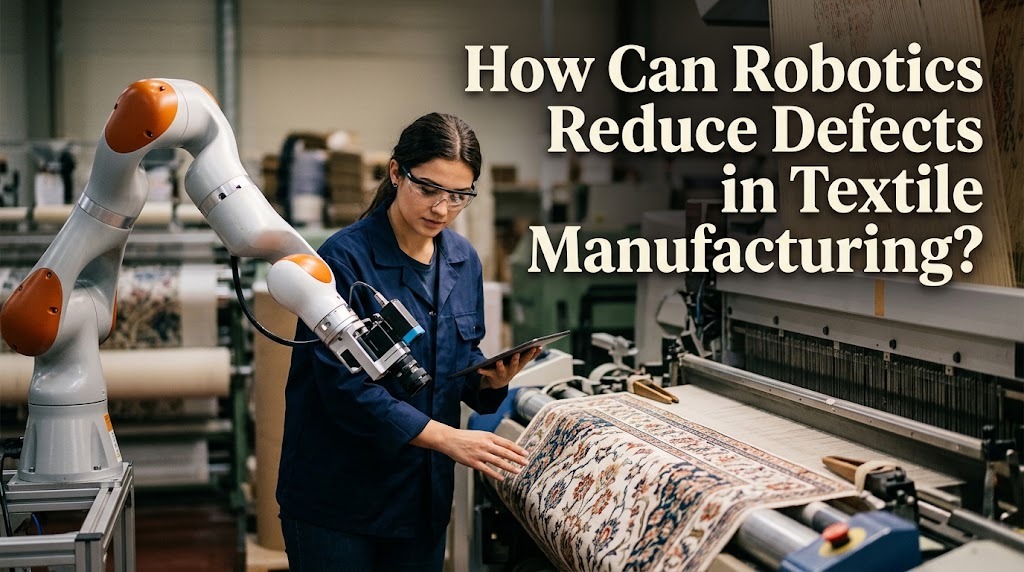
Textile manufacturing requires consistent quality at every stage of production. Small errors in cutting, sewing, handling, or inspection can result in defective products, wasted materials, and higher production costs. Robotics can help manufacturers improve consistency by performing repetitive tasks with controlled movements and precise positioning. Automated systems can also support quality inspection and detect certain defects more quickly. By combining robotics with appropriate sensors, software, and human supervision, textile manufacturers can reduce production errors and improve overall product quality.
IMPROVING CUTTING PRECISION
Robotic cutting systems can improve the accuracy of fabric cutting by following programmed patterns and predetermined measurements. Automated cutting equipment can maintain consistent positioning across repeated production cycles, reducing variations caused by manual handling. Precise cutting is important because inaccurate fabric dimensions can create problems during sewing and assembly. Sensors and computer-controlled systems can also help machines respond to the characteristics of different materials. Better cutting accuracy can reduce material waste and lower the number of products affected by dimensional errors.
MAINTAINING CONSISTENT SEWING QUALITY
Robotic sewing systems can perform repetitive stitching operations with consistent speed and movement. When properly programmed, they can maintain predetermined stitch patterns and positions across multiple pieces of fabric. This consistency can help reduce defects such as uneven stitching, incorrect positioning, or inconsistent seam placement. Automated sewing is particularly useful for repetitive production tasks where the same operation must be performed many times. Human workers can remain involved in tasks that require judgment, adjustment, or handling of materials that are difficult to automate.
USING VISION SYSTEMS FOR QUALITY INSPECTION
Robotics can be combined with machine vision cameras and image-processing software to inspect textile products. Vision systems can identify visible problems such as stains, holes, irregular patterns, misplaced components, or certain stitching defects. Automated inspection can examine products continuously and apply consistent inspection criteria. This can help manufacturers identify defective items before they move to later production stages. However, the effectiveness of vision-based inspection depends on image quality, lighting, sensor capabilities, software accuracy, and the types of defects the system has been trained or programmed to recognize.
REDUCING HUMAN ERROR IN REPETITIVE TASKS
Repetitive manufacturing activities can become tiring and may increase the likelihood of inconsistent movements or mistakes. Robots can perform predefined tasks repeatedly without experiencing physical fatigue in the same way as human workers. This consistency can reduce errors associated with repetitive handling, particularly when the task has clear and stable requirements. Automation does not eliminate human error completely because robots can also produce mistakes when their programming, calibration, or input materials are incorrect. Regular monitoring and maintenance are therefore necessary to maintain reliable performance.
IMPROVING MATERIAL HANDLING
Incorrect handling of fabric can cause wrinkles, stretching, misalignment, or damage that affects the final product. Robotic handling systems can move textile materials according to programmed paths and controlled movements. Automated systems can also help position fabric accurately before cutting, sewing, or other processing steps. Sensors can provide information about material position and movement, allowing equipment to make adjustments when supported by the system design. Better handling can reduce defects caused by improper positioning and unnecessary physical contact with materials.
SUPPORTING REAL-TIME QUALITY CONTROL
Robotic production systems can work alongside sensors and monitoring software to detect process abnormalities during manufacturing. If a system identifies a deviation from predefined parameters, it may trigger an alert or stop a process for inspection. Detecting problems earlier can prevent the same error from affecting a large batch of products. Manufacturers can also analyze production data to identify recurring problems and determine where process improvements are needed. This creates a more proactive approach to quality control rather than relying only on final product inspection.
REDUCING WASTE AND PRODUCTION REWORK
Defective textile products often require rework or complete replacement, which consumes additional materials, labor, and production time. By improving consistency in cutting, sewing, handling, and inspection, robotic systems can help reduce the number of defects that reach later production stages. Early detection is particularly valuable because correcting a problem before additional processing can be less costly than repairing a completed product. Manufacturers can use quality data to identify frequent defect sources and adjust production processes accordingly. The result can be improved material efficiency and more predictable production output.
CONCLUSION
Robotics can reduce defects in textile manufacturing by improving cutting precision, maintaining consistent sewing, automating inspection, and controlling material handling. When combined with machine vision, sensors, and production monitoring, robotic systems can also identify problems earlier and support more consistent quality control. However, automation is not a complete solution by itself. Robots require accurate programming, calibration, maintenance, suitable materials, and effective human oversight. When these elements are integrated properly, robotics can help textile manufacturers produce more consistent products while reducing waste, rework, and production errors.
Recent Posts

Bagaimana Sistem SKS pada Program Kuliah... 22.11.2026/48 View

How Does Technology Make Daily Evaluation... 21.11.2026/76 View

Apa Strategi Menghadapi Kesenjangan antara Kompetensi... 21.11.2026/78 View

Mengapa Inventaris Aset Penting bagi Kelancaran... 21.11.2026/73 View

When Should Musicians Join a Record... 21.11.2026/78 View
