

How Can Robots Assist Structural Assessment After Natural Disasters?
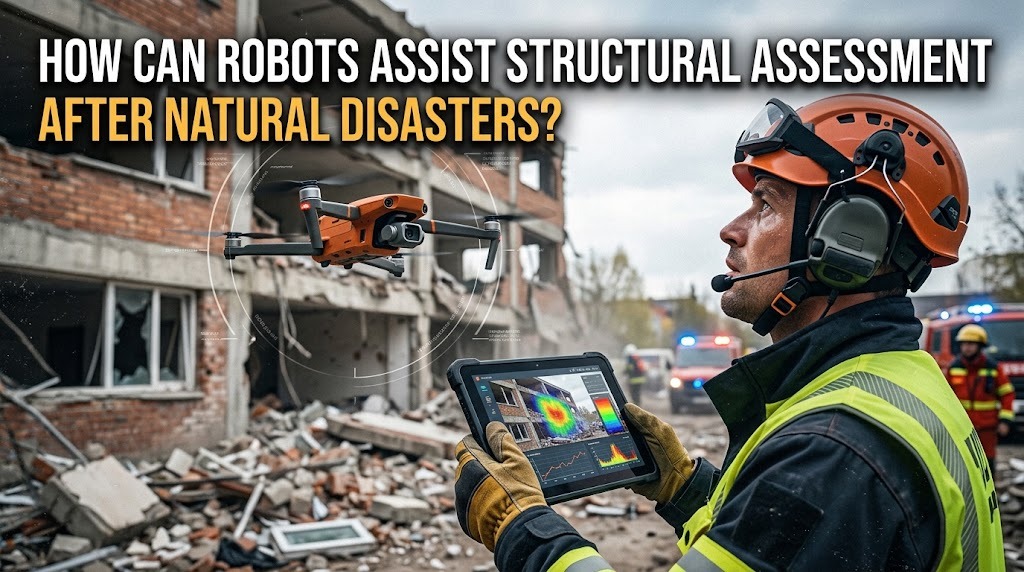
Natural disasters such as earthquakes, floods, hurricanes, and landslides can cause severe damage to buildings, bridges, roads, and other infrastructure. Assessing this damage is essential for identifying structural hazards and planning recovery operations. However, entering damaged structures can expose engineers and emergency responders to collapsing walls, unstable floors, debris, and other dangers. Robots can assist structural assessment by collecting visual data, measuring environmental conditions, and inspecting areas that may be unsafe for people to enter.
INSPECTING DAMAGED BUILDINGS
Robots equipped with cameras can examine damaged buildings without requiring inspectors to enter every affected area. Ground robots can travel through accessible corridors, while aerial drones can capture images of roofs, upper floors, and exterior walls.
These images help engineers identify visible cracks, fallen ceilings, damaged columns, and other signs of structural deterioration. By documenting the condition of a building from multiple angles, robots can provide useful information for deciding which areas require closer examination.
DETECTING CRACKS AND STRUCTURAL DEFECTS
High-resolution cameras and specialized sensors allow inspection robots to identify visible cracks, deformations, and surface damage. Some systems use artificial intelligence to analyze images and highlight patterns that may indicate structural problems.
Robots can also carry instruments that measure distances, vibrations, or other physical properties relevant to structural assessment. These measurements help engineers investigate potential weaknesses and compare observations across different locations. However, automated detection can produce false results, so qualified professionals must verify important findings.
ACCESSING DANGEROUS OR CONFINED SPACES
Earthquakes and landslides may leave buildings with unstable floors, narrow passages, and partially collapsed structures. Compact tracked robots and legged robots can sometimes navigate debris or confined spaces that are difficult for conventional inspection equipment to reach.
These robots can transmit live video and sensor measurements to operators outside the hazardous area. Their ability to access difficult locations may help inspectors gather information before deciding whether human entry is appropriate. Nevertheless, robots can become trapped or lose communication, so operators must plan recovery procedures carefully.
USING DRONES FOR AERIAL DAMAGE ASSESSMENT
Aerial drones provide an efficient way to inspect large areas after disasters. They can capture overhead images of damaged roofs, bridges, roads, and buildings that are difficult to observe from ground level.
When combined with photogrammetry, drone imagery can be used to create three-dimensional models of affected structures. Engineers can compare these models with previous records or later surveys to identify changes in shape and alignment. Flight operations must account for obstacles, weather, battery limitations, and local safety regulations.
MEASURING STRUCTURAL MOVEMENT AND VIBRATION
Some robots can carry sensors that measure vibration, displacement, tilt, or other indicators of structural behavior. These measurements can help engineers investigate whether a structure is moving or responding abnormally to external forces.
For example, sensors placed near a damaged bridge may help document changes in vibration patterns during an inspection. Such information can complement visual observations and conventional structural monitoring. A single measurement does not establish whether a structure is safe, so engineers must interpret results in the context of the building's design and damage history.
SUPPORTING SEARCH AND RESCUE OPERATIONS
After a major disaster, structural assessment often takes place alongside search and rescue. Robots equipped with cameras, microphones, thermal sensors, or other detection equipment can help responders investigate areas where survivors may be located.
Their observations can provide information about accessible routes, blocked passages, and potentially unstable sections of a building. This information may help rescue teams plan safer entry points and prioritize their activities. Rescue robots support human responders but cannot guarantee that every space has been searched or that a structure is stable.
CREATING DIGITAL MODELS FOR DAMAGE ANALYSIS
Robots can collect images and measurements that support digital mapping and three-dimensional reconstruction. These models help engineers visualize damaged structures, document affected components, and compare the current condition with available design drawings or earlier surveys.
Digital models can also help recovery teams organize inspection records and monitor repairs over time. When data from multiple robots is combined, teams can develop a more complete view of a disaster-affected site. Accurate results depend on good sensor calibration, consistent measurements, and reliable data processing.
IMPROVING SAFETY AND DECISION-MAKING
Robotic inspections can reduce the need for engineers and emergency personnel to enter hazardous locations during the initial assessment. Remote observations also help teams identify areas that need restricted access or additional investigation.
Engineers can use robotic data to support decisions about evacuation zones, temporary stabilization, repair priorities, and further inspections. However, robots do not replace professional structural evaluations. Important decisions must consider building codes, material properties, site conditions, and the possibility of hidden damage that sensors cannot detect.
CONCLUSION
Robots assist structural assessment after natural disasters by inspecting damaged buildings, detecting visible defects, surveying infrastructure, measuring movement, and creating digital models. These capabilities improve access to dangerous locations and provide valuable information for engineers and emergency responders. When robotic data is combined with professional judgment and established inspection procedures, it can support safer assessments and more effective disaster recovery.
Recent Posts

Bagaimana Sistem SKS pada Program Kuliah... 22.11.2026/49 View

How Does Technology Make Daily Evaluation... 21.11.2026/77 View

Apa Strategi Menghadapi Kesenjangan antara Kompetensi... 21.11.2026/78 View

Mengapa Inventaris Aset Penting bagi Kelancaran... 21.11.2026/74 View

When Should Musicians Join a Record... 21.11.2026/79 View
