

How Can Scientific Literacy Be Improved Among Students?
UNDERSTANDING THE IMPORTANCE OF SCIENTIFIC LITERACY
Scientific literacy is the ability to understand scientific concepts, use evidence, and apply scientific knowledge to different situations. For students, this skill is important because they encounter scientific information in classrooms, books, websites, social media, and other digital platforms. Improving scientific literacy helps students understand information instead of simply memorizing facts. It also encourages them to ask questions and look for reasonable explanations based on evidence. Therefore, scientific literacy should become an important part of the learning process.
Students with good scientific literacy can connect what they learn at school with real life situations. They can use scientific knowledge to understand topics related to health, technology, the environment, energy, and other everyday issues. This makes learning more meaningful and encourages students to become more interested in science. Teachers and schools can support this development through activities that involve investigation, discussion, observation, and problem solving.
USING PRACTICAL AND EXPERIMENTAL LEARNING
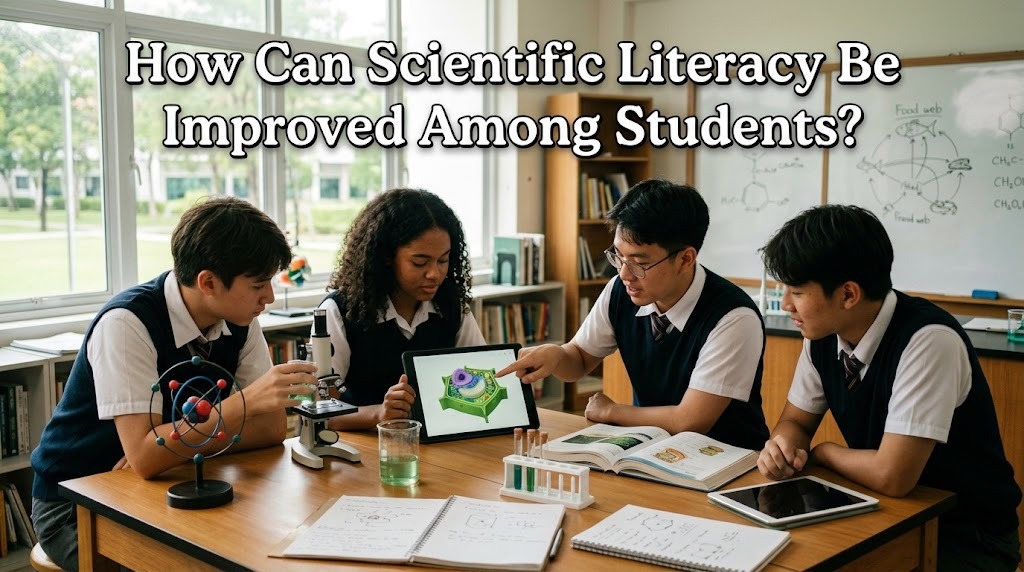
One effective way to improve scientific literacy is through practical learning and simple experiments. Students can observe a phenomenon, create questions, collect information, and discuss possible explanations. These activities allow them to experience how scientific knowledge is developed through evidence and investigation. Practical activities can also make abstract scientific concepts easier to understand. Students become active participants instead of only receiving information from textbooks.
Experiments do not always require expensive laboratory equipment. Teachers can use simple materials that are safe and easily available to demonstrate scientific concepts. For example, students can investigate changes in temperature, water evaporation, plant growth, or simple physical processes. After an activity, students can be asked to explain their observations and connect them with scientific concepts. This process can strengthen their ability to interpret evidence and communicate scientific ideas.
DEVELOPING CRITICAL THINKING AND QUESTIONING SKILLS
Improving scientific literacy also requires students to develop critical thinking skills. Teachers can encourage students to ask questions such as what causes a phenomenon, what evidence supports a claim, and whether a conclusion is reasonable. These questions help students examine information instead of accepting every statement immediately. Students can also compare different explanations and identify which ones have stronger supporting evidence. Regular questioning can gradually develop a more analytical approach to learning.
Classroom discussions can provide opportunities for students to express their ideas and listen to different perspectives. When students explain their reasoning, they learn how to communicate evidence based arguments clearly. Teachers can guide discussions by correcting misunderstandings and encouraging students to support their opinions with relevant evidence. This approach helps students understand that scientific conclusions should be based on reliable information rather than personal assumptions.
IMPROVING DIGITAL AND INFORMATION LITERACY
The internet can provide valuable resources for science learning, but students need to know how to evaluate online information. Digital literacy can support scientific literacy by teaching students how to identify reliable sources and recognize misleading claims. Students should learn to check the source of an article, the evidence behind a claim, and whether information is supported by credible scientific references. They should also compare information from several trustworthy sources when researching a scientific topic. These habits are especially important because scientific information can spread quickly online.
Teachers can give students assignments that involve evaluating online scientific information. For example, students can compare a reliable educational source with an unsupported claim and identify differences in evidence and reasoning. They can also practice checking whether statistics, images, or headlines accurately represent the information being discussed. Such activities help students become more careful when consuming and sharing information. As a result, technology can become a useful tool for developing scientific literacy rather than simply a source of information.
CONNECTING SCIENCE WITH EVERYDAY LIFE
Students can improve scientific literacy when they understand how science relates to situations they experience every day. Teachers can introduce examples involving health, food, climate, energy, transportation, and technology to make scientific concepts more relevant. Connecting lessons with familiar situations can help students understand why scientific knowledge matters outside the classroom. It can also encourage them to use evidence when making decisions about everyday issues. This approach makes science learning more practical and meaningful.
Schools can also organize projects that require students to investigate problems in their surroundings. Students might observe environmental conditions, study energy use, or investigate a local issue using appropriate scientific methods. They can then present their findings through reports, presentations, or discussions. These activities combine observation, research, analysis, and communication while giving students opportunities to apply what they have learned.
CONCLUSION
Scientific literacy can be improved among students through practical learning, critical questioning, reliable information sources, and meaningful connections between science and everyday life. Students need opportunities to investigate problems, interpret evidence, discuss ideas, and apply scientific concepts to real situations. Teachers can support this process by creating active learning experiences and teaching students how to evaluate information from digital sources. Schools can also provide projects and activities that encourage students to explore scientific issues independently. With consistent practice, students can develop stronger scientific understanding, critical thinking, and evidence based reasoning that will be useful in both education and everyday life.
Recent Posts

Bagaimana Sistem SKS pada Program Kuliah... 22.11.2026/33 View

How Does Technology Make Daily Evaluation... 21.11.2026/67 View

Apa Strategi Menghadapi Kesenjangan antara Kompetensi... 21.11.2026/67 View

Mengapa Inventaris Aset Penting bagi Kelancaran... 21.11.2026/65 View

When Should Musicians Join a Record... 21.11.2026/66 View
