

How Can Startups Estimate Robotic Prototype Development Costs?
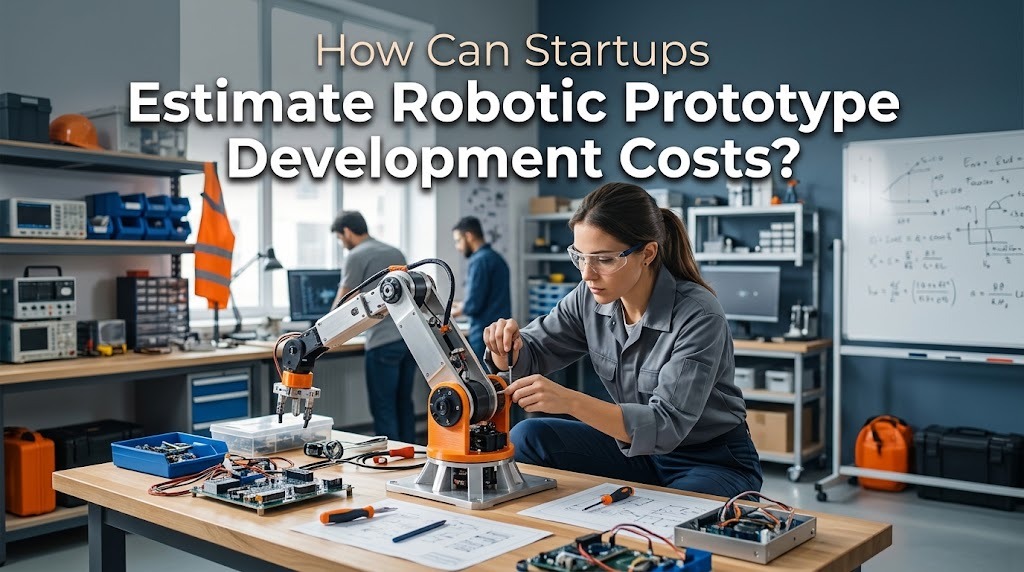
Developing a robotic prototype can help startups test an idea before investing in large-scale production. However, robotics projects often involve hardware, software, engineering, testing, and manufacturing expenses that can change throughout development. Estimating these costs early allows startups to create realistic budgets and identify potential financial risks. A useful estimate should include both obvious expenses, such as components, and less visible costs, such as testing and redesign. By breaking the project into clear categories, startups can develop a more reliable prototype budget.
DEFINE THE PROTOTYPE REQUIREMENTS
The first step is to determine exactly what the prototype needs to accomplish. Startups should identify its intended functions, operating environment, required movement, sensors, power source, control system, and expected performance. A simple robotic prototype with basic movements will generally require fewer components than an autonomous robot with advanced sensing and navigation capabilities. Clear requirements also prevent teams from purchasing unnecessary hardware. The more precisely the prototype is defined, the easier it becomes to estimate the resources and engineering work required.
CALCULATE HARDWARE AND COMPONENT COSTS
Hardware is often one of the largest parts of a robotics prototype budget. Startups may need motors, actuators, sensors, batteries, controllers, communication modules, structural components, wiring, and electronic boards. Each component should be listed individually with an estimated unit price and required quantity. Teams should also consider shipping, replacement parts, and the possibility that some components may need to be purchased more than once during testing. Comparing multiple suppliers can help startups identify reasonable prices while maintaining the technical requirements of the prototype.
ESTIMATE SOFTWARE AND ENGINEERING COSTS
Robotic prototypes require more than physical components. Developers may need to create control software, embedded programs, interfaces, communication systems, or algorithms for perception and navigation. Startups should estimate the engineering hours required for design, programming, integration, debugging, and documentation. If external engineers or contractors are involved, their rates should be included in the budget. Open-source software can sometimes reduce licensing costs, but integration and customization still require technical effort.
INCLUDE DESIGN AND MANUFACTURING EXPENSES
Prototype development may require custom mechanical parts that cannot be purchased as standard components. Startups may use 3D printing, CNC machining, laser cutting, or other fabrication methods to produce frames, brackets, gears, and protective enclosures. The cost depends on material selection, dimensions, manufacturing complexity, and production quantity. Design changes can also create additional fabrication expenses. Estimating several iterations is therefore more realistic than assuming the first manufactured version will be the final prototype.
BUDGET FOR TESTING AND REDESIGN
Testing is a major part of prototype development because the first version may not perform as expected. Startups should allocate funds for laboratory testing, field trials, calibration, troubleshooting, and replacement components. Problems discovered during testing may require mechanical modifications, software changes, or completely different components. Including these possibilities in the initial estimate reduces the risk of running out of funds during development. A prototype budget should account for iteration because experimentation is a normal part of engineering development.
CONSIDER LABOR AND DEVELOPMENT TIME
Labor costs can significantly affect the total cost of a robotic prototype. A project may require mechanical engineers, electrical engineers, software developers, robotics specialists, designers, and technicians. Startups should estimate the number of hours each role will contribute and multiply those hours by the applicable labor rate. Development time should also include meetings, integration, testing, troubleshooting, and project management. Even when founders or employees do not receive separate prototype-development invoices, their working time represents a real resource that should be considered when evaluating the project's cost.
ADD CONTINGENCY AND UNEXPECTED COSTS
Robotics development involves uncertainty, so startups should include a contingency amount in their budget. Unexpected expenses can result from component shortages, failed tests, damaged hardware, design changes, or technical problems. A contingency budget provides flexibility when the project does not follow the original plan. The appropriate amount depends on the complexity and maturity of the project, with highly experimental prototypes generally carrying greater uncertainty. Keeping contingency funds separate from planned expenses also makes it easier to monitor how unexpected costs affect the project.
CREATE A DETAILED COST BREAKDOWN
After identifying the major expenses, startups should organize them into a detailed cost model. A basic structure can include hardware, software, engineering labor, manufacturing, testing, tools, shipping, and contingency. Each category should contain individual items and estimated quantities so that the team can see what drives the total cost. Startups should update the estimate as supplier quotations and actual development data become available. Comparing the original estimate with actual spending can also improve the accuracy of future prototype budgets.
CONCLUSION
Startups can estimate robotic prototype development costs by defining technical requirements and calculating expenses for hardware, software, engineering, manufacturing, testing, and labor. They should also account for redesigns, shipping, replacement components, and unexpected technical problems. A detailed cost breakdown makes it easier to identify the project's major financial drivers and adjust the design when necessary. Because robotics development is iterative, a realistic budget should allow room for testing and improvement. Careful cost estimation can help startups control spending while developing a prototype that meets its intended technical goals.
Recent Posts

Bagaimana Sistem SKS pada Program Kuliah... 22.11.2026/48 View

How Does Technology Make Daily Evaluation... 21.11.2026/76 View

Apa Strategi Menghadapi Kesenjangan antara Kompetensi... 21.11.2026/78 View

Mengapa Inventaris Aset Penting bagi Kelancaran... 21.11.2026/73 View

When Should Musicians Join a Record... 21.11.2026/78 View
