

How Can Students Improve Their Numeracy Literacy Skills?
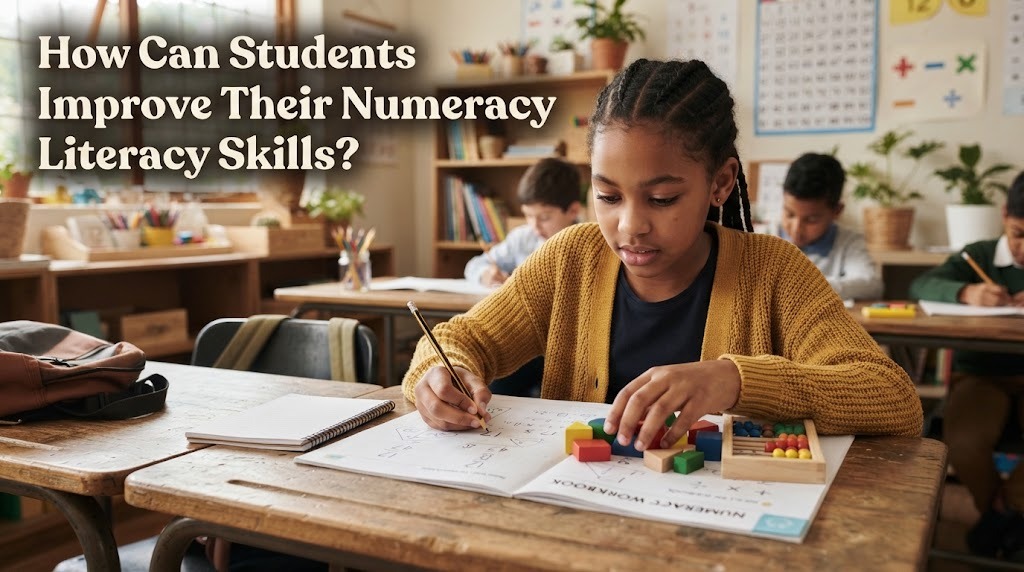
Numeracy literacy is an essential skill that helps students understand and use numbers in everyday life. It is not only about solving mathematical problems but also about interpreting data, making calculations, and using logical thinking to solve real-world situations. Students use numeracy skills when managing money, reading charts, measuring objects, and making decisions based on numerical information.
In education, strong numeracy literacy supports academic achievement and prepares students for future careers. However, some students find mathematics difficult because they focus too much on memorizing formulas instead of understanding concepts. The good news is that numeracy literacy can improve through regular practice, practical activities, and effective learning strategies. So, how can students develop these important skills?
UNDERSTAND BASIC MATHEMATICAL CONCEPTS
Building strong numeracy literacy starts with understanding basic mathematical concepts. Students should become familiar with addition, subtraction, multiplication, division, fractions, percentages, and decimals. These skills are the foundation for solving more complex mathematical problems. When students understand the basic concepts, they can approach new topics with greater confidence.
Instead of memorizing formulas without understanding them, students should learn why a formula works and when to use it. For example, understanding percentages can help students calculate discounts while shopping or compare prices. Teachers and parents can use simple examples from daily life to explain mathematical ideas. A strong foundation makes it easier for students to develop advanced numeracy skills.
PRACTICE MATHEMATICS REGULARLY
Regular practice is one of the most effective ways to improve numeracy literacy. Students do not need to study for many hours at once because short and consistent practice can be more manageable. Spending 15 to 30 minutes each day solving mathematical problems can help strengthen understanding. Repeating different types of questions also helps students recognize patterns and choose suitable methods.
Students should review their mistakes instead of simply checking the final answers. Understanding why an answer is incorrect can prevent similar errors in the future. They can also keep a notebook of difficult questions and revisit them regularly. With consistent effort, mathematical problem-solving can become more familiar and less stressful.
CONNECT NUMERACY WITH EVERYDAY ACTIVITIES
Numeracy becomes easier to understand when students connect it with real-life situations. Activities such as shopping, cooking, traveling, and managing personal expenses involve numbers and calculations. For example, students can calculate the total cost of groceries, compare product prices, or determine how much money they can save each month. These simple activities show that mathematics is useful beyond the classroom.
Students can also practice measurement while preparing food or organizing their daily schedules. Calculating travel time and distance can improve their understanding of numbers in practical situations. Parents and teachers can encourage students to explain how they reach an answer. This approach helps students develop practical numeracy skills and understand the value of mathematics in daily life.
DEVELOP DATA INTERPRETATION SKILLS
Numeracy literacy also involves understanding information presented through numbers, tables, graphs, and charts. Students should learn how to read data, identify important details, and make conclusions based on evidence. For example, they can interpret a bar chart showing classroom attendance or a line graph showing changes in temperature. These activities improve their ability to understand numerical information.
Students should also practice comparing values and identifying trends. They can ask questions such as which category has the highest value, how much a number has increased, or what a graph suggests. It is important to distinguish between information shown by the data and personal assumptions. Developing data interpretation skills helps students become more careful and informed decision-makers.
USE DIGITAL LEARNING TOOLS EFFECTIVELY
Digital learning tools can make numeracy practice more engaging and accessible. Educational applications, online quizzes, interactive exercises, and video lessons provide different ways to understand mathematical concepts. Students can use these resources to practice at their own pace and review topics they find difficult. Some platforms also provide immediate feedback, helping learners identify areas that need improvement.
However, digital tools should support learning rather than replace independent thinking. Students should try to solve problems before checking answers or using calculators. They should also choose reliable educational resources and avoid depending entirely on automated solutions. When used responsibly, technology can make numeracy learning more flexible and enjoyable.
IMPROVE LOGICAL THINKING AND PROBLEM-SOLVING
Numeracy literacy is closely connected to logical thinking and problem-solving. Students need to understand a question, identify the relevant information, select an appropriate method, and check whether the answer makes sense. This process is useful not only in mathematics but also in science, business, and everyday decision-making. Learning to solve problems step by step can reduce confusion.
Students can improve these abilities by working on word problems and practical challenges. They should practice explaining their reasoning instead of focusing only on the final result. Discussing different solution methods with classmates can also introduce new perspectives. Over time, students can become more independent and confident when facing unfamiliar problems.
LEARN THROUGH GROUP DISCUSSIONS
Group discussions can help students improve numeracy literacy by allowing them to share ideas and learn from others. When students explain a mathematical solution to a friend, they must organize their thoughts and understand the process clearly. Listening to different approaches can also reveal alternative ways to solve the same problem. This makes learning more interactive and collaborative.
Teachers can organize small study groups where students work together on exercises or real-life numerical challenges. Students who understand a topic can support classmates who need additional explanation. However, each student should still attempt the problems independently to build personal understanding. A supportive learning environment can make mathematics feel less intimidating.
BUILD CONFIDENCE AND A POSITIVE LEARNING ATTITUDE
A positive attitude toward mathematics can influence how students approach numeracy learning. Students who believe that their abilities can improve through effort are more likely to continue practicing when they face difficulties. Making mistakes should be seen as part of the learning process rather than proof of failure. This mindset encourages students to explore different strategies and keep improving.
Students can build confidence by setting small and realistic learning goals. For example, they may aim to understand fractions this week or improve their accuracy in percentage calculations. Celebrating progress, even small achievements, can help maintain motivation. With patience and consistent practice, students can gradually develop stronger numeracy literacy skills.
ASK TEACHERS FOR GUIDANCE AND FEEDBACK
Teachers play an important role in helping students develop numeracy literacy. Students should ask questions whenever they do not understand a concept or a particular problem. Clear explanations and examples can help them recognize where their understanding is incomplete. Asking for help early can also prevent learning difficulties from becoming more complicated.
Feedback from teachers helps students identify their strengths and areas for improvement. Instead of focusing only on grades, students should pay attention to comments about their methods, reasoning, and accuracy. Teachers can recommend additional exercises or alternative explanations based on individual needs. Through regular communication and guidance, students can make steady progress in numeracy learning.
CONCLUSION
Improving numeracy literacy requires consistent practice, a strong understanding of basic mathematics, and the ability to apply numbers in real-life situations. Students can develop these skills by interpreting data, using digital learning tools, strengthening logical thinking, and participating in group discussions. Building confidence and asking teachers for feedback are also important steps in the learning process.
Numeracy literacy is a valuable skill that supports academic success and everyday decision-making. Students do not need to master everything immediately because improvement happens through small, continuous efforts. By developing good learning habits and practicing regularly, students can become more confident, independent, and capable of using mathematics in different situations.
Recent Posts

Bagaimana Sistem SKS pada Program Kuliah... 22.11.2026/31 View

How Does Technology Make Daily Evaluation... 21.11.2026/67 View

Apa Strategi Menghadapi Kesenjangan antara Kompetensi... 21.11.2026/66 View

Mengapa Inventaris Aset Penting bagi Kelancaran... 21.11.2026/64 View

When Should Musicians Join a Record... 21.11.2026/65 View
