

How Can Students Understand Feedback from Their Thesis Supervisors?
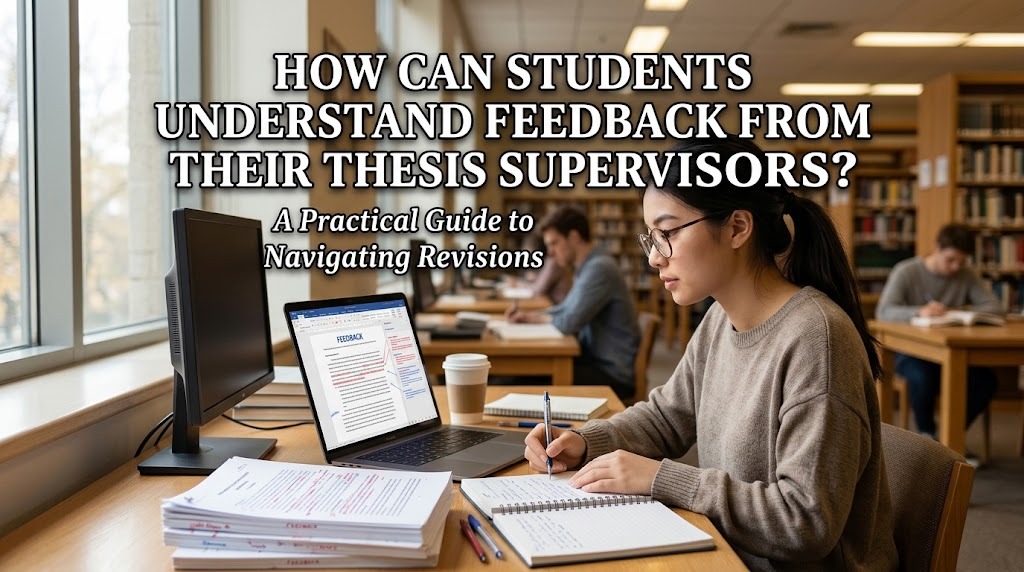
Receiving feedback from a thesis supervisor is an important part of the academic research process. Supervisors review students' work to identify weaknesses, provide suggestions, and ensure that the research meets academic requirements. Their comments may cover various aspects, including research arguments, methodology, data analysis, writing structure, and references. For students who are completing their first thesis, understanding these comments can sometimes be challenging.
Learning how to understand thesis supervisor feedback can help students complete revisions more accurately and avoid unnecessary corrections. Rather than treating comments as criticism, students should view them as guidance for improving their research. By reading feedback carefully, identifying the main issues, and communicating with supervisors, students can make the revision process more organized and productive.
READ EACH COMMENT CAREFULLY AND IDENTIFY THE MAIN ISSUE
The first step in understanding thesis supervisor feedback is reading every comment carefully. Students should avoid making immediate changes before understanding what the supervisor is asking them to improve. Some comments may be direct, such as correcting a sentence or adding a reference, while others may require students to reconsider an argument or provide a more detailed explanation.
After reading the comments, identify the main issue behind each suggestion. For example, a request to strengthen the research background may indicate that the existing explanation does not sufficiently establish the importance of the topic. Similarly, a comment about unclear findings may mean that the data need to be connected more directly to the research questions. Understanding the purpose of each correction helps students make changes that address the actual problem.
UNDERSTAND COMMON ACADEMIC TERMS USED IN FEEDBACK
Supervisors often use academic terms when reviewing thesis drafts. Words such as clarify, elaborate, restructure, justify, and provide evidence may appear in their comments. Students who are unfamiliar with these terms may find it difficult to determine what kind of revision is expected.
To understand these instructions, students can consult academic writing references or review examples from previous research. For instance, clarify generally means making an explanation easier to understand, while justify requires providing reasons or evidence to support a particular decision. If the meaning of a comment remains uncertain, students should ask their supervisors for a more specific explanation. Developing familiarity with academic feedback terminology can make future revisions easier to understand.
CONNECT FEEDBACK WITH THE RELEVANT THESIS SECTIONS
Supervisor comments usually refer to particular parts of the thesis, such as the introduction, literature review, methodology, findings, or conclusion. Students should identify where each correction belongs before making changes. This helps prevent mistakes, especially when one comment may affect several chapters.
For example, a change to the research objectives may require adjustments to the methodology and conclusion. Similarly, adding a theoretical explanation to the literature review may affect how the findings are discussed. Students can create a table containing the supervisor's comments, the relevant thesis section, and the action required. This thesis feedback organization method makes it easier to track corrections and maintain consistency throughout the document.
ASK FOR CLARIFICATION AND MAINTAIN COMMUNICATION
Not every supervisor comment will be immediately clear. Sometimes, instructions may be too brief, involve complex academic concepts, or appear inconsistent with earlier suggestions. In these situations, students should not rely entirely on personal assumptions. Asking for clarification can help prevent incorrect interpretations and unnecessary revisions.
Before contacting a supervisor, students should prepare specific questions and identify the sentences or sections they do not understand. For example, they can ask whether a particular explanation needs additional references or whether an entire section should be reorganized. It is also useful to communicate politely and provide context so that supervisors can respond more effectively. Effective communication with thesis supervisors helps students understand expectations and complete revisions in the right direction.
CREATE A REVISION CHECKLIST AND REVIEW THE CHANGES
After understanding the feedback, students should turn the comments into a practical revision checklist. Each item can describe the correction that needs to be completed, the section involved, and its current status. Students can mark tasks as pending, in progress, or completed to monitor their work systematically.
Once the revisions are finished, compare the updated thesis with the original feedback. Check whether every comment has been addressed and whether the changes have created inconsistencies in other sections. Students should also review grammar, citations, formatting, and the overall flow of the document. Preparing a brief summary of completed corrections can help supervisors review the revised version. Through a structured thesis revision checklist, students can make sure their work responds to feedback more thoroughly.
CONCLUSION
Students can understand feedback from thesis supervisors by reading comments carefully, learning common academic terms, connecting suggestions with the relevant thesis sections, and asking for clarification when necessary. These steps help students identify the purpose of each correction instead of making changes based on assumptions.
Organizing feedback into a revision checklist and reviewing completed changes can also make the process more manageable. Supervisor comments should be viewed as part of academic guidance that supports research improvement. With clear communication and a systematic approach, students can respond to feedback more confidently and produce a stronger final thesis.
Recent Posts

Bagaimana Sistem SKS pada Program Kuliah... 22.11.2026/47 View

How Does Technology Make Daily Evaluation... 21.11.2026/74 View

Apa Strategi Menghadapi Kesenjangan antara Kompetensi... 21.11.2026/75 View

Mengapa Inventaris Aset Penting bagi Kelancaran... 21.11.2026/72 View

When Should Musicians Join a Record... 21.11.2026/75 View
