

How Can Teachers Assess Students Numeracy Literacy Skills?
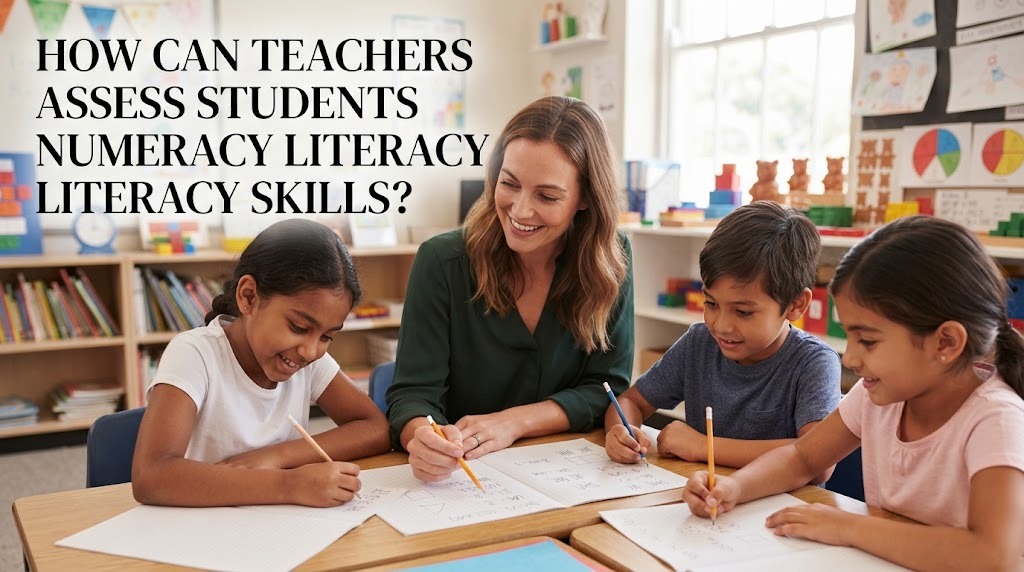
Numeracy literacy is an important ability that helps students understand and use mathematical information in real life. It includes more than performing calculations because students also need to interpret data, understand quantities, solve problems, and make decisions based on numerical information. For teachers, assessing numeracy literacy is important to understand how well students can apply mathematical knowledge in different situations. A good assessment should measure both mathematical understanding and the ability to use that understanding practically.
Teachers can use different assessment methods instead of relying only on traditional mathematics tests. Classroom activities, problem-solving tasks, projects, observations, and discussions can provide useful information about students' abilities. By using several methods, teachers can identify strengths, difficulties, and areas that require additional support. So, how can teachers assess students' numeracy literacy skills effectively?
USE REAL-LIFE PROBLEM-SOLVING QUESTIONS
Real-life problems can help teachers assess whether students can apply mathematics outside the classroom. Questions can involve shopping, budgeting, distance, time, measurements, percentages, or interpreting everyday information. Students should be asked to identify relevant information and determine which mathematical strategy is appropriate. This shows whether they understand how mathematics can be applied to practical situations.
Teachers should not focus only on whether the final answer is correct. The steps students use to reach an answer can provide important information about their reasoning. Asking students to explain their methods can reveal misunderstandings that may not be visible in a standard test. This makes real-life problem-solving tasks useful for assessing practical numeracy.
ASSESS DATA INTERPRETATION SKILLS
Students need to understand information presented in tables, graphs, charts, and simple statistics. Teachers can provide visual data and ask students to describe patterns, compare values, or draw conclusions. For example, students may analyze a graph showing monthly rainfall or a table containing survey results. These tasks assess whether students can understand and use numerical information.
Teachers can include questions that require more than reading individual numbers. Students can be asked to identify trends, calculate differences, or explain what the data suggests. They should also learn to distinguish information directly supported by the data from assumptions. This type of assessment helps teachers understand students' ability to use data in meaningful contexts.
OBSERVE STUDENTS DURING CLASS ACTIVITIES
Classroom observation can provide information that written tests may not capture. Teachers can observe how students approach mathematical problems, choose strategies, use learning materials, and respond to challenges. They can also notice whether students ask relevant questions or explain their reasoning to classmates. These observations can reveal how students use numeracy skills during natural learning situations.
Teachers can record specific observations using simple checklists or notes. For example, they can monitor whether a student can compare quantities, interpret a graph, estimate an answer, or explain a calculation. Regular observation allows teachers to track progress over time. It can also help identify students who need additional explanation or practice.
USE PROJECT-BASED ASSESSMENT
Projects can provide a broader way to assess numeracy literacy. Students might collect data, create a budget, conduct a simple survey, measure objects, or analyze information related to a practical topic. During the project, students need to select information, perform calculations, interpret results, and communicate their findings. This allows teachers to assess several numeracy skills within one activity.
Teachers should provide clear instructions and assessment criteria before students begin. The criteria can include accuracy, reasoning, data interpretation, problem-solving, and the ability to explain results. Students can present their findings through reports, presentations, tables, or charts. Project-based assessment can therefore show how students use mathematics in a more complete process.
CHECK STUDENTS' MATHEMATICAL REASONING
Numeracy literacy requires students to understand why an answer makes sense, not simply produce a number. Teachers can assess reasoning by asking students to explain their steps and justify their conclusions. Open-ended questions are particularly useful because they may allow students to use different valid strategies. This gives teachers a clearer picture of students' mathematical thinking.
For example, instead of asking only for the answer to a calculation, teachers can ask students to explain how they solved it. Students can also be given two possible solutions and asked to determine which one is reasonable. These activities encourage students to analyze information and evaluate their own thinking. Such evidence can help teachers identify conceptual understanding and reasoning skills.
USE SHORT FORMATIVE ASSESSMENTS
Short formative assessments can help teachers monitor learning during a lesson or unit. These assessments may include quick quizzes, exit tickets, short calculations, or one practical question. The purpose is to identify what students understand before moving to more advanced material. Teachers can then adjust instruction based on the results.
Formative assessment is most useful when feedback follows soon after the activity. Students can learn which part of their reasoning needs improvement instead of simply receiving a score. Teachers can also provide additional practice for concepts that many students find difficult. Regular formative assessment makes assessment part of the learning process.
INCLUDE SELF-ASSESSMENT AND PEER ASSESSMENT
Students can participate in assessing their own numeracy skills. Teachers can ask them to reflect on which mathematical concepts they understand well and which ones they still find difficult. Simple questions can help students think about their problem-solving strategies and learning progress. This encourages students to become more aware of their own learning.
Peer assessment can also provide useful learning opportunities when it is carefully guided. Students can review a classmate's solution and discuss whether the reasoning is clear and accurate. Teachers should provide simple criteria so students know what to look for. These activities can strengthen both numeracy understanding and communication skills.
USE CLEAR ASSESSMENT CRITERIA
Clear criteria help teachers assess numeracy literacy consistently. The criteria can cover calculation accuracy, understanding of concepts, data interpretation, reasoning, problem-solving, and communication. Students should understand what is expected before completing an assessment. Clear expectations can also make feedback easier to understand.
Teachers should avoid judging numeracy ability based only on speed. Some students may need more time to process information but still demonstrate strong reasoning. Assessment should consider the quality of mathematical thinking and the ability to apply knowledge. A balanced approach provides a more complete picture of students' numeracy literacy.
COMBINE DIFFERENT ASSESSMENT METHODS
No single assessment method can capture every aspect of numeracy literacy. A written test may measure calculations, while projects and observations can show how students apply mathematics in practical situations. Discussions can reveal reasoning, and data interpretation tasks can assess the ability to understand numerical information. Combining these methods gives teachers more evidence about student learning.
Teachers can use assessment results to plan follow-up instruction. Students who have difficulty with basic concepts may need additional practice, while others may benefit from more challenging problems. Assessment should therefore be connected to teaching and learning rather than treated only as a way to assign grades. This approach can help students develop stronger numeracy skills over time.
CONCLUSION
Teachers can assess students' numeracy literacy skills through real-life problem-solving tasks, data interpretation activities, classroom observations, projects, formative assessments, and mathematical reasoning exercises. Self-assessment and peer assessment can also provide additional insight into students' learning. Using clear criteria helps teachers evaluate different aspects of numeracy in a consistent way.
The most effective approach is to combine several assessment methods and use the results to guide further instruction. Numeracy literacy involves more than obtaining correct answers because students also need to understand information, explain their reasoning, and apply mathematics in practical situations. Through regular and varied assessment, teachers can better support students in developing confident and useful numeracy skills.
Recent Posts

Bagaimana Sistem SKS pada Program Kuliah... 22.11.2026/33 View

How Does Technology Make Daily Evaluation... 21.11.2026/67 View

Apa Strategi Menghadapi Kesenjangan antara Kompetensi... 21.11.2026/67 View

Mengapa Inventaris Aset Penting bagi Kelancaran... 21.11.2026/65 View

When Should Musicians Join a Record... 21.11.2026/66 View
