

How Can Teachers Identify Potential Science Olympiad Competitors?
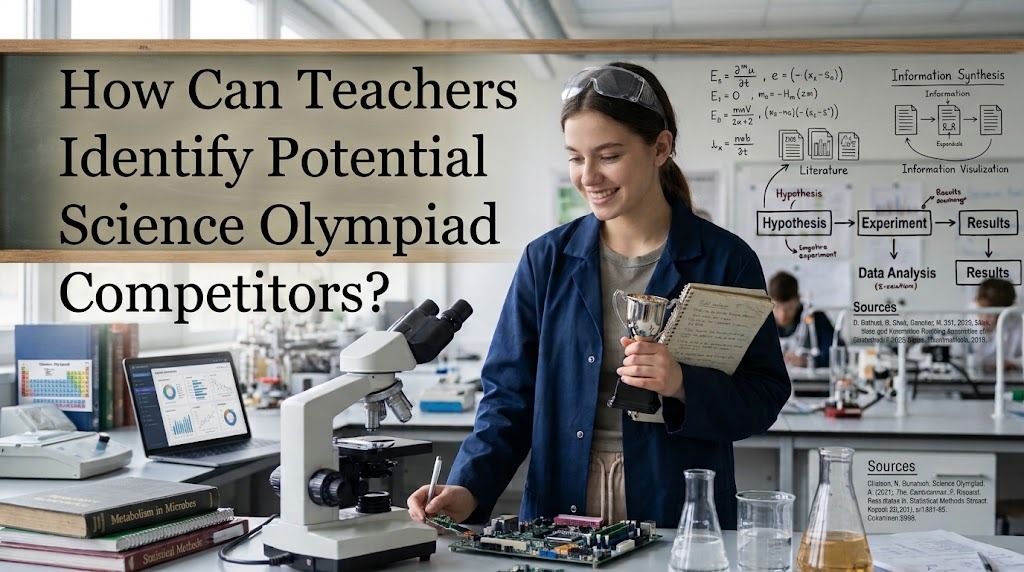
Identifying potential Science Olympiad competitors is an important step in developing students' scientific abilities and preparing them for academic competitions. Teachers play a significant role in recognizing learners who demonstrate curiosity, strong analytical thinking, and an interest in exploring scientific subjects.
However, selecting potential participants should not depend entirely on academic grades. Some students may have strong problem-solving abilities, creativity, or experimental skills that are not always reflected in regular classroom assessments. By observing students through different learning activities, teachers can identify individuals who have the potential to develop into successful Science Olympiad participants.
OBSERVING STUDENTS' INTEREST IN SCIENCE
One of the first ways teachers can identify potential competitors is by observing students' interest in scientific subjects. Students who frequently ask questions, participate in discussions, or show curiosity about natural phenomena may have a strong interest in science.
For example, a student may want to understand why certain chemical reactions occur, how the human body functions, or how physical forces influence everyday activities. This curiosity can indicate a willingness to explore scientific topics beyond regular classroom materials.
Teachers can encourage these students by providing additional reading materials, scientific projects, and opportunities to participate in academic activities. Genuine interest can become an important foundation for long-term competition preparation.
EVALUATING ACADEMIC PERFORMANCE
Academic performance can provide useful information when identifying potential Science Olympiad participants. Students who consistently demonstrate a strong understanding of mathematics and science subjects may already have the knowledge needed for more advanced learning.
Teachers can review examination results, classroom assignments, quizzes, and project evaluations to understand students' academic strengths. They can also identify learners who perform particularly well in specific scientific fields.
However, high grades should not be the only selection requirement. Students with average academic results may still demonstrate strong analytical abilities and considerable potential when given appropriate learning support.
ASSESSING CRITICAL THINKING ABILITIES
Science Olympiad competitions often require participants to analyze information, recognize patterns, and develop logical conclusions. Therefore, teachers should observe how students approach challenging questions rather than focusing only on their final answers.
Students who can explain their reasoning, compare different possibilities, and identify relationships between scientific concepts may demonstrate strong critical thinking abilities. They are also more likely to approach unfamiliar problems with curiosity.
Teachers can assess these abilities through open-ended questions, classroom discussions, case studies, and problem-solving exercises. These activities reveal how students process information and construct explanations.
IDENTIFYING STRONG PROBLEM-SOLVING SKILLS
Potential competitors often demonstrate an ability to approach difficult problems systematically. They may try different methods, break complex questions into smaller parts, and continue working even when the solution is not immediately clear.
Teachers can identify these qualities by providing challenging exercises that require students to apply several concepts at once. Observing their strategies can reveal whether they understand the underlying principles or simply rely on memorized formulas.
Problem-solving ability is particularly important because Science Olympiad questions may involve unfamiliar situations. Students who remain patient and flexible when facing difficult tasks can benefit from further competition training.
OBSERVING PARTICIPATION IN PRACTICAL EXPERIMENTS
Practical activities provide another opportunity to recognize students with scientific potential. During laboratory sessions, teachers can observe how learners handle equipment, follow procedures, record observations, and interpret experimental results.
Students who show accuracy, curiosity, and attention to detail may have useful abilities for competitions involving experimental investigations. Their willingness to test ideas and examine results can also indicate an interest in scientific research.
Teachers should provide opportunities for students to conduct simple experiments and participate in science projects. These activities help reveal practical strengths that may not appear in written examinations.
EVALUATING CREATIVITY AND SCIENTIFIC CURIOSITY
Scientific learning involves more than applying established formulas. Students also need creativity to consider different explanations, develop questions, and explore possible solutions.
Teachers can recognize creative learners by observing how they respond to open-ended problems. Some students may suggest unusual approaches, connect ideas from different subjects, or propose experiments to investigate everyday phenomena.
These qualities can support performance in Science Olympiad training because unfamiliar questions often require flexible thinking. Encouraging students to explore their own ideas can help develop their scientific potential.
CHECKING MOTIVATION AND LEARNING COMMITMENT
Science Olympiad preparation requires consistent effort and a willingness to study challenging materials. Teachers should therefore consider whether students are motivated to improve their knowledge and participate in additional learning activities.
Students who voluntarily complete extra exercises, seek explanations, or attend science enrichment sessions may demonstrate a strong commitment to learning. Their willingness to receive feedback and correct mistakes is also important.
Motivation should be evaluated over time rather than through a single activity. A student who remains interested and makes steady progress may have the commitment needed for a demanding preparation program.
USING DIAGNOSTIC TESTS AND SELECTION ACTIVITIES
Diagnostic tests can help teachers identify students who have the foundational knowledge and reasoning abilities required for Science Olympiad preparation. These assessments may include subject-specific questions, logical reasoning exercises, and problems that require scientific application.
Teachers can also organize selection activities such as mini competitions, science quizzes, laboratory tasks, and group problem-solving sessions. Different assessment formats provide a broader picture of students' abilities.
The results should be used to identify learning strengths and areas that need improvement. Diagnostic assessments are most useful when they guide further development rather than simply determine who is eligible to participate.
PROVIDING OPPORTUNITIES THROUGH SCIENCE CLUBS
Science clubs and extracurricular programs can help teachers discover students who may not initially stand out in regular classroom activities. These environments allow learners to explore scientific topics through projects, discussions, experiments, and collaborative activities.
Students who actively participate in science clubs may demonstrate curiosity, teamwork, creativity, and independent learning abilities. Teachers can observe their progress over several sessions and recognize individuals who are ready for more advanced challenges.
Science clubs also provide an opportunity to introduce students to the competition environment gradually. This can help them develop confidence before joining formal Science Olympiad training.
CONSIDERING STUDENT DEVELOPMENT AND POTENTIAL
Identifying potential competitors should involve evaluating both current abilities and opportunities for future improvement. Some students may already have strong scientific knowledge, while others may demonstrate rapid learning progress and a willingness to overcome difficulties.
Teachers should avoid judging students solely by their previous achievements or comparing them unfairly with classmates. Every learner has different strengths, learning experiences, and development needs.
A supportive selection process allows more students to demonstrate their abilities. It also helps schools build a wider group of potential participants who can receive appropriate guidance and training.
CONCLUSION
Teachers can identify potential Science Olympiad competitors by observing students' interest in science, academic performance, critical thinking, problem-solving abilities, and participation in practical activities. Motivation, creativity, and commitment to learning are also important factors in recognizing students who may benefit from competition training.
A combination of classroom observations, diagnostic tests, science clubs, and practical assessments can provide a more complete understanding of student potential. By offering fair selection opportunities and consistent guidance, teachers can help students develop their scientific abilities and prepare for future Science Olympiad competitions.
Recent Posts

Bagaimana Sistem SKS pada Program Kuliah... 22.11.2026/48 View

How Does Technology Make Daily Evaluation... 21.11.2026/76 View

Apa Strategi Menghadapi Kesenjangan antara Kompetensi... 21.11.2026/78 View

Mengapa Inventaris Aset Penting bagi Kelancaran... 21.11.2026/73 View

When Should Musicians Join a Record... 21.11.2026/78 View
