

How Can Teachers Support Students With Bodily Kinesthetic Intelligence?
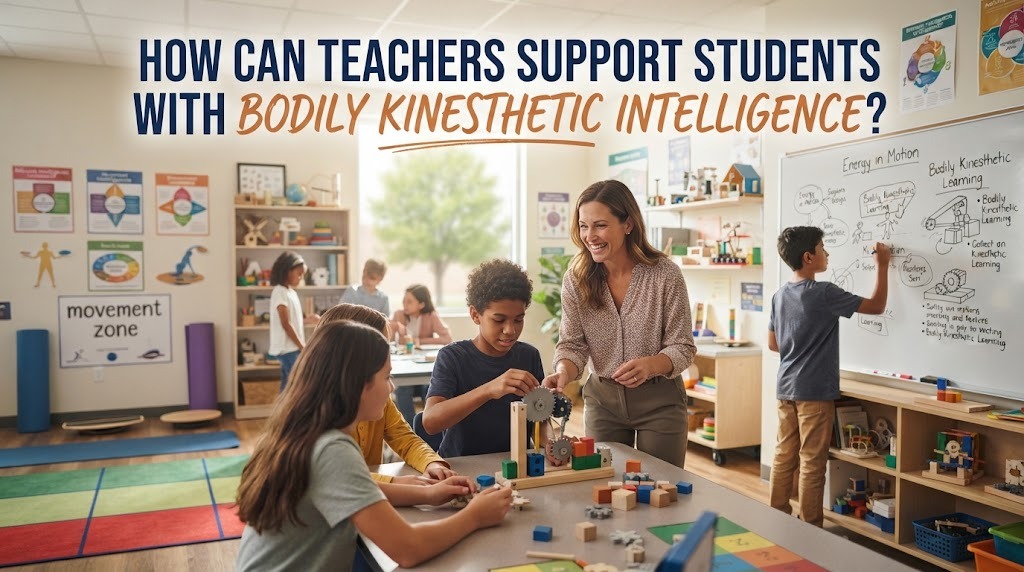
Every student has different strengths and ways of learning. Some students understand lessons better when they can move, touch, practice, and use their bodies during learning activities. This strength is often associated with bodily kinesthetic intelligence, one of the intelligences described in Howard Gardner’s theory of multiple intelligences. Teachers can support these students by creating learning activities that involve movement and direct experience. With the right approach, students can use their physical abilities while still developing their academic skills.
UNDERSTAND BODILY KINESTHETIC INTELLIGENCE
Bodily kinesthetic intelligence refers to the ability to use the body effectively to express ideas, solve problems, or perform physical activities. Students with this strength may enjoy hands on activities, sports, dancing, acting, building, or practical work. They may find it easier to understand certain concepts when they can physically interact with the learning material. However, this does not mean that every active student has the same learning needs. Teachers should observe each student and provide different learning opportunities.
It is also important to avoid assuming that a student can only learn through movement. Students can have several strengths at the same time, and their learning preferences can change depending on the subject and activity. Teachers can therefore combine physical activities with reading, discussion, visual materials, and other teaching methods. This creates a more flexible classroom environment. It also gives students opportunities to develop skills beyond their strongest area.
USE HANDS ON LEARNING ACTIVITIES
Teachers can provide activities that allow students to learn by doing rather than only listening to explanations. For example, science students can perform simple experiments, while mathematics students can use physical objects to understand measurements or shapes. History students can participate in role plays or classroom simulations to explore historical situations. These activities can make abstract ideas easier to connect with real experiences. They also give students an opportunity to actively participate in the learning process.
Hands on activities should still have clear learning goals. Movement alone does not automatically make an activity educational. Teachers should explain what students need to understand or demonstrate after completing the activity. This helps students connect physical experience with academic concepts. When planned carefully, practical activities can support both understanding and engagement.
INCLUDE MOVEMENT IN CLASSROOM ACTIVITIES
Teachers can introduce simple movement without turning every lesson into a physical exercise. Students can move between learning stations, arrange objects, act out concepts, or use gestures to represent information. Short activities involving controlled movement can also provide a change of pace during a long lesson. This can be especially useful when students need an active way to interact with the material. The movement should remain connected to the lesson so that it supports learning rather than becoming a distraction.
Teachers can also allow students to stand, demonstrate, or move when appropriate. For example, language students can act out new vocabulary, while students learning geography can use a classroom map to identify locations. These approaches provide opportunities to learn through physical interaction. Teachers should establish clear rules so that movement remains safe and organized. A structured environment helps students enjoy active learning without disturbing others.
USE ROLE PLAY AND DRAMA
Role play can be an effective way to combine movement, communication, and subject knowledge. Students can take different roles and act out situations related to the lesson. For example, they can perform a short conversation in a language class or recreate a situation from a history lesson. This allows students to use body movement, expression, communication, and problem solving at the same time. Role play can also make lessons more memorable because students directly experience the situation.
Teachers should provide clear instructions before students begin. Each student should understand their role and the learning objective of the activity. After the performance, teachers can ask students to reflect on what they learned and what they found difficult. This reflection helps connect the physical activity to deeper understanding. It also allows students to recognize how their actions contributed to the learning process.
PROVIDE PRACTICAL PROJECTS
Practical projects give students opportunities to create something while applying knowledge from different subjects. Students can build models, create simple products, conduct experiments, prepare demonstrations, or complete other project based activities. Such tasks require students to plan, use tools, solve problems, and make decisions. These experiences can be especially useful for students who enjoy working with their hands. At the same time, projects can develop communication, teamwork, creativity, and responsibility.
Teachers should divide large projects into clear steps so students know what to do. They can provide guidance while still allowing students to make their own decisions when possible. Assessment should consider both the learning process and the final result. This helps students understand that learning is not only about the finished product. The process of planning, testing, improving, and presenting can also provide valuable learning experiences.
CONNECT LEARNING WITH REAL LIFE
Students may understand lessons better when they can see how knowledge is used outside the classroom. Teachers can connect lessons with real world activities such as cooking, gardening, sports, crafts, simple repairs, or community projects when appropriate. These activities show students that academic concepts can be applied to practical situations. For example, mathematics can be connected to measuring ingredients, while science can be explored through gardening activities. Real life connections can make learning more meaningful and easier to remember.
Teachers do not need expensive equipment to create these experiences. Simple classroom materials can often be used to demonstrate important concepts. The main goal is to give students opportunities to apply knowledge through action. Teachers can then ask students to explain what they did and why they did it. This combination of action and explanation can strengthen understanding.
ENCOURAGE DIFFERENT WAYS TO SHOW UNDERSTANDING
Students should have opportunities to demonstrate what they know in different ways when appropriate. Instead of always requiring written answers, teachers can sometimes allow students to give demonstrations, presentations, models, performances, or practical tasks. This can help students show knowledge through their physical and creative abilities. However, written and verbal communication remain important skills that students also need to develop. Offering varied activities should complement these skills rather than replace them completely.
Teachers can use different forms of assessment depending on the learning objective. A practical demonstration may be suitable for one topic, while a written test may be more appropriate for another. Clear assessment criteria should be provided so students understand how their work will be evaluated. This creates a fair learning environment while allowing different strengths to be recognized. Variety can also make assessment more engaging for students.
CREATE A SAFE AND SUPPORTIVE CLASSROOM
Physical activities require a classroom environment where students feel safe to participate. Teachers should establish clear rules about safety, space, equipment, and respectful behavior before starting active activities. Students should know how to use materials correctly and how to move safely around others. Teachers should also make sure activities are accessible to students with different physical abilities. A supportive classroom allows students to participate without feeling embarrassed about their abilities.
Teachers should also encourage students when they make mistakes. Practical activities often involve trial and error, so mistakes can become part of the learning process. Instead of focusing only on perfect performance, teachers can emphasize effort, improvement, and problem solving. Positive feedback can help students become more confident when participating. This approach supports both physical development and academic learning.
CONCLUSION
Teachers can support students with bodily kinesthetic intelligence by providing opportunities to move, practice, create, demonstrate, and learn through direct experience. Hands on activities, role play, practical projects, movement, and real life applications can make learning more engaging. However, teachers should not limit these students to physical activities because students can have different strengths and learning needs. Combining movement with reading, discussion, visual materials, and reflection can create a balanced learning experience. With thoughtful planning and a safe and supportive classroom, teachers can help students use their physical strengths while developing broader academic and social skills.
Recent Posts

Bagaimana Sistem SKS pada Program Kuliah... 22.11.2026/31 View

How Does Technology Make Daily Evaluation... 21.11.2026/67 View

Apa Strategi Menghadapi Kesenjangan antara Kompetensi... 21.11.2026/66 View

Mengapa Inventaris Aset Penting bagi Kelancaran... 21.11.2026/64 View

When Should Musicians Join a Record... 21.11.2026/65 View
