

How Can Technology Help Create Academic Citations?
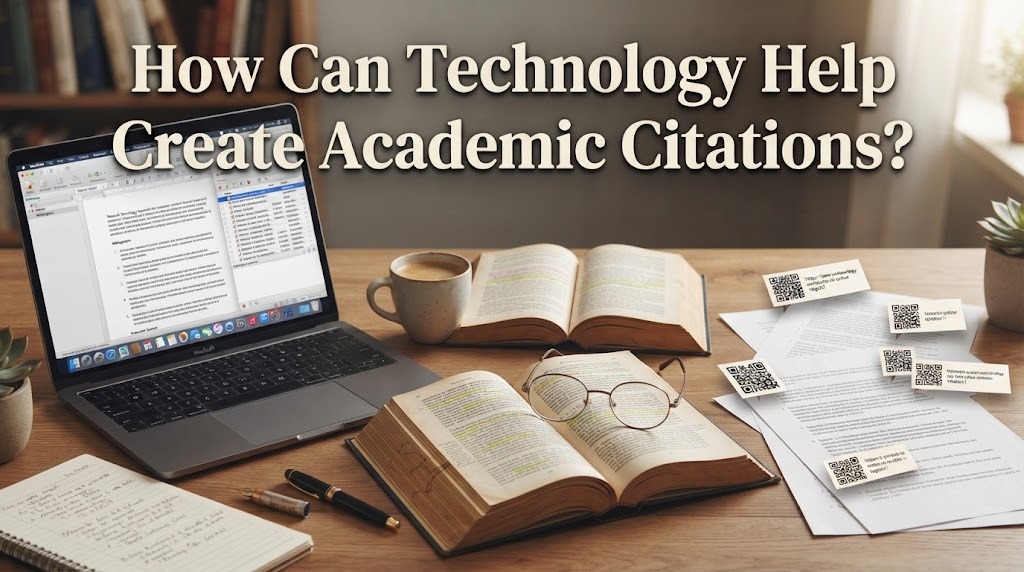
Technology has changed the way students and researchers create academic citations. In the past, writers often had to format every citation manually by checking printed style guides and source information. Today, digital tools can collect source details, organize research materials, and generate citations more quickly. These tools can make the citation process faster, easier, and more organized when used correctly.
However, technology does not completely replace the writer's responsibility. Citation tools can sometimes contain incorrect or incomplete information, especially when source details are missing. Writers should therefore understand basic citation principles and verify automatically generated citations. Combining technology with careful human review can produce more accurate academic references.
HOW TECHNOLOGY SUPPORTS ACADEMIC CITATIONS
Technology can help writers create citations by automatically organizing information about books, journal articles, websites, and other sources. Some tools can recognize bibliographic details and convert them into a selected citation style. This can reduce the amount of time spent typing author names, titles, dates, and publication information. It is particularly useful when an academic paper contains many sources.
Digital citation tools can also help writers store and manage sources in one place. Instead of keeping source information in separate notes, users can organize references digitally and retrieve them when needed. Some applications can connect references directly to a word processor or research platform. This makes it easier to insert citations while writing.
USING CITATION GENERATORS
A citation generator is a digital tool that creates citations based on information entered by the user. Depending on the tool, users may enter a DOI, URL, book title, or other source information. The generator then produces a citation in styles such as APA, MLA, or Chicago. This can be useful for students who need to create many citations within a short period.
Although citation generators are convenient, they should not be treated as completely reliable. A generator may misunderstand a source type, use incomplete information, or apply formatting that does not match the latest requirements. Writers should always check the generated citation against the original source and relevant style guidelines. Technology should assist the writing process rather than replace critical checking.
USING REFERENCE MANAGEMENT SOFTWARE
Reference management software allows users to collect, organize, and manage academic sources digitally. These applications can store information about journal articles, books, websites, and other materials. Many tools also allow users to create folders or groups for different research projects. This makes large collections of sources easier to manage.
Some reference managers can automatically generate in-text citations and reference lists while the writer works on a document. If the citation style needs to be changed, certain applications can update the formatting throughout the document. This feature can save considerable time when working on long academic papers. However, the generated information should still be reviewed for accuracy.
USING DOI AND ONLINE DATABASES
Technology also makes it easier to identify academic sources through DOIs and online research databases. A DOI provides a persistent identifier for many scholarly publications and can help retrieve accurate publication information. Academic databases may provide author names, article titles, journal information, publication dates, and other bibliographic details. These features can reduce errors when collecting source information.
Writers should still confirm that the information retrieved from a database matches the original publication. Different databases may display information differently or contain incomplete records. Using reliable academic databases and checking the original source can improve citation accuracy. This is especially important when preparing research papers, theses, and other formal academic documents.
USING WORD PROCESSORS FOR CITATIONS
Modern word processors can also support academic citation management. Some programs allow users to insert citations and create bibliographies directly within a document. Writers can select a citation style and enter information about their sources. The software can then organize the citations and bibliography according to the selected settings.
These features are useful because they keep citations connected to the document while it is being edited. If sources are added or removed, the software may update the citation list automatically. However, automatic formatting does not guarantee that every citation is correct. Writers should still compare the final document with the required academic citation guidelines.
USING BROWSER TOOLS AND ONLINE RESEARCH FEATURES
Web browsers and academic websites can make it easier to collect source information during research. Some academic databases provide tools that allow users to export citation information directly into reference managers. Certain websites also provide citation information for articles and other publications. These features can help researchers collect sources more efficiently.
However, writers should not assume that every online citation feature is accurate. Web-based citation information should be checked before being included in an academic paper. Important details such as author names, dates, titles, and publication information may sometimes be missing or incorrect. Careful verification remains necessary even when technology provides an automatically generated citation.
USING AI TO SUPPORT CITATION CREATION
Artificial intelligence can assist with citation-related tasks, such as organizing source information, identifying citation details, and explaining citation formats. AI tools can also help writers understand how different citation styles work. For example, they may explain the general structure of an APA or MLA reference. This can be useful for students who are learning academic citation.
However, AI-generated citations should be treated with caution. AI systems may sometimes provide incorrect, incomplete, or fabricated source information if they do not have access to the actual source. Writers should never rely on an AI-generated reference without checking that the source exists and that its details are accurate. The original publication and official citation guidelines should remain the main sources for verification.
BENEFITS OF TECHNOLOGY FOR ACADEMIC CITATIONS
One major benefit of technology is time efficiency. Digital tools can automate repetitive tasks that would otherwise require manual formatting. They can also organize hundreds of sources more efficiently than handwritten or scattered notes. This allows writers to spend more time analyzing research and developing their arguments.
Technology can also improve organization and consistency. Reference managers can keep source information together and help writers apply the same citation style throughout a document. They can reduce certain formatting mistakes and make it easier to update references. When used responsibly, technology can make academic citation more manageable.
LIMITATIONS AND RISKS OF CITATION TECHNOLOGY
Despite its advantages, citation technology has limitations. Automated tools may produce incorrect author names, publication dates, titles, or formatting when the source data is incomplete. Some tools may also fail to recognize unusual source types correctly. As a result, writers who rely entirely on automation may submit inaccurate citations.
Another risk is that users may stop learning the basic principles of academic citation. Understanding citation rules remains important because writers need to judge whether a generated citation is appropriate. Technology should therefore be viewed as a supporting tool rather than a replacement for academic knowledge. Human judgment is still essential when selecting, checking, and documenting sources.
BEST PRACTICES FOR USING TECHNOLOGY
The best approach is to combine digital tools with manual verification. First, collect source information from reliable publications or academic databases. Then use a citation generator, reference manager, or word processor to organize the information. After generating the citation, compare it with the original source and the required citation style.
Writers should also keep their research materials organized from the beginning. Saving the original source, recording important bibliographic details, and checking citations before submission can prevent many problems. It is also useful to use the latest guidelines required by the institution or publication. These habits allow technology to improve efficiency without sacrificing citation accuracy.
CONCLUSION
Technology can make academic citation faster, easier, and more organized. Citation generators, reference management software, word processors, academic databases, DOI systems, and AI tools can all support different parts of the citation process. These technologies are particularly helpful when writers need to manage a large number of academic sources.
However, technology should not replace critical thinking and human verification. Automated citations can contain errors, so writers should always check source information against the original publication and the required citation style. By using technology responsibly, students and researchers can create more accurate, consistent, and professional academic citations.
Recent Posts

Bagaimana Sistem SKS pada Program Kuliah... 22.11.2026/40 View

How Does Technology Make Daily Evaluation... 21.11.2026/71 View

Apa Strategi Menghadapi Kesenjangan antara Kompetensi... 21.11.2026/73 View

Mengapa Inventaris Aset Penting bagi Kelancaran... 21.11.2026/69 View

When Should Musicians Join a Record... 21.11.2026/73 View
