

How Can Technology Help Improve Numeracy Literacy?
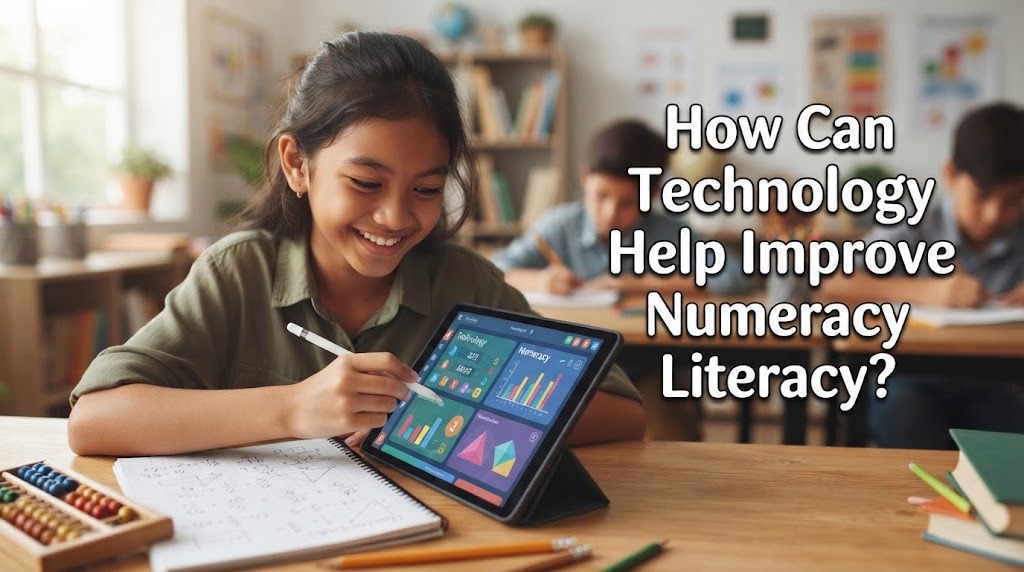
Technology has changed the way people learn, work, and solve everyday problems. Digital tools can make mathematical information easier to understand through interactive activities, visual content, and practical exercises. For students, technology can provide additional opportunities to practice numeracy skills beyond the traditional classroom.
Numeracy literacy is not only about performing calculations. It also involves understanding numbers, interpreting data, recognizing patterns, and applying mathematical knowledge to real situations. When used appropriately, technology can support these abilities and make numeracy learning more engaging, flexible, and connected to daily life.
MAKING NUMERACY LEARNING MORE INTERACTIVE
Technology can turn traditional mathematical exercises into interactive learning activities. Educational applications and digital platforms can provide quizzes, simulations, games, and problem-solving exercises. These features allow students to practice numerical concepts while receiving immediate responses to their answers.
Interactive activities can also make difficult concepts easier to explore. Instead of only reading an explanation, students may manipulate numbers, graphs, or visual models directly. This can help them understand how mathematical concepts work and encourage them to learn through practice.
USING EDUCATIONAL APPLICATIONS
Educational applications can provide structured opportunities to practice numeracy skills. Many learning applications include exercises involving arithmetic, percentages, measurements, statistics, and problem-solving. Students can choose activities based on their current level and repeat exercises when they need additional practice.
These applications can also provide feedback after an exercise is completed. Students can identify mistakes and review the concepts they have not yet understood. However, applications should be used as learning tools rather than simply as a way to obtain answers.
HELPING STUDENTS UNDERSTAND DATA
Modern technology makes it easier to collect, organize, and display data. Spreadsheet applications can be used to create tables, calculate values, and produce graphs. These activities can introduce students to practical data analysis in a way that is connected to real situations.
For example, students can record daily expenses and create a simple chart to understand their spending patterns. They can also collect information from a class survey and represent the results in a graph. Through activities like these, students learn how numbers can be used to describe and understand situations.
PROVIDING VISUAL EXPLANATIONS
Some mathematical concepts can be difficult to understand when they are presented only through text or formulas. Technology can provide visual explanations using charts, diagrams, animations, and interactive models. These formats can help students see relationships between numbers and concepts more clearly.
Visual tools can be particularly useful when learning topics such as fractions, percentages, geometry, and statistics. Students can observe how changing one value affects another. This can support deeper understanding rather than relying only on memorization.
SUPPORTING PERSONALIZED LEARNING
Technology can give students more flexibility in choosing how and when they practice numeracy. Digital learning platforms can provide exercises with different levels of difficulty. Students can spend more time on topics they find challenging and move forward when they are ready.
This flexibility can support different learning needs. Some students may need additional practice with basic calculations, while others may benefit from more complex data interpretation. Teachers can also use digital learning information to identify areas where students need additional support.
CONNECTING NUMERACY WITH REAL LIFE
Technology can make numeracy literacy more relevant by connecting mathematical concepts with everyday activities. Students can use budgeting applications, online shopping platforms, navigation tools, calculators, and other digital services to explore numerical information. These examples demonstrate that mathematics is present in many aspects of modern life.
For instance, a student can use a budgeting spreadsheet to track income and expenses. A navigation application can also demonstrate the relationship between distance, time, and estimated arrival. By working with these practical examples, students can understand why numeracy skills are useful outside the classroom.
ENCOURAGING PROBLEM SOLVING
Digital tools can provide realistic problems that require students to analyze information before reaching an answer. Instead of simply solving an equation, students may need to compare data, estimate results, identify patterns, or select an appropriate method. This approach can strengthen problem-solving skills.
Technology can also allow students to experiment with different solutions. If an approach does not work, they can make changes and try again. This process encourages students to view mistakes as opportunities to learn and improve their understanding.
INTRODUCING SPREADSHEETS AND DIGITAL CALCULATIONS
Spreadsheet software is a useful tool for developing practical numeracy skills. Students can use formulas to perform calculations, organize information, and create charts. Learning these basic functions can also prepare students for tasks they may encounter in higher education and the workplace.
However, students should understand the mathematical process behind the tools they use. A spreadsheet can calculate a result quickly, but users still need to know what the result means. Understanding the reasoning behind a calculation helps prevent incorrect interpretations and supports stronger numeracy literacy.
HELPING STUDENTS LEARN AT THEIR OWN PACE
Digital resources allow students to review lessons whenever they need them. Recorded explanations, online exercises, digital textbooks, and educational videos can be accessed repeatedly. This can be helpful when students need more time to understand a particular concept.
Learning at an individual pace can also encourage students to take greater responsibility for their progress. They can identify topics they find difficult and search for additional explanations or exercises. At the same time, guidance from teachers remains important to ensure that students use reliable resources and understand the concepts correctly.
DEVELOPING DIGITAL AND NUMERACY SKILLS TOGETHER
Numeracy literacy and digital literacy are increasingly connected. People need numerical skills to understand digital information, while digital tools can help them work with numbers more efficiently. Learning both skills together can prepare students for environments where technology and data are part of everyday activities.
Students should therefore learn not only how to operate digital tools but also how to evaluate the information produced by those tools. They need to understand whether data is presented accurately, whether a calculation makes sense, and whether a conclusion is supported by the available information. This combination of digital and numerical skills can support more responsible decision-making.
CONCLUSION
Technology can help improve numeracy literacy by making learning more interactive, visual, flexible, and connected to real-life situations. Educational applications, spreadsheets, digital simulations, graphs, and practical tools can provide students with more opportunities to practice calculations, understand data, and solve problems.
However, technology works best when it supports understanding rather than replacing mathematical thinking. Students still need to learn how numbers work, explain their reasoning, and evaluate whether a result is reasonable. With appropriate guidance and regular practice, technology can become a useful tool for developing strong numeracy literacy.
Recent Posts

Bagaimana Sistem SKS pada Program Kuliah... 22.11.2026/33 View

How Does Technology Make Daily Evaluation... 21.11.2026/67 View

Apa Strategi Menghadapi Kesenjangan antara Kompetensi... 21.11.2026/67 View

Mengapa Inventaris Aset Penting bagi Kelancaran... 21.11.2026/65 View

When Should Musicians Join a Record... 21.11.2026/66 View
