

How Can Technology Help Students Develop Logical Intelligence?
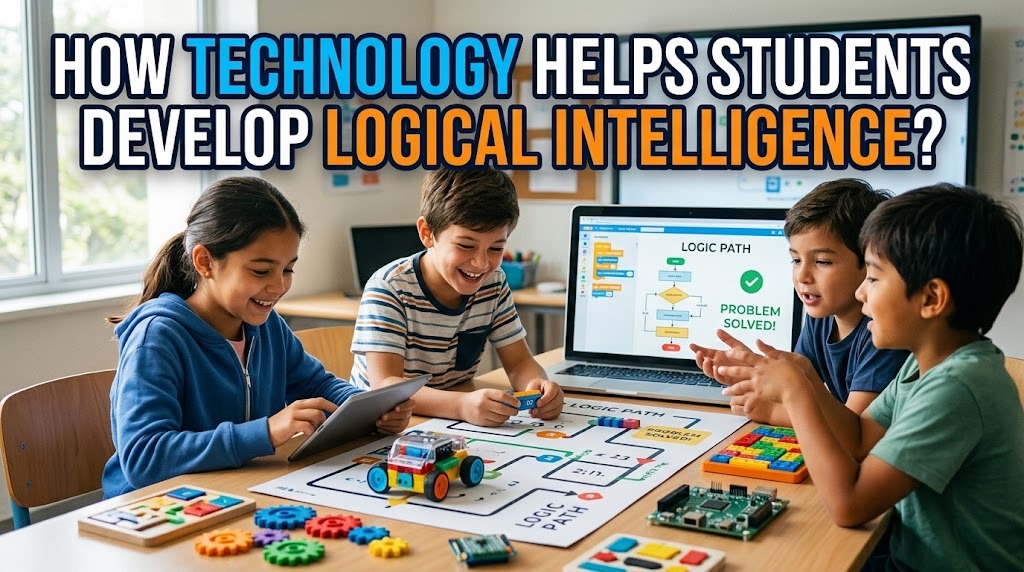
Technology has become an important part of modern education. Students can use digital tools to access information, practice skills, and explore different ways of solving problems. When used appropriately, technology can provide opportunities to develop logical intelligence through activities that require analysis, reasoning, and decision making. Digital learning can also make complex concepts easier to explore through interactive content. However, students need to use technology actively rather than simply consuming information.
UNDERSTANDING LOGICAL INTELLIGENCE
Logical intelligence is the ability to analyze information, recognize patterns, understand relationships, and use reasoning to solve problems. This ability is useful when students need to understand complex concepts or determine the most appropriate solution to a question. Logical intelligence is not limited to mathematics because it can also be applied to science, language, business, technology, and other fields. Students can develop it through activities that require them to think systematically.
Technology can support this development by providing digital environments where students can practice reasoning. Interactive exercises, simulations, educational applications, and coding platforms can encourage students to analyze information and test possible solutions. These activities often provide immediate feedback, allowing students to identify mistakes and try different approaches. As a result, technology can become a useful tool for practicing logical thinking.
USING EDUCATIONAL APPLICATIONS
Educational applications can provide students with exercises designed to improve reasoning and problem-solving abilities. Mathematics applications, logic puzzles, quizzes, and interactive learning platforms can encourage students to find patterns and understand relationships between concepts. Interactive learning allows students to practice skills repeatedly and receive feedback about their answers. This can make the learning process more active than simply reading information.
Students can also choose applications that match their learning needs and interests. For example, a student who enjoys problem solving may practice logic puzzles, while another student may explore mathematical simulations. The important factor is understanding the reasoning behind an answer rather than simply trying to obtain a high score. Active participation makes technology more useful for developing logical intelligence.
DEVELOPING LOGICAL THINKING THROUGH CODING
Coding is another technology-based activity that can support logical intelligence. When writing a program, students need to organize instructions in a particular sequence and determine how different commands work together. Programming requires logical reasoning, problem solving, and attention to detail. If a program does not work correctly, students need to identify the error and find a suitable solution.
Coding also teaches students that complex tasks can be divided into smaller steps. They can test one part of a program, examine the result, and make changes when necessary. This process encourages systematic thinking and problem solving. Students do not need to become professional programmers to benefit from these skills because basic coding activities can already provide useful reasoning practice.
LEARNING THROUGH SIMULATIONS AND INTERACTIVE CONTENT
Digital simulations can help students explore situations that may be difficult to experience directly in a traditional classroom. Simulations can represent scientific experiments, business situations, mathematical concepts, or other learning environments. Students can change certain variables and observe how the results change. This process helps students understand cause-and-effect relationships and encourages them to analyze outcomes.
Interactive content can also allow students to experiment without immediately facing real-world consequences. They can test an idea, observe the result, and try another approach. This creates opportunities for experimentation, analysis, and reflection. When students explain why a particular result occurred, they are practicing logical reasoning rather than simply watching information.
USING TECHNOLOGY RESPONSIBLY
Technology can support logical intelligence, but the way students use it is important. Simply searching for an answer or allowing an application to complete every task does not necessarily develop reasoning skills. Students should try to understand the process behind an answer and evaluate whether the information they receive is accurate. This encourages independent thinking and prevents excessive dependence on digital tools.
Students should also compare information from reliable sources when researching a topic. Online information can vary in quality, so checking the source, evidence, and context is an important part of critical thinking. Responsible technology use combines digital skills with human reasoning. Teachers and parents can support students by encouraging them to explain their answers and evaluate the information they find online.
CONCLUSION
Technology can help students develop logical intelligence by providing interactive opportunities to analyze information, solve problems, and test different solutions. Educational applications, coding activities, simulations, and interactive learning materials can make reasoning practice more engaging. These tools can also provide feedback that helps students identify mistakes and improve their understanding. However, technology is most useful when students actively think about the information and processes involved.
Students can gain greater benefits by using digital tools as learning aids rather than relying on them to provide every answer. Questioning information, solving problems independently, testing ideas, and reflecting on results can strengthen logical thinking. With responsible use, technology can support students in developing reasoning skills that are useful for academic learning and future challenges.
Recent Posts

Bagaimana Sistem SKS pada Program Kuliah... 22.11.2026/21 View

How Does Technology Make Daily Evaluation... 21.11.2026/63 View

Apa Strategi Menghadapi Kesenjangan antara Kompetensi... 21.11.2026/65 View

Mengapa Inventaris Aset Penting bagi Kelancaran... 21.11.2026/62 View

When Should Musicians Join a Record... 21.11.2026/59 View
