

How Can You Develop Visual Intelligence from an Early Age?
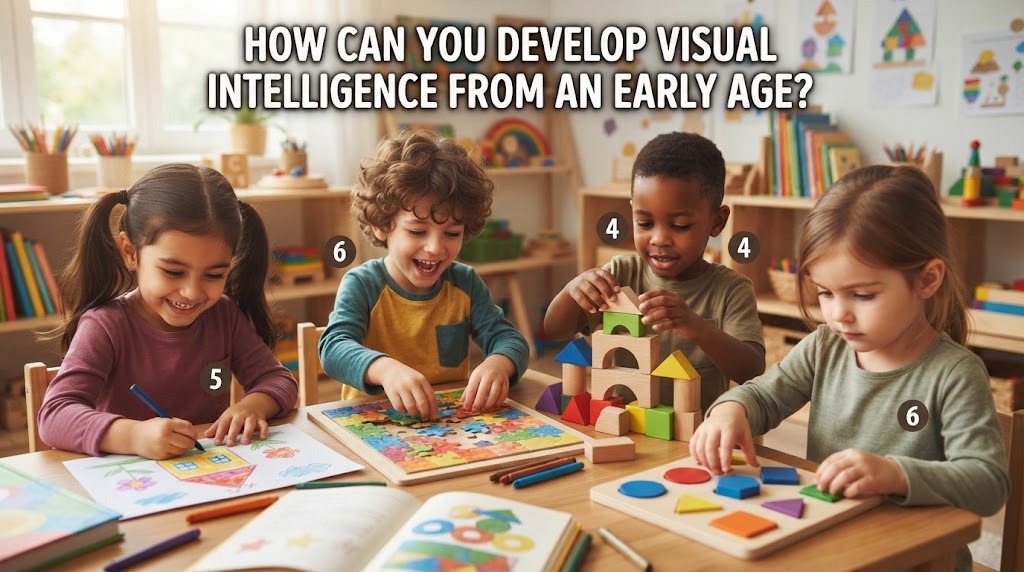
Visual intelligence is the ability to understand, interpret, remember, and organize visual information. This ability helps children recognize shapes, colors, patterns, sizes, directions, and relationships between objects. Developing visual intelligence from an early age can support learning, creativity, spatial awareness, and problem solving. The process does not need to be complicated because many simple activities can provide useful visual practice.
Children naturally explore their surroundings through observation and play. Parents and teachers can support this development by providing activities that encourage children to look carefully, compare objects, imagine possibilities, and understand space. With regular practice and age-appropriate activities, children can gradually strengthen their visual thinking skills.
START WITH SHAPES AND COLORS
Learning basic shapes and colors is a simple way to introduce children to visual intelligence. Parents can ask children to identify circles, squares, triangles, rectangles, and other familiar shapes around them. Children can also sort objects according to their colors, sizes, or shapes. These activities help them notice similarities and differences between visual elements.
Simple games can make this learning process more enjoyable. For example, children can search for objects with the same color around the house or match cards with identical shapes. These activities encourage visual recognition while allowing children to learn through play. As children become more familiar with basic visual characteristics, they can gradually work with more complex patterns.
ENCOURAGE DRAWING AND CREATIVE ACTIVITIES
Drawing is another useful activity for developing children's visual intelligence. When children draw, they learn to observe lines, shapes, proportions, positions, and details. They also begin to understand how different elements can be combined to create an image. The goal should not be perfect artwork but the opportunity to observe and express ideas visually.
Parents can encourage children to draw familiar objects such as houses, animals, people, or toys. They can also ask children to draw an object from different positions or create their own imaginary scenes. These activities combine visual thinking and creativity and allow children to practice turning mental images into visible forms.
USE PUZZLES AND BUILDING GAMES
Puzzles and building activities can strengthen children's spatial awareness. Jigsaw puzzles require children to compare shapes, colors, and images to determine where pieces belong. Building blocks, construction toys, and similar activities require children to think about size, balance, position, and structure.
These activities also introduce problem solving in an enjoyable way. When a piece does not fit, children need to examine it and try another position. They gradually learn that changing an object's position can produce a different result. This supports spatial reasoning and helps children understand how objects relate to one another.
READ PICTURE BOOKS AND VISUAL STORIES
Picture books can provide valuable opportunities for children to develop visual intelligence. Children can observe characters, objects, settings, colors, and sequences while following a story. Parents can ask questions such as what the child sees, what might happen next, or how two pictures are different.
Visual storytelling can also help children understand sequences and relationships. For example, a series of pictures can show how a seed becomes a plant or how a character completes a task. Asking children to explain the sequence encourages them to observe details and connect visual information with meaning.
PRACTICE PATTERN RECOGNITION
Pattern recognition is an important part of visual intelligence. Parents can introduce simple patterns using colors, shapes, numbers, objects, or movements. For example, a child can complete a sequence such as circle, square, circle, square, and identify what should come next.
As children develop, the patterns can become more complicated. They can also create their own patterns and explain the rule behind them. This encourages children to observe relationships instead of simply memorizing individual elements. Regular pattern activities can support visual reasoning and logical thinking.
EXPLORE MAPS AND SPATIAL ACTIVITIES
As children grow, simple maps and spatial activities can provide more advanced visual practice. Parents can draw a basic map of a room, classroom, playground, or familiar area and ask children to identify different locations. Children can also practice giving directions using words such as left, right, above, below, near, and far.
These activities help children understand position, distance, direction, and spatial relationships. Older children can gradually work with more detailed maps or simple floor plans. Such activities can make visual intelligence useful in practical situations while strengthening their ability to understand space.
MAKE VISUAL LEARNING PART OF DAILY LIFE
Developing visual intelligence does not have to happen only during formal learning sessions. Everyday activities can provide opportunities for children to practice visual skills. Sorting toys, arranging objects, observing nature, cooking, organizing a room, and identifying signs can all encourage children to observe and compare visual information.
Parents and teachers should focus on making these activities enjoyable rather than treating them as tests. Children develop at different rates, so activities should be adjusted according to their age and abilities. Giving children opportunities to explore, ask questions, experiment, and make mistakes can create a positive environment for developing visual intelligence.
CONCLUSION
Developing visual intelligence from an early age can support children's learning, creativity, spatial awareness, memory, and problem solving. Simple activities such as drawing, puzzles, building games, picture books, pattern exercises, and basic maps can provide valuable practice. These activities help children understand shapes, relationships, positions, and visual patterns through enjoyable experiences.
The most important part is consistency and age-appropriate practice. Parents and teachers do not need expensive equipment because many useful activities can be done with everyday objects. By making visual learning a natural part of play and daily activities, children can gradually build stronger visual thinking skills that may support them as they grow.
Recent Posts

Bagaimana Sistem SKS pada Program Kuliah... 22.11.2026/21 View

How Does Technology Make Daily Evaluation... 21.11.2026/63 View

Apa Strategi Menghadapi Kesenjangan antara Kompetensi... 21.11.2026/65 View

Mengapa Inventaris Aset Penting bagi Kelancaran... 21.11.2026/62 View

When Should Musicians Join a Record... 21.11.2026/59 View
