

How Can You Find Free Academic References Through Google Scholar?
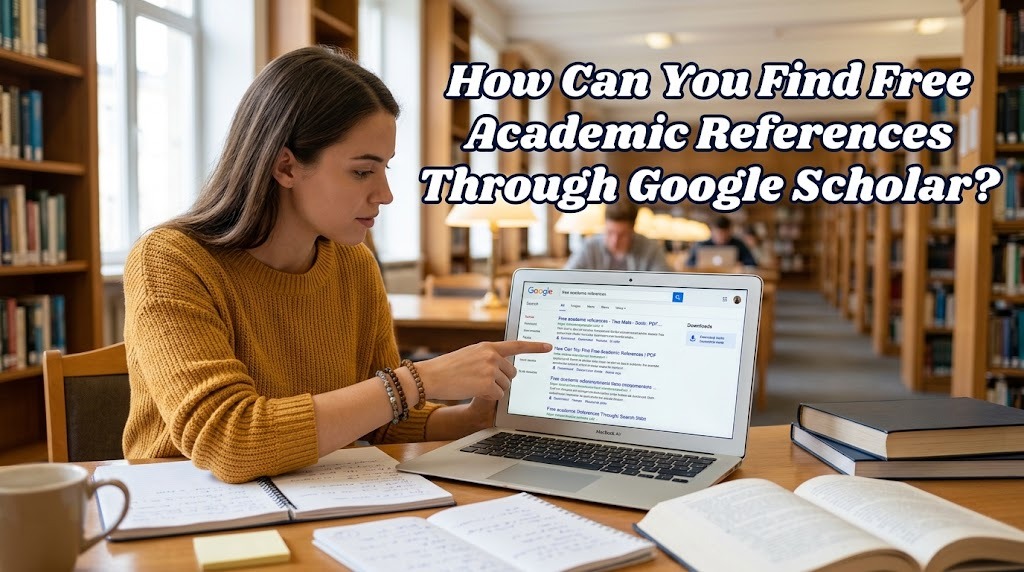
Academic references are essential for students who need to write essays, research papers, theses, and other academic assignments. However, access to scholarly publications can sometimes be limited by subscription fees or institutional access requirements. This can make it difficult for students to obtain the full text of important research articles. Google Scholar can help users discover academic publications and, in many cases, identify freely accessible versions available online.
Finding free academic references through Google Scholar requires careful searching because not every result provides unrestricted full-text access. Students need to distinguish between a publication being indexed in Google Scholar and having a free full-text version available. By using the platform's access links and checking reputable repositories, students can find useful academic materials without relying entirely on paid sources.
SEARCH FOR ACADEMIC REFERENCES
The first step is to enter specific keywords related to the research topic into Google Scholar. More precise searches can make it easier to identify relevant academic publications. Students can combine keywords related to their subject, research variables, population, or field of study. This approach reduces the number of unrelated results that need to be reviewed.
After searching, students should examine the results carefully. Important information such as the article title, author, publication year, journal, and abstract can help determine whether a source is suitable. Students should prioritize sources that directly address their research questions. This prevents them from spending time trying to access articles that are not useful for their academic work.
LOOK FOR FREE FULL TEXT LINKS
Google Scholar may display links to accessible versions of publications on the right side of a search result or below the main result information. These links can sometimes lead to publisher pages, institutional repositories, university websites, or other legitimate sources. If a free version is available, students can follow the provided link to access the article. Availability depends on the publication and the rights associated with it.
A free version may not always be hosted on the journal's main website. Researchers sometimes deposit versions of their work in institutional repositories or subject repositories. These versions can provide legitimate access to academic research. Students should pay attention to the version of the paper and its bibliographic information when using it as a reference.
USE UNIVERSITY AND INSTITUTIONAL REPOSITORIES
Many universities maintain repositories where researchers can make academic publications available. Google Scholar can index documents from these repositories, making them easier to discover through academic searches. Students may find theses, dissertations, conference papers, manuscripts, and research articles through these sources. Institutional repositories can therefore be useful when searching for free academic materials.
Students should still evaluate the source carefully before citing it. A university repository may contain different types of academic documents with different levels of review. Students should identify whether a document is a peer reviewed journal article, thesis, conference paper, or another type of publication. Understanding the document type helps students use the source appropriately.
CHECK OPEN ACCESS OPTIONS
Open access publications are scholarly works that can be read online without requiring a subscription or payment. When searching through Google Scholar, students may encounter articles that are freely available through open access journals or repositories. These sources can be particularly useful for students who do not have access to extensive academic databases.
However, free access should not be confused with automatic academic quality. Students should still examine the journal, authors, research methodology, evidence, and publication practices before citing an article. A source should be selected because it is both accessible and academically appropriate. Quality and relevance remain more important than whether a publication is free.
USE CITATION AND RELATED SEARCH FEATURES
Google Scholar provides features that can help students discover additional sources when they find one useful article. The Cited by option can lead to other publications that reference the original research. Some of these later publications may have freely accessible versions. Students can also use Related articles to discover research covering similar subjects.
These features are useful when the initial search produces limited free material. Students can follow citation connections and then check whether newer or related publications provide accessible full text. They should avoid assuming that every related article is equally reliable or relevant. Each source needs to be evaluated before it becomes part of the academic reference list.
VERIFY AND ORGANIZE FREE REFERENCES
Before using a free academic reference, students should verify its author, title, publication year, journal, and other bibliographic information. They should also check whether the accessible version matches the original publication or represents a preprint or repository copy. Accurate information is important for creating correct citations and reference lists.
Students should organize the references they find according to their research topics or sections. Recording useful details while searching can make the writing process easier and reduce the risk of losing valuable sources. Students should also keep track of where each article was accessed. Good reference organization helps ensure that free academic materials are used accurately and responsibly.
CONCLUSION
Students can find free academic references through Google Scholar by using specific keywords, checking full-text access links, exploring institutional repositories, and searching for open access publications. Citation and related-article features can also help users discover additional research that may be freely accessible. These strategies can be especially useful for students who have limited access to subscription-based academic databases.
Nevertheless, students should remember that free access does not automatically mean high quality. Every source should be evaluated for relevance, credibility, research methodology, publication details, and academic value. By combining effective Google Scholar searches with careful source evaluation, students can build a useful collection of academic references while reducing dependence on paid resources.
Recent Posts

Bagaimana Sistem SKS pada Program Kuliah... 22.11.2026/40 View

How Does Technology Make Daily Evaluation... 21.11.2026/71 View

Apa Strategi Menghadapi Kesenjangan antara Kompetensi... 21.11.2026/73 View

Mengapa Inventaris Aset Penting bagi Kelancaran... 21.11.2026/69 View

When Should Musicians Join a Record... 21.11.2026/73 View
