

How Can You Identify Meaningful Relationships Between Words in Verbal Tests?
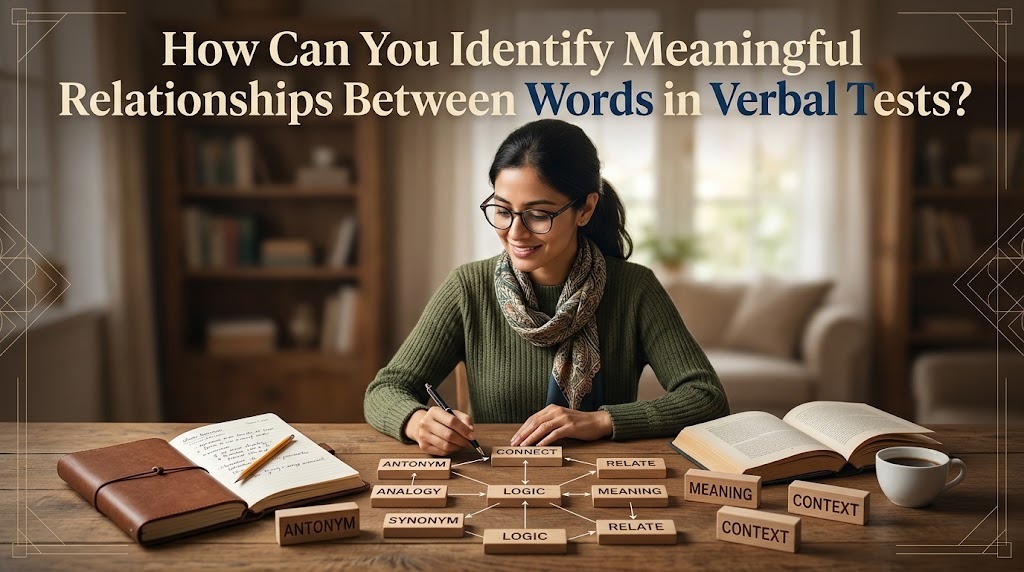
Identifying meaningful relationships between words is an important ability assessed in verbal reasoning tests. These assessments are commonly used in university admissions, job recruitment, scholarship examinations, and various professional selection processes. Candidates are expected to understand word meanings, recognize connections between different concepts, and select answers based on logical relationships.
Although some verbal questions may appear straightforward, identifying the correct relationship can become challenging when several answer choices seem similar. Candidates need more than vocabulary knowledge because they must also understand how words are connected in different situations. By developing vocabulary, practicing logical reasoning, and learning effective answering strategies, individuals can improve their ability to solve verbal test questions accurately.
UNDERSTAND DIFFERENT TYPES OF WORD RELATIONSHIPS
The first step in identifying meaningful relationships between words is understanding the different types of connections commonly found in verbal reasoning tests. These relationships describe how two words are associated based on their meanings, functions, characteristics, or situations. Recognizing these patterns makes it easier to analyze questions and determine suitable answers.
Some common types of word relationships include:
- Synonyms: Words with similar meanings, such as Happy and Joyful.
- Antonyms: Words with opposite meanings, such as Strong and Weak.
- Part-to-Whole: A relationship between an object and one of its components, such as Wheel and Car.
- Object and Function: A relationship between an object and its purpose, such as Pen and Writing.
- Cause and Effect: A connection between an action and its result, such as Heavy Rain and Flooding.
- Profession and Workplace: A relationship between a job and its working environment, such as Doctor and Hospital.
- Animal and Habitat: A connection between an animal and its natural environment, such as Fish and Water.
Understanding these categories provides a useful foundation for solving different verbal reasoning questions. However, candidates should focus on understanding the actual connections rather than simply memorizing examples. This makes it easier to recognize unfamiliar relationships during examinations.
ANALYZE THE MEANING OF EACH WORD CAREFULLY
Understanding individual word meanings is essential before identifying relationships between them. Candidates who are unfamiliar with the vocabulary used in a question may struggle to determine how the words are connected. Therefore, carefully examining each word is an important part of the reasoning process.
Start by identifying the basic definition of both words. Consider whether they describe objects, activities, professions, characteristics, or abstract ideas. Then determine how these meanings are connected. For example, the words Teacher and Student represent a relationship between two people involved in an educational process. A teacher provides instruction, while a student receives and learns from it.
Candidates should also pay attention to words with multiple meanings. Some English words can represent different ideas depending on the context. For instance, the word light can refer to brightness or something that is not heavy. Understanding the intended meaning is important because different interpretations can produce different relationships.
Developing this habit helps candidates avoid incorrect assumptions. It also improves their ability to interpret unfamiliar vocabulary and understand the purpose of each question.
RECOGNIZE PATTERNS THROUGH LOGICAL REASONING
Logical reasoning helps candidates identify meaningful connections between words without relying entirely on memorization. In verbal reasoning tests, some questions require individuals to recognize patterns and apply the same relationship to another pair of words. This ability is particularly important in word analogy questions.
For example, consider the relationship Bird is to Nest. A bird lives in a nest, so the relationship describes an animal and its habitat. A similar connection can be found in Bee is to Hive, because a bee lives in a hive. Recognizing this pattern allows candidates to identify the correct answer more systematically.
Another example is Knife is to Cutting. A knife is an object used for cutting, which represents a relationship between an object and its function. Candidates should look for another pair that demonstrates the same connection rather than choosing words that are merely associated with each other.
A useful technique is explaining the relationship in a simple sentence before examining the answer choices. This makes the logical connection clearer and reduces confusion. With regular practice, individuals can become more familiar with different patterns and improve their analytical and problem-solving abilities.
USE CONTEXT CLUES TO UNDERSTAND WORD CONNECTIONS
Context clues are useful when candidates encounter unfamiliar words or relationships in verbal reasoning questions. Sometimes, the meaning of a word cannot be understood easily when examined individually. However, surrounding sentences or additional information may provide clues that help reveal its intended meaning.
For example, a sentence may state that a person remained optimistic despite experiencing several difficulties. Even if a candidate does not know the exact definition of optimistic, the surrounding information suggests a positive attitude and hope for better results. This understanding can help identify related words such as hopeful or positive.
Context clues can also help distinguish between words that have similar meanings but different uses. For instance, angry and frustrated are related emotions, but they do not always describe the same situation. Understanding the context helps candidates determine which relationship is most appropriate.
To develop this ability, practice reading English passages and identifying unfamiliar expressions based on surrounding information. Pay attention to sentence structure, connecting words, and the overall message. This approach improves vocabulary understanding and makes it easier to recognize meaningful relationships between words.
EXPAND VOCABULARY THROUGH REGULAR LEARNING
A strong vocabulary provides an important foundation for identifying relationships between words. The more words candidates understand, the easier it becomes to recognize similarities, differences, functions, and connections between concepts. Limited vocabulary, on the other hand, can make verbal reasoning questions more difficult.
One effective method is reading English materials regularly. Articles, newspapers, books, and educational resources introduce different words and expressions in various contexts. When encountering unfamiliar vocabulary, record its meaning and identify its synonyms, antonyms, and common usage.
Candidates can also use flashcards and vocabulary applications to review previously learned words. Organizing vocabulary into categories, such as emotions, professions, objects, activities, and characteristics, can make learning more structured. Reviewing these categories regularly helps strengthen memory and improve word recognition.
In addition, try using newly learned vocabulary in sentences. Active usage helps individuals understand how words function in real communication rather than simply remembering their definitions. These habits can gradually improve vocabulary knowledge, language comprehension, and verbal reasoning performance.
PRACTICE VERBAL REASONING QUESTIONS AND EVALUATE YOUR ANSWERS
Regular practice is essential for improving the ability to identify meaningful relationships between words. Candidates who frequently solve verbal reasoning questions become more familiar with different question formats and can recognize common patterns more efficiently. Practice also provides opportunities to identify weaknesses and improve problem-solving strategies.
Begin with basic exercises involving synonyms, antonyms, and simple word analogies. Once these concepts become easier, move on to more challenging questions involving cause and effect, object functions, abstract concepts, and relationships between professions or activities.
After completing each exercise, review the answers carefully. Do not focus only on whether an answer is correct or incorrect. Understand why a particular relationship is appropriate and why the other options do not match. This process helps develop more accurate reasoning habits.
Time management should also be part of preparation because many selection tests have strict time limits. Practice answering questions within a reasonable period while maintaining accuracy. Avoid spending too long on unfamiliar questions, and use elimination techniques when several options appear similar.
Consistent preparation can improve answering speed, logical thinking, concentration, and confidence. These abilities are useful not only for verbal reasoning examinations but also for academic learning and professional communication.
CONCLUSION
Identifying meaningful relationships between words in verbal tests requires a combination of vocabulary knowledge, logical reasoning, reading comprehension, and analytical thinking. Candidates should understand different relationship patterns, examine word meanings carefully, and use context clues to interpret unfamiliar expressions.
Regular practice and vocabulary development are equally important for improving accuracy and answering speed. By learning effective strategies and evaluating mistakes, individuals can become more confident when solving verbal reasoning questions and achieve better results in university admissions, job recruitment, and other selection processes.
Recent Posts

Bagaimana Sistem SKS pada Program Kuliah... 22.11.2026/45 View

How Does Technology Make Daily Evaluation... 21.11.2026/73 View

Apa Strategi Menghadapi Kesenjangan antara Kompetensi... 21.11.2026/75 View

Mengapa Inventaris Aset Penting bagi Kelancaran... 21.11.2026/71 View

When Should Musicians Join a Record... 21.11.2026/75 View
