

How Can You Improve Visual Intelligence Easily?
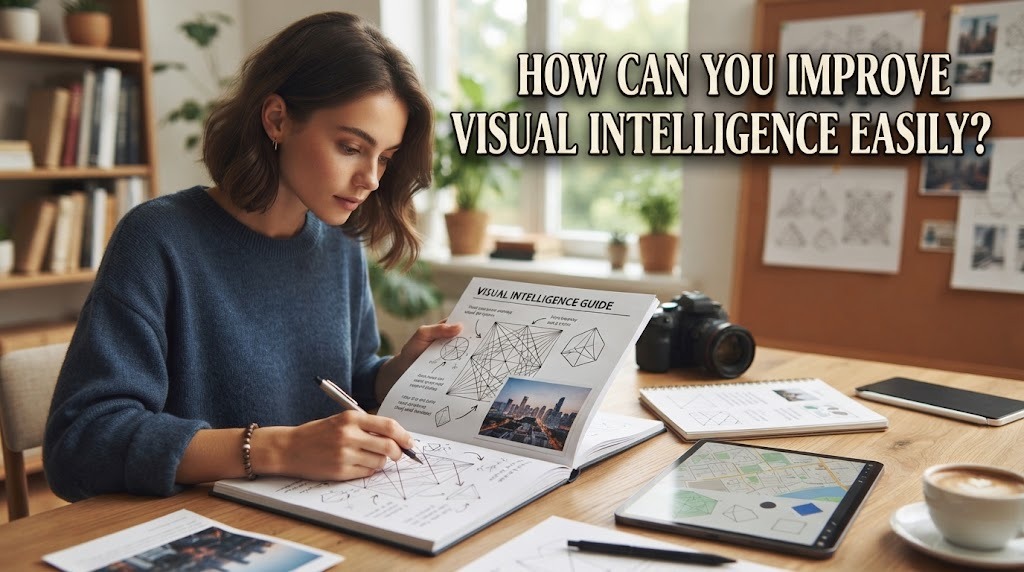
Visual intelligence is the ability to understand, interpret, remember, and organize visual information. It helps people recognize patterns, understand shapes, imagine objects, and identify relationships between different elements. This ability is useful in learning, working, creating, and handling everyday activities. The good news is that visual intelligence can be improved through simple and consistent practice.
Many activities around us involve visual thinking, from reading maps and understanding charts to arranging objects and using digital devices. By practicing specific activities regularly, people can become more comfortable with visual information and improve their spatial awareness. Developing this skill does not require complicated equipment or advanced training.
UNDERSTAND HOW VISUAL INTELLIGENCE WORKS
Before improving visual intelligence, it is useful to understand what the skill involves. Visual intelligence includes the ability to recognize patterns, identify shapes, understand spatial relationships, and mentally visualize objects. It also involves interpreting images and connecting visual information with existing knowledge. These abilities work together when people solve problems or understand their surroundings.
Visual intelligence is different from simply having good eyesight. Eyes receive visual information, while the brain interprets and organizes that information. Therefore, improving visual thinking skills requires activities that encourage observation, comparison, imagination, and analysis. Understanding this difference can help people choose more effective ways to practice.
PRACTICE DRAWING AND SKETCHING
Drawing is one of the simplest activities for developing visual intelligence. It encourages people to observe shapes, proportions, lines, positions, and details more carefully. Even simple sketches can train the brain to understand how different visual elements relate to one another. The goal is not to create perfect artwork but to improve observation and visual understanding.
People can start by drawing everyday objects such as cups, books, plants, or furniture. After becoming comfortable with basic objects, they can try drawing the same object from different angles. This practice can strengthen spatial awareness because the brain learns to imagine how objects change when their position changes.
SOLVE PUZZLES AND VISUAL GAMES
Puzzles are another practical way to improve visual intelligence. Activities such as jigsaw puzzles, pattern games, mazes, and shape-matching exercises require people to analyze visual information and recognize relationships. These activities encourage the brain to compare different shapes, positions, and patterns. Regular practice can make visual problem solving more familiar.
Visual games can also make learning enjoyable because they combine concentration with problem solving. People can gradually increase the difficulty instead of immediately choosing complex puzzles. For example, beginners can start with simple shape-matching activities before trying more complicated spatial puzzles. This approach allows visual problem solving skills to develop gradually.
USE MIND MAPS AND VISUAL NOTES
Mind maps can help improve visual intelligence while also supporting learning. Instead of writing information only in long paragraphs, people can organize ideas using branches, symbols, keywords, shapes, and connections. This method requires the brain to think about how different pieces of information are related. It can therefore strengthen both visual organization and memory.
Visual notes can be especially useful for students and professionals who regularly handle large amounts of information. A complicated topic can be transformed into a simple diagram that shows its main ideas and supporting details. Creating these visual structures encourages people to identify important relationships rather than memorizing isolated facts. Over time, this can strengthen visual learning skills.
TRAIN YOUR BRAIN TO NOTICE PATTERNS
Pattern recognition is an important part of visual intelligence. People can practice this skill by looking for repeated shapes, colors, numbers, arrangements, or sequences. For example, when looking at a group of objects, try identifying what makes certain objects similar or different. This simple habit encourages the brain to analyze visual information more carefully.
Pattern recognition is useful in many areas of life. Designers use it when creating visual compositions, while analysts may identify patterns in charts and data. Students can also use pattern recognition when studying diagrams, mathematics, science, or languages. Practicing this ability regularly can make it easier to identify meaningful information in complex visual materials.
OBSERVE YOUR SURROUNDINGS MORE CAREFULLY
Everyday environments provide many opportunities to practice visual intelligence. Instead of simply looking at surroundings, try paying attention to details, distances, shapes, directions, and spatial relationships. For example, observe how furniture is arranged in a room or notice the position of buildings when walking through a familiar area. These small exercises can turn ordinary activities into visual training.
Another useful activity is mentally remembering a place and trying to describe its layout afterward. People can also look at an object for a short time, put it away, and then try to visualize its details. These exercises encourage the brain to store and reconstruct visual information. With consistent practice, visual observation skills can become stronger.
CONCLUSION
Improving visual intelligence does not require complicated methods. Drawing, solving puzzles, creating mind maps, recognizing patterns, and observing surroundings are simple activities that can be practiced regularly. These activities train the brain to understand shapes, relationships, positions, and visual details more effectively.
The most important factor is consistency. Practicing for a few minutes each day can be more useful than practicing intensively only once in a while. By making visual activities part of everyday routines, people can gradually develop stronger visual thinking, spatial awareness, and problem solving skills.
Recent Posts

Bagaimana Sistem SKS pada Program Kuliah... 22.11.2026/12 View

How Does Technology Make Daily Evaluation... 21.11.2026/63 View

Apa Strategi Menghadapi Kesenjangan antara Kompetensi... 21.11.2026/64 View

Mengapa Inventaris Aset Penting bagi Kelancaran... 21.11.2026/61 View

When Should Musicians Join a Record... 21.11.2026/59 View
