

How Can You Improve Your Verbal Reasoning Skills for Selection Tests?
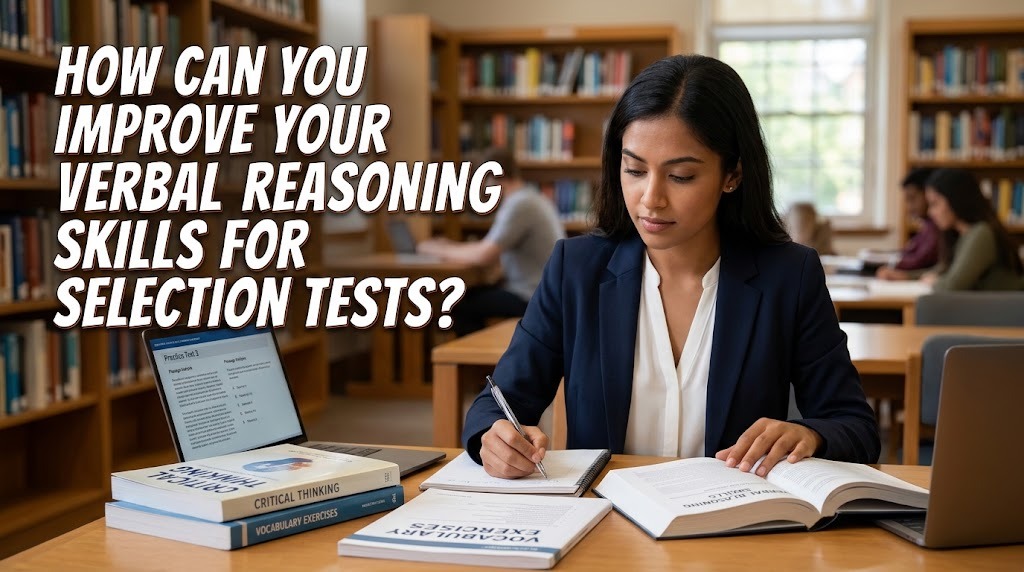
Verbal reasoning skills are important abilities that help individuals understand information, analyze written statements, recognize word relationships, and draw logical conclusions. These skills are commonly assessed in various selection tests, including university admissions, job recruitment, scholarship programs, and professional assessments. Candidates are often required to answer questions within a limited time, making accuracy and speed equally important.
Improving verbal reasoning skills requires consistent practice, a strong vocabulary, good reading habits, and effective problem-solving strategies. By understanding the types of questions and learning how to approach them correctly, candidates can become more confident when facing verbal reasoning assessments. Developing these abilities can also improve everyday communication and critical thinking.
UNDERSTAND THE TYPES OF VERBAL REASONING QUESTIONS
The first step in improving verbal reasoning skills is understanding the types of questions commonly included in selection tests. These questions are designed to evaluate how well candidates understand language, identify information, and recognize logical connections between words or statements. Some assessments focus on vocabulary, while others require deeper reading comprehension and analytical thinking.
Common types of verbal reasoning questions include:
- Synonyms and Antonyms: Identifying words with similar or opposite meanings.
- Word Analogies: Finding relationships between two words and applying the same pattern to another pair.
- Reading Comprehension: Understanding written passages and identifying important information.
- Sentence Completion: Selecting appropriate words to complete sentences based on context.
- Logical Statements: Determining whether conclusions are supported by the information provided.
Understanding these question formats helps candidates recognize the skills required for each task. It also makes preparation more organized because individuals can identify which areas need additional attention. Instead of answering questions randomly, candidates can develop specific strategies for different question types.
EXPAND YOUR VOCABULARY THROUGH REGULAR READING
A strong vocabulary is one of the most important foundations of verbal reasoning. Candidates who understand a wide range of words can interpret questions more easily and avoid confusion when encountering unfamiliar terms. Vocabulary knowledge also helps individuals recognize subtle differences in meaning, which is particularly useful in synonym, antonym, and reading comprehension questions.
One effective way to expand vocabulary is by developing a regular reading habit. Reading articles, newspapers, educational materials, and books exposes individuals to different expressions and sentence structures. When encountering an unfamiliar word, try to understand its meaning through context before checking a dictionary. Recording new vocabulary along with its definitions and example sentences can also make the learning process more effective.
In addition, candidates should review previously learned words regularly. Repetition helps strengthen memory and makes vocabulary easier to recall during examinations. Learning a few new words every day is generally more manageable than memorizing hundreds of unfamiliar terms in one session.
PRACTICE READING COMPREHENSION AND CRITICAL THINKING
Reading comprehension plays an essential role in verbal reasoning because candidates must understand written information before making accurate decisions. Some selection tests provide short passages followed by statements that must be evaluated according to the information presented. Candidates need to distinguish between facts, assumptions, and conclusions rather than relying on personal opinions.
To improve this ability, practice reading different types of texts and identifying their main ideas. Pay attention to important details, supporting arguments, relationships between sentences, and the author's purpose. After reading a passage, try summarizing its message using your own words. This exercise helps develop the ability to recognize relevant information without becoming distracted by unnecessary details.
Critical thinking is equally important because verbal reasoning questions often require more than simply understanding individual words. Candidates must evaluate whether an argument is logical and whether a conclusion follows from the available evidence. Practicing these activities regularly can improve analytical accuracy and help individuals make better decisions when answering challenging questions.
DEVELOP EFFECTIVE STRATEGIES FOR ANSWERING QUESTIONS
Having good verbal reasoning knowledge is not always enough to achieve a high score. Candidates also need effective strategies to approach questions systematically. A suitable answering method can reduce mistakes, improve concentration, and help individuals use their examination time more efficiently.
One useful strategy is to read each question carefully before choosing an answer. Pay attention to keywords because a small difference in wording can change the meaning of a statement. For analogy questions, identify the relationship between the first pair of words before examining the available options. For reading comprehension questions, refer to the passage instead of making assumptions based on general knowledge.
Another important technique is eliminating incorrect answers. If several options seem similar, compare their meanings and determine which one best matches the question. Avoid spending too much time on a single difficult question because other questions may offer opportunities to gain points more quickly. Developing a consistent answering strategy helps candidates remain focused throughout the assessment.
IMPROVE SPEED AND ACCURACY THROUGH TIMED PRACTICE
Time management is an important part of verbal reasoning preparation, especially when selection tests contain many questions with strict time limits. Candidates who understand the material but work too slowly may struggle to complete the assessment. Therefore, improving speed while maintaining accuracy should become a regular part of preparation.
Start by practicing verbal reasoning questions without a strict time limit to understand the basic concepts. Once familiar with the question formats, introduce a timer to simulate actual examination conditions. Gradually reduce the time available as your confidence and accuracy improve. This method helps develop the ability to process information efficiently without rushing unnecessarily.
After completing each practice session, review both correct and incorrect answers. Identify whether mistakes happen because of limited vocabulary, misunderstanding the passage, poor concentration, or incorrect reasoning. Keeping a record of these weaknesses makes it easier to evaluate progress and determine which areas require more practice.
Candidates should also learn to distribute their time appropriately. Answer easier questions first when the test format allows it, then return to more challenging questions. However, always follow the specific instructions of the assessment because some tests have different scoring systems or navigation restrictions.
BUILD CONFIDENCE THROUGH CONSISTENT PREPARATION
Consistent preparation helps candidates develop stronger verbal reasoning abilities over time. Instead of studying intensively only a few days before an examination, establish a realistic daily learning routine. Even short practice sessions can produce meaningful improvements when performed regularly and supported by proper evaluation.
Candidates can use practice books, online exercises, sample questions, and mock tests to improve their abilities. These resources provide opportunities to experience different question formats and become familiar with common examination patterns. Taking full-length practice tests is particularly useful because it helps individuals understand how to manage concentration and time under realistic conditions.
Confidence also develops when candidates recognize their progress. Set achievable learning targets, monitor practice scores, and review difficult questions until the underlying concepts become clear. Remember that verbal reasoning is a skill that can be developed through learning and repetition, not simply an ability that someone either has or does not have.
CONCLUSION
Improving verbal reasoning skills for selection tests requires a combination of vocabulary development, reading comprehension, critical thinking, effective answering strategies, and consistent practice. Candidates should understand different question types, develop regular reading habits, and evaluate their mistakes to identify areas that need improvement.
With proper preparation and effective time management, individuals can improve both their answering accuracy and confidence. The key to achieving better results is maintaining consistent practice and applying suitable strategies when facing different verbal reasoning questions.
Recent Posts

Bagaimana Sistem SKS pada Program Kuliah... 22.11.2026/45 View

How Does Technology Make Daily Evaluation... 21.11.2026/73 View

Apa Strategi Menghadapi Kesenjangan antara Kompetensi... 21.11.2026/75 View

Mengapa Inventaris Aset Penting bagi Kelancaran... 21.11.2026/71 View

When Should Musicians Join a Record... 21.11.2026/75 View
