

How Can You Introduce Regional Languages to Children at an Early Age?
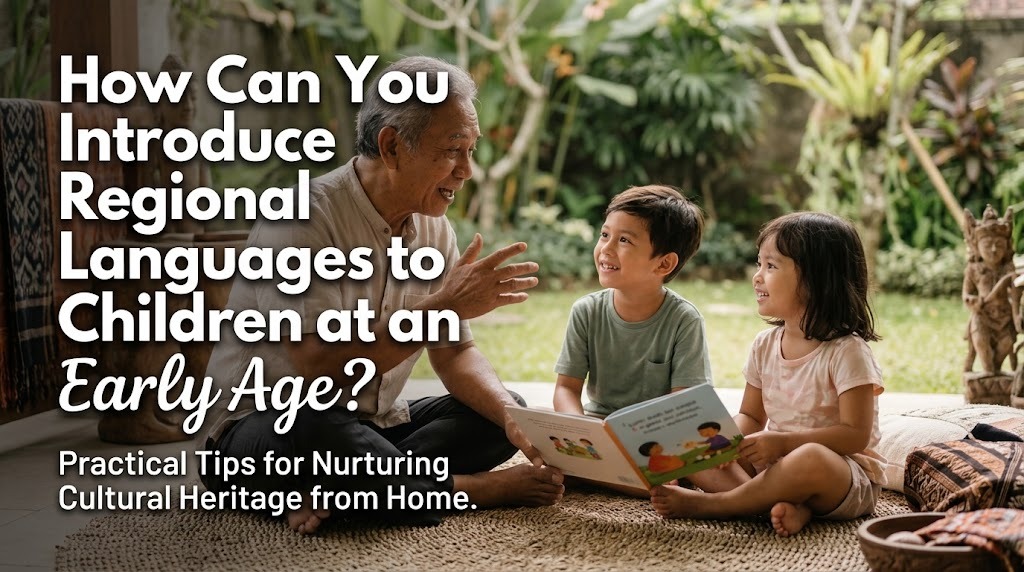
Introducing regional languages to children at an early age is an effective way to preserve Indonesia’s cultural heritage and encourage communication between generations. Children often learn language through everyday interactions with parents, caregivers, relatives, and their surrounding environment. When they regularly hear and use a regional language, they can gradually become familiar with its vocabulary, pronunciation, and expressions. Learning a regional language can also help children understand their family backgrounds and local traditions. The most effective approach is to make regional-language learning enjoyable, consistent, and part of everyday life.
USE REGIONAL LANGUAGES IN DAILY CONVERSATIONS
One of the easiest ways to introduce a regional language is to use it during everyday conversations at home. Parents can begin with simple greetings, expressions of gratitude, names of familiar objects, and common questions. For example, children can learn how to greet relatives, ask for food, or describe their daily activities using the language spoken in their community. Repeated exposure helps them become familiar with words without feeling that they are participating in a formal lesson.
Parents do not need to speak the regional language perfectly to encourage learning, although consulting fluent family members can help ensure that expressions are used correctly. They can introduce a few words at a time and gradually expand the vocabulary as children become more comfortable. Conversations should remain natural, supportive, and appropriate for the child's age. Regular interaction is more useful than memorizing long lists of unfamiliar words without context. When children hear regional languages in meaningful situations, they can begin to associate the words with real experiences and relationships.
TEACH THROUGH SONGS AND TRADITIONAL STORIES
Songs and stories can make regional-language learning more enjoyable for young children. Traditional songs often use repetition, rhythm, and simple vocabulary, making them easier to remember. Parents and teachers can introduce children's songs in the local language and explain the meaning of unfamiliar words. Singing together also gives children opportunities to practice pronunciation and develop listening skills.
Traditional stories, folktales, and local legends can introduce children to language while sharing cultural knowledge. Adults can tell stories using simple sentences, expressive voices, and pictures that help children understand what is happening. They can pause to explain new words or ask children to repeat interesting expressions. Songs and storytelling connect language learning with imagination, enjoyment, and cultural heritage. By hearing these stories repeatedly, children can gradually become familiar with both the language and the traditions associated with it.
USE GAMES AND INTERACTIVE ACTIVITIES
Games provide children with opportunities to practice regional languages without making learning feel like a difficult task. Parents can use picture cards, word-matching games, simple puzzles, and guessing activities featuring familiar objects. For example, children can identify household items, animals, fruits, or colors using regional-language vocabulary. These activities help connect new words with objects and experiences they already understand.
Role-playing can also encourage children to use regional languages in everyday situations. They might pretend to shop at a traditional market, greet a visitor, visit a relative, or prepare a meal. Adults can participate by asking simple questions and responding positively when children attempt to speak. Interactive activities help children practice vocabulary, listening, and speaking in a relaxed environment. The activities should match each child's age and abilities so that learning remains enjoyable rather than stressful.
INVOLVE GRANDPARENTS AND THE LOCAL COMMUNITY
Grandparents and older relatives can be valuable sources of regional-language knowledge because they may use expressions that are less familiar to younger generations. Children can learn greetings, family terms, traditional sayings, and stories through conversations with them. These interactions also provide opportunities to build closer family relationships. Parents can encourage children to ask relatives about the meanings of words and the situations in which particular expressions are used.
Community activities can provide additional learning opportunities outside the home. Children may participate in local cultural events, traditional performances, storytelling sessions, or activities organized by community groups. Meeting other speakers allows them to hear different speaking styles and practice communicating with people beyond their immediate family. Learning directly from fluent speakers helps children understand how regional languages are used in real life. Families should choose activities that are welcoming and appropriate for children, especially when they are just beginning to learn.
USE DIGITAL RESOURCES TO SUPPORT LEARNING
Digital technology can provide additional ways for children to explore regional languages. Educational videos, recorded stories, songs, digital dictionaries, and language-learning applications may introduce vocabulary through sound, images, and animation. Parents can select resources that match the child's age and focus on languages spoken in their family or community. Listening to native or fluent speakers can also help children become familiar with pronunciation and natural speech patterns.
However, digital resources work best when combined with direct conversation and practical activities. Parents can watch a short video with their children, discuss its meaning, and practice several new words afterward. They should also check whether the material uses accurate language and represents local cultural practices appropriately. Technology should support human interaction rather than replace opportunities to speak with family members and other language users. With adult guidance, digital tools can make regional-language learning more accessible and engaging.
CREATE A POSITIVE AND CONSISTENT LEARNING ENVIRONMENT
Children are more likely to continue learning when they feel comfortable making mistakes. Parents and teachers should encourage their efforts, respond patiently, and avoid embarrassing them when they mispronounce words or use incorrect expressions. Correct pronunciation and grammar can be introduced gently through examples and repetition. Celebrating small improvements can help children develop confidence and motivation.
Consistency is also important because children need repeated opportunities to hear and use new vocabulary. Families can set aside time for regional-language conversations during meals, bedtime stories, family visits, or weekend activities. They can gradually introduce more complex expressions as children develop their skills. A supportive environment helps children see regional languages as useful and valuable parts of everyday life. By combining regular practice with encouragement, families can help children develop lasting interest in their regional language.
CONCLUSION
Introducing regional languages to children at an early age can be achieved through daily conversations, songs, traditional stories, interactive games, family involvement, and suitable digital resources. Children benefit most when learning is connected to familiar experiences and supported by patient adults. Parents, grandparents, teachers, and community members can work together to provide regular opportunities for listening and speaking. It is also important to respect each child's pace and celebrate progress rather than demand immediate fluency. Making regional languages a natural part of childhood helps preserve cultural heritage and strengthens connections between generations.
Recent Posts

Bagaimana Sistem SKS pada Program Kuliah... 22.11.2026/49 View

How Does Technology Make Daily Evaluation... 21.11.2026/76 View

Apa Strategi Menghadapi Kesenjangan antara Kompetensi... 21.11.2026/78 View

Mengapa Inventaris Aset Penting bagi Kelancaran... 21.11.2026/74 View

When Should Musicians Join a Record... 21.11.2026/78 View
