

How Can You Measure Someone’s Level of Visual Intelligence?
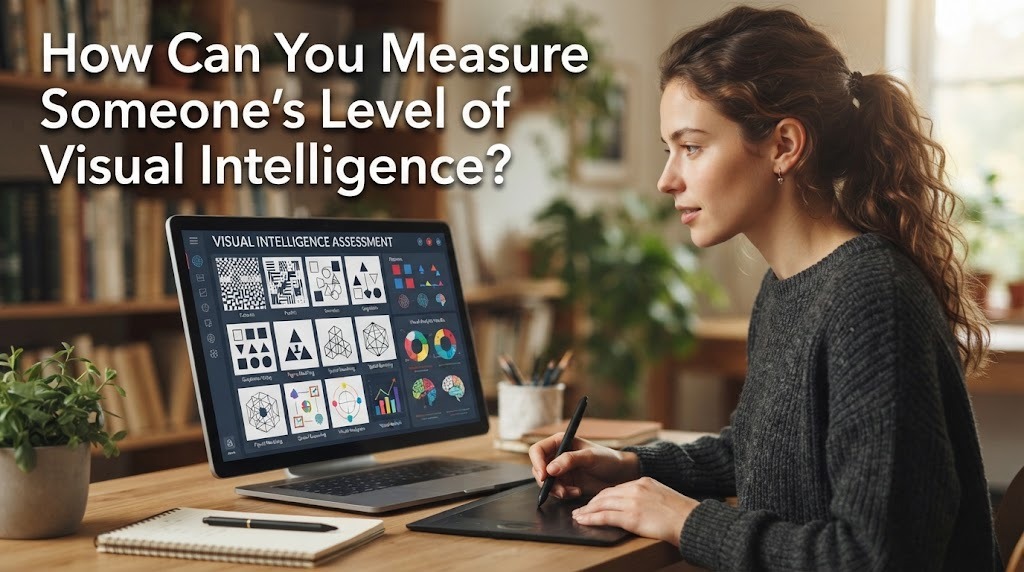
Visual intelligence refers to the ability to understand, process, remember, and work with visual information. It includes skills such as recognizing patterns, understanding shapes, remembering images, visualizing objects, and understanding spatial relationships. Measuring visual intelligence can help identify how effectively someone processes and uses visual information.
There is no single activity that can describe every aspect of visual intelligence. Different assessments may focus on spatial reasoning, visual memory, pattern recognition, or mental visualization. Therefore, measuring this ability usually involves several types of tasks rather than relying on one simple test.
WHAT DOES A VISUAL INTELLIGENCE TEST MEASURE?
A visual intelligence assessment may examine several abilities related to visual thinking. These can include recognizing patterns, understanding shapes, identifying differences, rotating objects mentally, and remembering visual information. Spatial awareness and visual reasoning are often important parts of these assessments.
The goal is generally to understand how a person processes visual information and solves problems without relying heavily on written explanations. For example, a task may show several shapes and ask the participant to identify which one completes a pattern. Another activity may require someone to determine how an object would look after being rotated.
TESTS FOR SPATIAL REASONING
Spatial reasoning is one of the areas commonly associated with visual intelligence. It involves understanding how objects relate to each other in space, including their position, direction, size, and orientation. This skill can be explored through activities involving shapes, maps, diagrams, and three-dimensional objects.
A test may ask participants to mentally rotate an object or identify how two shapes are connected. Strong spatial reasoning can make it easier to visualize objects and understand their relationships in physical or digital spaces. These skills can be useful in areas such as design, engineering, architecture, and technical work.
TESTS FOR VISUAL MEMORY AND PATTERN RECOGNITION
Visual memory refers to the ability to remember and recall information that has been seen. Assessment activities may briefly display images, symbols, shapes, or patterns and then ask participants to identify or reproduce them. These tasks can provide information about how effectively someone stores and recalls visual details.
Pattern recognition is another important area. Participants may need to identify similarities, differences, sequences, or missing elements in a group of visual objects. These tasks can show how well someone notices relationships and changes within visual information.
PRACTICAL WAYS TO OBSERVE VISUAL INTELLIGENCE
Formal assessments are not the only way to observe visual skills. Everyday activities can also provide useful examples of how someone handles visual information. Drawing, solving puzzles, reading maps, building objects, organizing spaces, and interpreting charts can all involve visual intelligence.
For example, someone may demonstrate visual thinking when they can quickly understand a diagram or mentally visualize how furniture will fit into a room. However, performance in one activity should not be treated as a complete measurement of visual intelligence. Different tasks may require different combinations of abilities.
WHY TEST RESULTS SHOULD BE INTERPRETED CAREFULLY
Visual intelligence is a broad concept, so a single score may not represent every visual ability a person has. Test performance can also be influenced by factors such as familiarity with the task, attention, experience, and the testing environment. A test result should therefore be viewed as information about specific skills rather than a complete description of a person's abilities.
For more meaningful assessment, different types of visual tasks can be considered together. Professional assessments may also use standardized procedures and comparisons with appropriate reference groups. This can provide a more structured understanding of strengths and areas that may need further development.
HOW TO DEVELOP VISUAL INTELLIGENCE AFTER MEASUREMENT
Measuring visual intelligence can be useful, but identifying strengths is only one part of the process. People can continue developing visual skills through drawing, puzzles, photography, mind mapping, design activities, building exercises, and visual problem solving. Regular practice can strengthen observation, spatial awareness, visual memory, and pattern recognition.
Technology can also provide interactive opportunities through educational applications, digital design tools, 3D environments, and visual puzzles. The most useful activities are those that require active thinking rather than passive viewing. Practicing different types of visual tasks can help people apply these skills in learning, work, and everyday situations.
CONCLUSION
Visual intelligence can be measured by examining abilities such as spatial reasoning, visual memory, pattern recognition, and mental visualization. Different tests and practical activities can provide information about how a person understands and processes visual information.
However, no single test can fully describe every aspect of visual intelligence. Results are more useful when they are interpreted carefully and considered alongside the specific skills being assessed. With regular practice, people can also continue developing their visual abilities regardless of their initial assessment results.
Recent Posts

Bagaimana Sistem SKS pada Program Kuliah... 22.11.2026/21 View

How Does Technology Make Daily Evaluation... 21.11.2026/64 View

Apa Strategi Menghadapi Kesenjangan antara Kompetensi... 21.11.2026/65 View

Mengapa Inventaris Aset Penting bagi Kelancaran... 21.11.2026/62 View

When Should Musicians Join a Record... 21.11.2026/61 View
