

How Can You Pass a Psychometric Test for a Job?
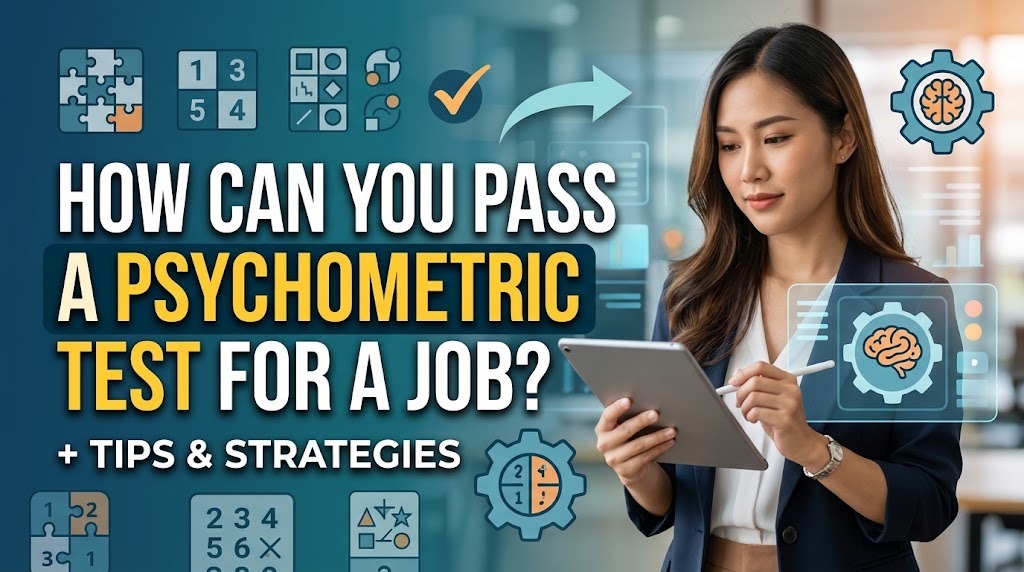
Passing a psychometric test for a job can be an important step in the recruitment process. Employers use these assessments to evaluate different aspects of candidates, including logical reasoning, numerical ability, verbal comprehension, and personality characteristics. The results may help recruiters understand whether an applicant's abilities and working preferences align with the requirements of a position.
Although psychometric tests can feel challenging, candidates can improve their readiness through preparation and practice. Understanding the test format, strengthening relevant skills, and managing time effectively can help applicants approach the assessment with greater confidence. Rather than trying to achieve a perfect score in every situation, the goal is to demonstrate relevant abilities accurately and respond to questions carefully.
UNDERSTAND THE TYPE OF PSYCHOMETRIC TEST
The first step toward performing well in a psychometric test is understanding which type of assessment you will take. Some employers use numerical reasoning tests to evaluate how candidates interpret figures, percentages, tables, and charts. Others use verbal reasoning tests to assess reading comprehension and the ability to draw conclusions from written information. Logical reasoning tests may focus on patterns, sequences, and relationships between shapes or ideas.
Personality assessments are different because they generally explore behavioral preferences rather than testing whether an answer is mathematically or logically correct. Candidates should therefore prepare according to the assessment type instead of using the same strategy for every test. If the employer provides instructions about the format or duration, review them carefully before the assessment. Knowing what to expect can reduce uncertainty and make psychometric test preparation more focused.
PRACTICE WITH SAMPLE QUESTIONS REGULARLY
Regular practice is one of the most useful ways to prepare for a job psychometric test. Sample questions help candidates become familiar with common formats, identify areas that need improvement, and understand how questions are presented. For example, numerical reasoning practice can strengthen skills in percentages and ratios, while logical reasoning exercises can improve the ability to recognize patterns.
Try to practice consistently rather than completing many questions in one session without reviewing the results. After each exercise, examine incorrect answers and identify why the mistakes occurred. Some errors may result from misunderstanding instructions, while others may involve calculation mistakes or difficulty recognizing a pattern. By reviewing these weaknesses, candidates can improve their approach over time. Psychometric test practice is most useful when it includes both answering questions and learning from mistakes.
IMPROVE TIME MANAGEMENT AND ACCURACY
Many psychometric tests for recruitment have time limits, so candidates need to balance speed with accuracy. Spending too much time on a difficult question can reduce the time available for easier questions. Before starting, check the instructions to understand the duration, scoring method, and whether unanswered or incorrect responses affect the result.
During the test, read each question carefully and identify the information needed to solve it. If a question is taking too long and the format allows you to move on, consider answering other questions first and returning to it later. Avoid rushing through every question because careless mistakes can reduce performance. Practicing under timed conditions can help you develop a realistic pace and become more comfortable with the test format. Effective time management in psychometric tests involves using available time strategically while maintaining attention to detail.
PREPARE MENTALLY AND FOLLOW THE TEST INSTRUCTIONS
Mental preparation can influence how comfortably candidates approach a psychometric assessment. Before the test, get sufficient rest, prepare the required materials, and choose a quiet location if the assessment is conducted online. Arriving or logging in early can also reduce unnecessary pressure and provide time to check the instructions.
During the assessment, focus on the question in front of you instead of worrying about how other candidates might perform. Read the directions carefully, especially when the test uses unfamiliar symbols, special response rules, or examples. If you feel nervous, pause briefly when permitted and take a few slow breaths before continuing. Remember that preparation does not guarantee a particular result, but a calm and organized approach can help you demonstrate your abilities more effectively.
ANSWER PERSONALITY QUESTIONS HONESTLY AND CONSISTENTLY
Some employers include a personality test for job applicants to understand typical behavior, preferences, and working styles. Unlike numerical or logical reasoning questions, personality assessments usually do not have a single correct answer for every item. Their purpose is to describe patterns that may be relevant to a particular role or work environment.
When answering personality questions, consider how you generally behave rather than choosing responses simply because they appear desirable. Trying to create an idealized profile can produce answers that do not accurately reflect your preferences. Read each statement carefully and respond honestly, keeping in mind that different working styles can be suitable for different positions. Employers should interpret personality results alongside other relevant information rather than treating them as a complete measure of a candidate's potential. An honest approach supports a more accurate personality assessment and helps both the applicant and employer understand potential areas of compatibility.
CONCLUSION
To perform well in a psychometric test for a job, candidates should understand the assessment format, practice relevant questions, manage time carefully, prepare mentally, and follow the instructions. These steps can help applicants become more familiar with the test and identify areas that require additional preparation.
Personality assessments require a different approach from ability tests because they focus on behavioral preferences rather than correct or incorrect answers. Candidates should respond honestly and avoid trying to manipulate the results. By combining consistent preparation with a careful and realistic approach, applicants can improve their readiness and approach the recruitment process with greater confidence.
Recent Posts

Bagaimana Sistem SKS pada Program Kuliah... 22.11.2026/61 View

How Does Technology Make Daily Evaluation... 21.11.2026/87 View

Apa Strategi Menghadapi Kesenjangan antara Kompetensi... 21.11.2026/85 View

Mengapa Inventaris Aset Penting bagi Kelancaran... 21.11.2026/83 View

When Should Musicians Join a Record... 21.11.2026/87 View
