

How Can You Practice Psychometric Tests at Home?
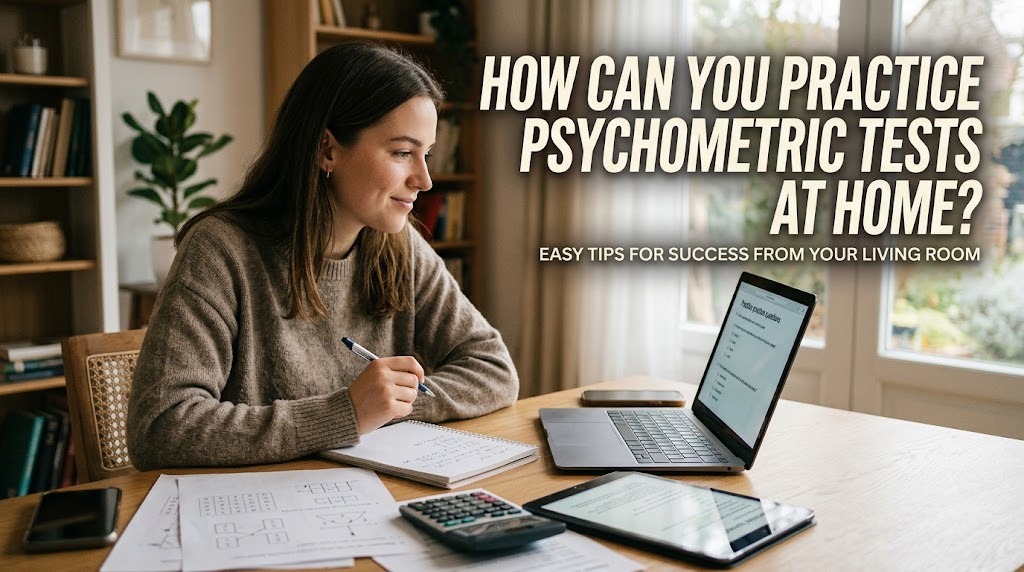
Preparing for a job application often involves more than reviewing a résumé or practicing interview questions. Many employers use psychometric tests to evaluate candidates' reasoning abilities, problem-solving skills, and behavioral preferences. Practicing these assessments at home can help job applicants become familiar with different question formats and improve their confidence before taking an actual test.
Practicing psychometric tests at home is convenient because candidates can choose their own study schedule and work at a comfortable pace. With suitable practice materials and a consistent routine, applicants can identify their strengths, recognize areas that need improvement, and develop strategies for managing time during assessments. Although practice cannot guarantee a particular result, it can help candidates prepare more effectively for the recruitment process.
CHOOSE RELIABLE PSYCHOMETRIC TEST PRACTICE MATERIALS
The first step is to find suitable psychometric test practice materials. These may include sample questions, practice worksheets, online assessments, or preparation guides covering numerical reasoning, verbal reasoning, logical reasoning, and personality questionnaires. Choosing materials that resemble the format of the expected assessment can make practice more relevant.
Candidates should also check the quality of the resources they use. Reliable materials generally provide clear instructions, appropriate examples, and explanations of answers where applicable. It is useful to review several question types rather than repeatedly practicing only familiar questions. This approach can help applicants understand the different skills measured by psychometric assessments and prepare for a wider range of challenges.
PRACTICE NUMERICAL, VERBAL, AND LOGICAL REASONING
Many psychometric tests for job applicants include questions that assess reasoning skills. Numerical reasoning practice may involve percentages, ratios, tables, charts, or basic calculations. Verbal reasoning exercises often require candidates to interpret written information and determine whether a statement is supported by a passage. Logical reasoning practice may involve identifying patterns, sequences, or relationships between symbols and figures.
Practicing these areas separately can help candidates understand the methods needed for each question type. For example, applicants can review percentage calculations before working on questions involving financial data. For verbal reasoning, they can practice distinguishing information explicitly stated in a passage from assumptions that are not supported. For logical reasoning, they can learn to identify changes in shapes, positions, or sequences systematically instead of guessing.
USE TIMED PRACTICE TO IMPROVE TIME MANAGEMENT
Some psychometric assessments have strict time limits, so practicing under timed conditions can be helpful. Candidates can begin by answering questions without a time limit to understand the format and develop accuracy. Once they become more familiar with the questions, they can introduce a timer to simulate the pressure of a real assessment.
During timed practice, applicants should monitor both their speed and accuracy. Completing many questions quickly is not necessarily beneficial if the answers are frequently incorrect. After each session, candidates can review which questions took the longest and determine whether the difficulty came from unfamiliar concepts, unnecessary calculations, or misreading instructions. This process helps develop more effective time management strategies for the actual test.
REVIEW MISTAKES AND TRACK YOUR PROGRESS
Reviewing incorrect answers is an important part of psychometric test preparation. Rather than immediately moving to another practice set, candidates should identify why an answer was wrong. Common reasons include misunderstanding a question, overlooking relevant information, applying an incorrect calculation, or spending too much time on a difficult problem.
Keeping a simple record of practice results can help applicants monitor their progress. They may note the types of questions they find challenging, the time required to complete each section, and recurring mistakes. Over time, this information can guide future practice sessions toward areas that need more attention. Progress should be assessed across several practice sessions rather than judged from a single result.
CREATE A CONSISTENT AND COMFORTABLE STUDY ROUTINE
A psychometric test preparation routine does not need to involve several hours of practice every day. Candidates can set aside manageable study sessions based on their schedules and gradually increase the difficulty of the exercises. For example, one session can focus on numerical reasoning, while another can concentrate on verbal or logical reasoning.
A suitable environment can also support effective practice. Choosing a quiet location, reducing distractions, and using a device similar to the one planned for the actual assessment can make practice more realistic. Candidates should take breaks when needed and avoid studying when they are too tired to concentrate. Consistent preparation, combined with careful review, can be more useful than completing large numbers of questions without understanding the answers.
CONCLUSION
Practicing psychometric tests at home can help job applicants become familiar with assessment formats, strengthen reasoning skills, and prepare for time-limited questions. Candidates can begin by selecting reliable materials, practicing numerical, verbal, and logical reasoning, and gradually introducing timed sessions. Reviewing mistakes and tracking progress can also help identify areas that require additional attention.
Effective preparation depends on consistency and understanding rather than simply completing as many questions as possible. By building a realistic study routine and focusing on areas that need improvement, candidates can approach recruitment assessments with greater confidence. However, practice results are not a guarantee of success, and applicants should always follow the instructions provided by the employer or assessment provider.
Recent Posts

Bagaimana Sistem SKS pada Program Kuliah... 22.11.2026/61 View

How Does Technology Make Daily Evaluation... 21.11.2026/87 View

Apa Strategi Menghadapi Kesenjangan antara Kompetensi... 21.11.2026/85 View

Mengapa Inventaris Aset Penting bagi Kelancaran... 21.11.2026/83 View

When Should Musicians Join a Record... 21.11.2026/87 View
